
WEEX VIP monthly market report | Sep 2026

 Prefer us on Google
1. WEEX market insights
2. Monthly highlights
3. Macro outlook
Inflation, employment, and rates: From rate-cut hopes to higher for longer
August CPI rose 0.4% MoM and 3.4% YoY, with core CPI up 2.4% YoY. Nonfarm payrolls increased by 162,000. Inflation remained persistent, while employment showed resilience. On September 16, the Fed raised rates by 25 basis points to 3.75% – 4.00%, prompting markets to reassess the rate outlook.The 10-year Treasury yield topped 5%, reaching approximately 5.27% on September 28, as stocks retreated. Rising yields reflected not only inflation concerns but also higher real rates, borrowing costs, and term premiums. For growth stocks, higher discount rates weigh on valuations. For companies reliant on external financing, rising funding costs squeeze investment and margins. However, if rising yields partly reflect stronger growth expectations, companies with solid earnings and order execution may remain resilient, as seen in September's AI hardware stocks.Geopolitics and energy: Oil amplifies inflation expectations
Uncertain negotiations and rising shipping risks pushed oil supply premiums higher, sending Brent crude back above $100 by month-end. Higher oil prices affect more than energy stocks. Rising fuel and transport costs feed into production, logistics, and consumer prices, raising inflation concerns and interest rate expectations.Gold also failed to sustain its gains amid escalating tensions. Higher yields increased the opportunity cost of holding non-yielding assets, putting gold, stocks, and crypto under pressure on some trading days. September's markets were driven by more than a simple flight to safety. Investors first assessed how energy supply risks affected inflation and rates, then weighed the relative appeal of gold, stocks, and crypto.Stocks and AI: Indices retreat as AI investors shift focus to earnings
Major stock indices hit record closing highs mid-month before pulling back. On September 28, the S&P 500 and Nasdaq fell approximately 0.8% and 0.9%, respectively. Rising long-term yields pressured high-valuation growth stocks, but AI investment remained strong. Investors shifted their focus from AI's growth potential to whether that growth could translate into revenue, margins, and cash flow.AI infrastructure remained relatively strong, with focus expanding beyond accelerators to memory, networking, and data center construction. AMD surged nearly 10% in a single day, pushing its market cap above $1 trillion, as investors continued to price in computing demand and product competitiveness. Going forward, stock performance will increasingly depend on orders, supply capacity, gross margins, and customer capex rather than AI hype alone.
-- Price
4. Crypto market overview
1) Total market cap and trading volume
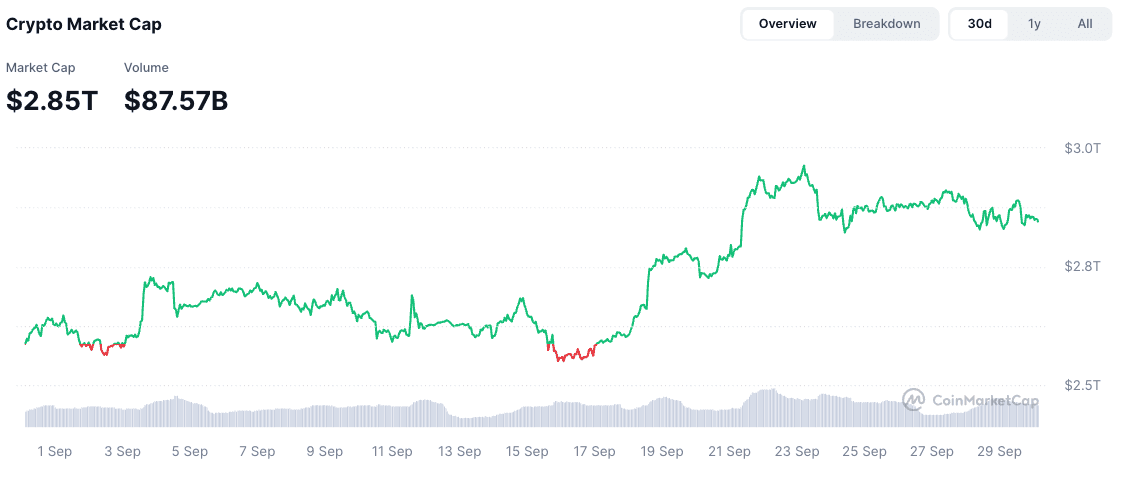 Source: CMCTotal crypto market cap rose approximately 7.5%, from $2.648 trillion to $2.847 trillion, while 24-hour trading volume climbed 40.8%, from $76.8 billion to $108.1 billion. Market cap hit a low of $2.579 trillion on September 16 and peaked at $2.957 trillion on September 23 before giving back some gains. Trading volume grew much faster than market cap, indicating increased market activity.
2) Trending assets and sectors: Capital rotates faster than fundamentals evolve
Privacy: ZEC briefly topped $1,500 in September, making privacy coins a high-beta trading theme. Privacy demand and quantum security narratives fueled interest, but rapid gains also increased crowding and pullback risks.RWA and tokenized assets: ONDO and QNT gained attention amid growing interest in asset tokenization. Regulatory progress boosted interest in on-chain securities infrastructure. However, projects differ in product structures, compliance requirements, and actual revenue. Regulatory advances do not necessarily translate into higher valuations for all related tokens.High-beta on-chain assets: NEAR and LIT stood out during sector rotation, while meme tokens such as PONS and AIINU, along with Robinhood Chain-related assets, attracted short-term traders.Overall, September saw a selective rally driven by capital returning to major cryptocurrencies and rotating into thematic assets, rather than a broad-based market surge. RWA, privacy, and on-chain trading platforms each had their own catalysts, but sustained momentum will depend on trading volume, capital flows, and real-world adoption.3) ETFs and stablecoins: Strong inflows, uncertain liquidity
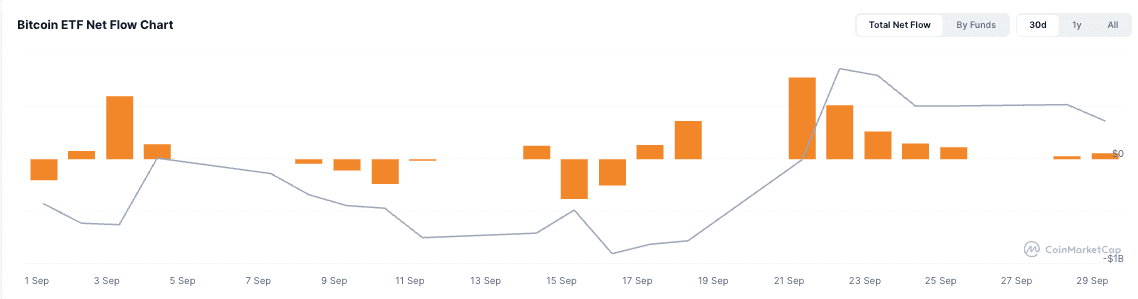
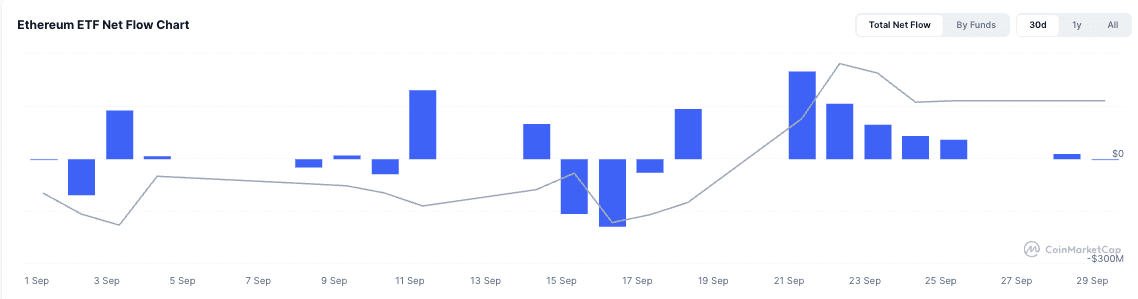 Source: CMCBTC ETFs recorded approximately $2.7964 billion in net inflows this month, while ETH ETFs attracted $890.9 million. Inflows were concentrated in the final week, signaling renewed institutional interest, though broader participation remains unconfirmed. BTC struggled to hold its monthly highs as rising yields, profit-taking, and leveraged position adjustments partly offset fresh demand. ETF inflows can support demand but do not guarantee an immediate price breakout.
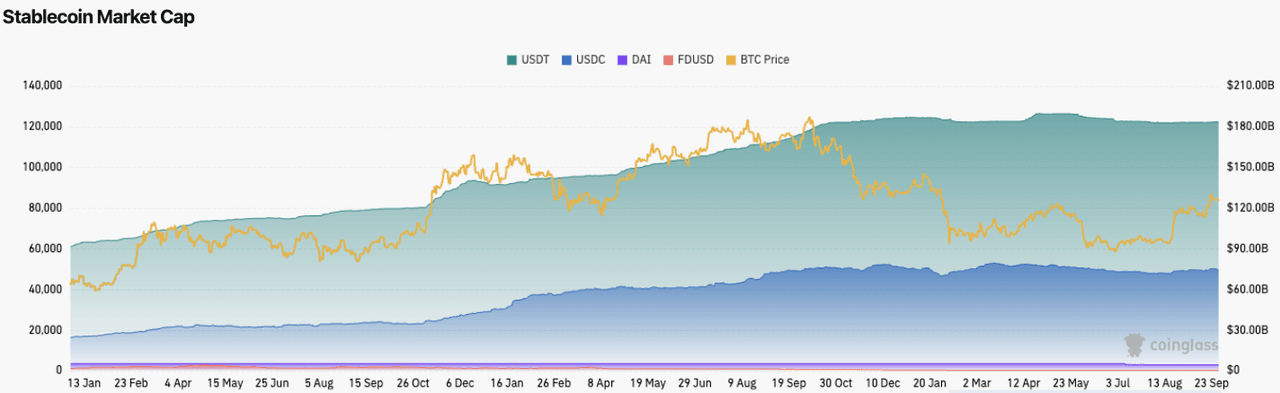 Source: CoinglassStablecoin market cap grew a modest 0.82% in September, from $261.78 billion to $263.95 billion. This suggests improving on-chain dollar liquidity, though growth remained limited compared with ETF inflows. Stronger stablecoin supply, spot volume, and ETF inflows would signal broader risk appetite. If ETF inflows prove short-lived, gains may remain concentrated in major coins and trending sectors.
4) BTC, ETH, and SOL performance: Major coins gain, SOL outperforms
BTC: Rebounds but faces overhead resistanceBTC rebounded sharply from around $75,000 mid-month to $87,400 in late September. By September 29, it had retreated to around $83,200, down 4.8% from its monthly high. Despite posting a monthly gain, BTC's pullback suggests overhead selling pressure remains. On-chain data shows significant accumulation in the $83,000 – $84,000 range. Nearly 400,000 BTC changed hands in this zone between September 22 and 29, making it a key area of contention between buyers and sellers. Meanwhile, holdings accumulated around $62,000 – $63,000 declined by only 30,000 BTC, suggesting that investors who built positions over the past six months remain largely committed rather than trading short-term. Of the nearly 400,000 BTC accumulated at $83,000 – $84,000, roughly 370,000 came from other price ranges. Even if BTC slips below this zone, a moderate decline could attract buying interest, potentially drawing prices back toward this high-volume area.Key support: $82,600 – $83,000, followed by $80,900 – $81,500 if breached. Stronger support lies at $75,000 – $76,500.Key resistance: $84,400 – $85,200, followed by the monthly high zone of $86,600 – $87,400. A daily close back above the first resistance zone would signal a short-term recovery. A breakout and sustained hold above the monthly highs would further confirm upward momentum.ETH: Outperforms BTC, but faces resistance at $2,700 – $2,800ETH rebounded from a mid-month low of around $2,358 to $2,806 before closing near $2,657 on September 29, down 5.3% from its monthly high. ETH outperformed BTC for the month, showing relative strength during the rebound, but has yet to reclaim $2,700.Key support: $2,635 – $2,655, followed by $2,600 – $2,630. Stronger support lies at $2,358 – $2,400.Key resistance: $2,695 – $2,745, with stronger resistance at $2,780 – $2,806. Sustained daily closes above $2,745 could pave the way for another test of the monthly highs. A break below $2,600 would significantly weaken the rebound structure.SOL: Strongest performer, but nearing monthly resistanceSOL rebounded from around $96 mid-month to $125, closing at $117.81 on September 29. It gained approximately 17.8% for the month, outperforming BTC and ETH, but retreated 5.7% from its monthly high, entering short-term consolidation after a strong rally.Key support: $115.9 – $117.7, followed by $110.9 – $113.2 if breached. Stronger support lies at $96 – $101.Key resistance: $119.9 – $122.9, followed by the monthly high near $124.9. A sustained move above $122.9 and a confirmed breakout above $124.9 could extend the rally. A break below $115.9 may trigger a retest of the $110 – $113 zone.
5. Key events this month
FOMC raises rates by 25 bps, putting inflation and interest rates back in focus
At its September meeting, the Fed raised rates by 25 basis points to 3.75% – 4.00%, increasing market sensitivity to valuations and liquidity. Rising oil prices and long-term yields added to volatility in stocks and crypto. Looking ahead, market focus will shift from the rate hike itself to inflation, employment, and the future rate path. Shifting rate expectations will remain a key driver of BTC, ETH, and high-beta assets.Rate hikes and oil shocks reshape risk asset valuations
Markets struggled to absorb tightening pressures after the mid-September rate hike. Oil prices climbed back above $100 and 10-year Treasury yields topped 5% by month-end, further pressuring high-valuation assets. Stock indices and BTC retreated from their highs, reflecting renewed sensitivity to interest rates. Looking ahead, key factors extend beyond the next rate decision: whether oil prices fuel inflation expectations and whether employment and consumer spending can support corporate earnings.CLARITY Act fails to advance, adding regulatory uncertainty
In mid-September, the CLARITY Act failed to secure enough votes to advance in the Senate, dampening expectations for clearer digital asset regulations. Near-term regulatory uncertainty may continue to affect valuations of RWA, trading platforms, and related infrastructure assets. Longer term, further legislative and regulatory developments remain key to watch.Tokenized securities policy advances and BCH/UNI futures plans
In mid-September, temporary, conditional regulatory measures opened a limited path for tokenized stock trading, but did not authorize all on-chain stock products. CME also plans to launch BCH and UNI futures on October 19, pending regulatory review. These developments strengthened interest in RWA infrastructure and regulated derivatives, though their impact will depend on regulatory scope, product rollout, trading demand, and liquidity.
6. October outlook
- October 7 – 8 | TOKEN2049: Discussions are expected to focus on AI, RWA, stablecoins, payments, and blockchain infrastructure. Watch for new projects, partnerships, and capital flows that could fuel sustained trading opportunities.
- October 14 | CPI: Rising oil prices have renewed inflation concerns. Markets will watch whether higher energy costs spill over into core inflation. Hotter data could pressure long-duration tech stocks and high-beta crypto, while cooler data may help ease yields.
- October 19 | BCH and UNI futures: The planned launches remain subject to regulatory review. Watch whether they proceed on schedule, whether spot trading volume increases, and whether the potential benefits are already priced in.
- October 27 – 28 | FOMC meeting: Following September's rate hike, markets are increasingly sensitive to the Fed's policy outlook. Watch the rate decision, policy statement, and post-meeting remarks. Shifts in rate expectations could affect Treasury yields, dollar liquidity, and risk assets such as BTC and ETH.
This content is provided for general informational purposes only and doesn't constitute financial, investment, legal, or tax advice. Any events, rewards, online promotions, or related information mentioned herein should not be considered a recommendation, solicitation, or invitation to purchase, sell, trade, or otherwise deal in any crypto assets. Crypto assets are highly volatile and may result in loss. The availability of WEEX services, products, and related events may vary by region. You are responsible for ensuring that your participation is in accordance with applicable local laws and regulations.

Gordon is a digital asset market analyst with six years of experience in digital asset research. He focuses primarily on BTC, RWA, and global macroeconomic trends, and is skilled at interpreting crypto market movements and hot topics through data analysis.
Contents
Latest coin listings on WEEX


