
Ethereum Futures Trading: How to Size ETH Positions and Read PnL

 Prefer us on Google


Ethereum futures trading comes down to three numbers: position size, the price where you are wrong, and what the trade costs to hold. With ETH near $2,750 in late September 2026, it has lagged bitcoin's short-squeeze rally, and the Glamsterdam upgrade is heading to public testnet on October 6. Many spot holders are now looking at perpetuals to trade the gap. This guide shows how ETH futures PnL and ROE are calculated and how fees and funding change the result. It then sizes a position from a stop-loss rather than from the leverage slider and lists the dated catalysts that could move ETH.
Where Ethereum Futures Stand in Late September 2026
On September 23, ETH traded around $2,742, while BTC traded near $84,400. That puts the ETH/BTC ratio at about 0.0325, which means ether has underperformed through bitcoin's squeeze. When the rally hit on Sept 21, ETH shorts accounted for about $122.8 million of the $648 million in short liquidations. Bitcoin drew most of the flow, however, including a record $999 million single-day inflow into spot BTC ETFs.
The spot backdrop for ETH is not weak:
- BitMine added 27,562 ETH on Sept 22, lifting its treasury to about 5.98 million ETH, roughly 4.9% of supply.
- Aave governance is voting on raising WETH's loan-to-value ratio from 77.5% to 81% on Base and Arbitrum, which would increase borrowing capacity against ETH.
- Market sentiment sits in "greed" territory (the Fear & Greed Index reads 76), so leveraged positioning is building across major coins.
That mix, with ETH lagging but carrying catalysts, is what attracts futures traders. It is also why sizing matters: a lagging asset can stay behind longer than a leveraged position can survive.
How Ethereum Futures PnL Is Calculated
On a USDT-margined ETH perpetual such as WEEX's ETH-USDT contract, PnL is linear:
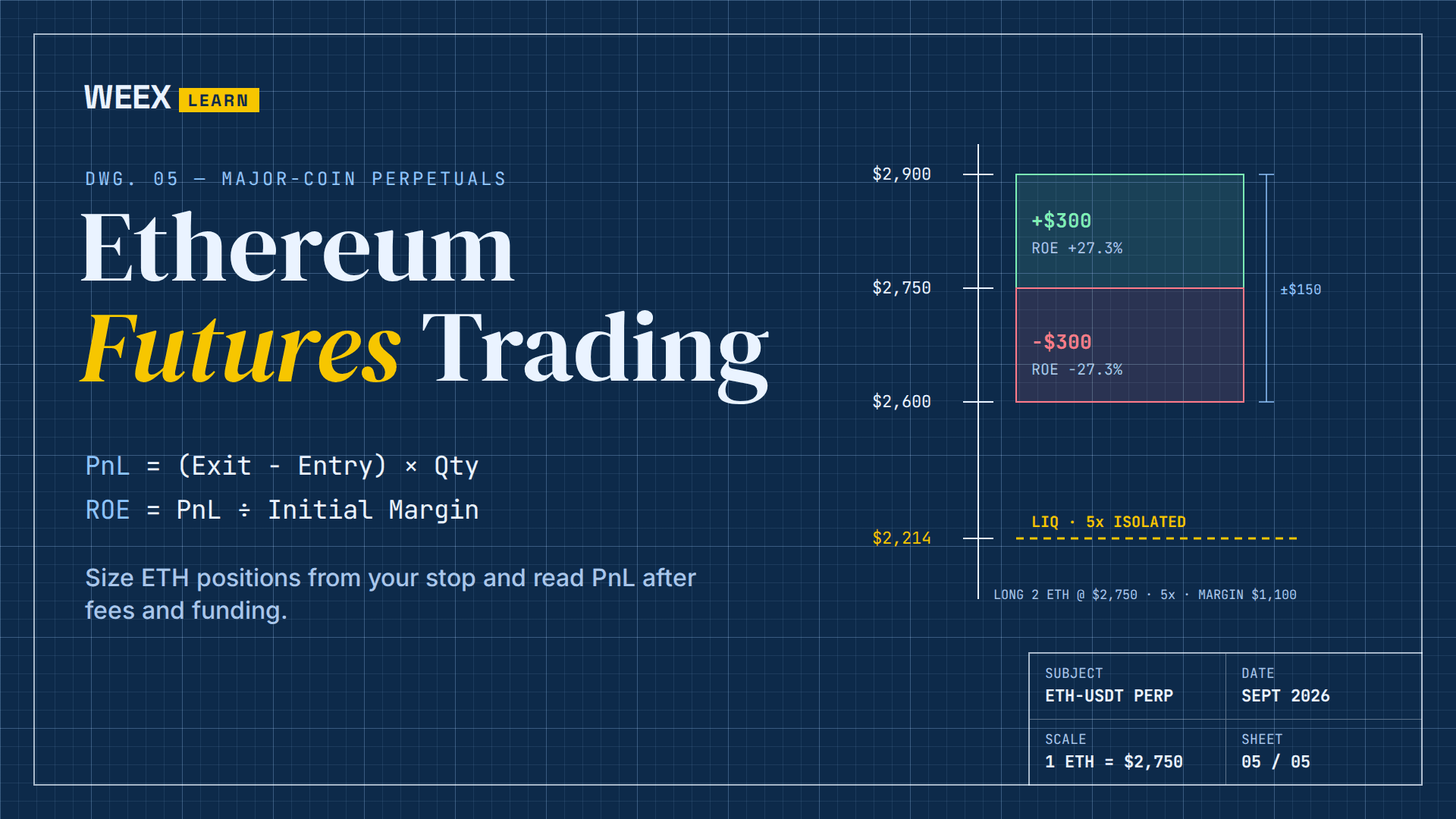
- Long PnL = (exit price − entry price) × quantity of ETH
- Short PnL = (entry price − exit price) × quantity of ETH
- ROE (return on equity) = PnL ÷ initial margin
- Initial margin = position notional ÷ leverage
Worked example. Open a long of 2 ETH at $2,750 at 5x leverage.
- Notional: 2 × $2,750 = $5,500
- Initial margin: $5,500 ÷ 5 = $1,100
- If ETH rises to $2,900: PnL = ($2,900 − $2,750) × 2 = +$300, and ROE = $300 ÷ $1,100 = +27.3%
- If ETH falls to $2,600: PnL = −$300, and ROE = −27.3%
- Approximate liquidation price (isolated, illustrative 0.5% maintenance margin): $2,750 × (1 − 1/5 + 0.005) ≈ $2,214
Leverage doesn't change the dollar PnL. A $150 move on 2 ETH is $300 at 2x or at 20x. What leverage changes is ROE and how close liquidation sits. At 20x, the same trade posts only $275 of margin, and a $300 loss exceeds it, so the position would already have been liquidated at around $2,626.
One more detail: unrealized PnL on most exchanges is calculated from the mark price, not the last traded price. The mark price follows an index across several spot exchanges, so a brief wick on one venue does not change your displayed PnL or trigger liquidation by itself.
The Hidden Costs: Fees and Funding on an ETH Perp
The PnL formula shows gross profit. In practice, two costs are taken off the result:
- Trading fees are charged on notional value when you open and again when you close. With an illustrative 0.06% taker fee, the example above costs $5,500 × 0.06% = $3.30 to open and $5,800 × 0.06% = $3.48 to close, $6.78 in total.
- Funding is paid between longs and shorts, usually every 8 hours. At an illustrative +0.01% per period, the long pays $5,500 × 0.01% = $0.55 per settlement, or $1.65 a day.
If the trade is held for one day and closed at $2,900, net PnL is about $300 − $6.78 − $1.65 = $291.57, an ROE of roughly 26.5%.
Over a single day these costs look small, but they grow for traders who hold for weeks or trade often. When funding rises the way it did on BTC perps after Sept 21, reaching about 10.5% annualized on some venues, carrying an ETH long for a month can cost close to a full percentage point of price movement. Check the live funding rate and fee tier on WEEX before opening a position, since both change with market conditions.
-- Price
How to Size an Ethereum Futures Position From Your Stop
Most blown futures accounts start by choosing leverage first. Reverse the order:
- Pick the invalidation level. For example, a long from $2,750 with a stop at $2,640, below recent consolidation. That is $110 of risk per ETH.
- Set the account risk. On a $5,000 account, risking 1% means $50.
- Calculate quantity. $50 ÷ $110 ≈ 0.45 ETH, a notional of about $1,250.
- Pick leverage last. 2x needs about $625 of margin, and liquidation sits near $1,389, far below the stop. Even 5x ($250 margin, liquidation near $2,214) keeps the stop well ahead of liquidation.
- Place the stop and take-profit when you open. WEEX's take-profit and stop-loss guide covers choosing between mark price and last price triggers.
If the stop is hit, you lose about $50 plus fees, whatever leverage you chose. That is the point of sizing from the stop. It is also why the 1% rule protects an account better than any leverage cap.
A practical note from experienced ETH traders: ETH typically moves more than BTC in percentage terms. Leverage that feels comfortable on bitcoin is effectively more aggressive on ether, so give ETH stops more room and trade a smaller size. For the basics of margin modes and order types, see WEEX's crypto futures trading guide.
ETH Futures Catalysts to Watch Into October
These dates are already on the calendar, and each can move volatility and funding:
- Sept 29, 2026: Glamsterdam client software is due. Delays would weaken the upgrade story.
- Oct 6, 2026: Glamsterdam public testnet trials begin, testing enshrined proposer-builder separation (ePBS) and parallel transaction processing.
- Aave's WETH risk-parameter vote: A higher loan-to-value ratio means more leverage against ETH on-chain. That supports demand but also makes on-chain liquidations larger if ETH drops.
- BTC's $84,000 support: ETH has lagged BTC on the way up. If bitcoin's post-squeeze longs unwind, ETH usually follows BTC down.
Ethereum futures trading rewards traders who know their numbers before they enter: the PnL at the target, the cost at the stop, and the funding while they wait. The catalysts will settle direction; the maths above decides whether you are still in the trade when they do.
FAQ
1. How do you calculate PnL on Ethereum futures?
For a USDT-margined long, PnL = (exit − entry) × ETH quantity; for a short, reverse the subtraction. ROE equals PnL divided by the initial margin. Subtract trading fees and funding to get the net result.
2. Does higher leverage increase ETH futures profit?
It increases ROE, not dollar profit. A $150 move on 2 ETH is $300 at any leverage. Higher leverage only lowers the margin you post and moves the liquidation price closer to your entry.
3. What is the funding rate on ETH perpetual futures?
It is a periodic payment between longs and shorts, usually settled every 8 hours, that keeps the perpetual price close to spot. When funding is positive, longs pay shorts. Rates change continuously, so check the live rate before opening.
4. How much of my account should I risk on one ETH futures trade?
Many traders cap risk at 1–2% of their account per trade. That percentage is set by where your stop-loss sits, not by how much leverage you pick.
Risk Warning
Ethereum futures are leveraged derivatives, and you can lose part or all of your margin quickly. ETH is more volatile than BTC in percentage terms, and upgrade timelines such as Glamsterdam can slip. Stop-losses can fill with slippage during fast markets. Funding and fees reduce returns and can turn a small gain into a loss over time. The fee, funding and maintenance margin figures in this article are illustrative, so confirm current WEEX rates before trading. This content is educational and is not investment advice.
This content is provided for general informational purposes only and doesn't constitute financial, investment, legal, or tax advice. Any events, rewards, online promotions, or related information mentioned herein should not be considered a recommendation, solicitation, or invitation to purchase, sell, trade, or otherwise deal in any crypto assets. Crypto assets are highly volatile and may result in loss. The availability of WEEX services, products, and related events may vary by region. You are responsible for ensuring that your participation is in accordance with applicable local laws and regulations.
You may also like

What Is a White Label Crypto Exchange? A Complete Beginner's Guide

Is Hyperliquid Safe? Risks You Should Know Before You Trade

What a Blockchain Explorer Can and Cannot Tell You

How to Look Up a Wallet Address and Transaction History

How to Verify a Crypto Transaction With a Blockchain Explorer?
BTC Futures Trading on WEEX: Claim BTC Rewards Before Sep 25
What Is a Funding Rate? How Perpetual Futures Charge Longs and Shorts
Perpetual Futures for Beginners: Margin, Funding and Liquidation Explained
What the LUSD Attack Shows About DeFi Risk
What Is BONK? WEEX Spot and 1000BONK Futures Status and Risk Checks
What Is BRETT? WEEX Spot and Futures Status and Risk Checks
What Is FLOKI? WEEX Spot and 1000FLOKI Futures Status and Risk Checks

What Is WIF (dogwifhat)? WEEX Spot and Futures Status and Risk Checks

Who Is Attending TOKEN2049 Singapore 2026? Top Speakers, Exchanges and Exhibitors to Watch
USDC on Arc: What Circle's Mainnet Launch Changes for Holders
SpaceX Stock Futures: Where to Put Stops on a 115% Range
How to Trade Microsoft (MSFT) Stock Token with USDT on WEEX
How to Trade Apple (AAPL) Stock Token with USDT on WEEX
Crypto Futures Trading Explained: Leverage, Funding, Liquidation
Crypto Futures Trading: Leverage, Funding and Apple Perps
How to Trade Tesla (TSLA) Stock Token with USDT on WEEX: A Trading Guide for Beginers in 2026
How to Trade NVIDIA (NVDA) Stock Token with USDT on WEEX
How to Trade U.S. Stocks Without a Brokerage Account Using USDT
Nike Stock Price Prediction 2026: What the $50 Target Actually Requires to Happen

CLARITY Act Enters a Critical Window: What the September 15 Senate Vote Actually Means
What Are Spot Stock Tokens? How Synthetic Stock Trading Works

XST Coin Price Bounced 19% Off a New Low in Hours: Is This the Bottom or Just Noise?
What to Do After Buying USDT in Pakistan: Spot, Futures or Hold?

What Is the WEEX Mini App? A Lightweight Way to Trade Inside Telegram
XST Coin Price Crosses Into Deep Capitulation Territory: What a 90%+ Decline Actually Signals
What Is a White Label Crypto Exchange? A Complete Beginner's Guide
Is Hyperliquid Safe? Risks You Should Know Before You Trade
What a Blockchain Explorer Can and Cannot Tell You
How to Look Up a Wallet Address and Transaction History
How to Verify a Crypto Transaction With a Blockchain Explorer?
BTC Futures Trading on WEEX: Claim BTC Rewards Before Sep 25


