
A $650 million wave of bridge hacks just triggered a $7 billion mass migration to Chainlink

 Prefer us on Google


Chainlink drew more than $7 billion of token value onto its cross-chain infrastructure in the second quarter as institutional adoption accelerated, according to its second-quarter review.
The migration came as crypto projects replaced older bridging systems and traditional-finance firms moved deeper into tokenized markets, expanding Chainlink's role across both sides of the digital-asset economy.
Chainlink said its Cross-Chain Interoperability Protocol (CCIP) handled $4.9 billion in quarterly volume, up 353% from a year earlier, while the network's total value secured reached $110 billion.
The growth is also sharpening a longstanding question for investors: whether wider use of Chainlink's infrastructure can translate into stronger economic demand for LINK, the network's native token.
Bridge attacks push billions toward Chainlink
Security concerns are reshaping how some of crypto's largest projects move assets between blockchains.
Mantle migrated more than $2.5 billion of MNT to Chainlink's Cross-Chain Interoperability Protocol, while Lombard Finance moved over $1 billion in Bitcoin assets and Solv shifted more than $700 million in tokenized Bitcoin.
KelpDAO moved about $1.5 billion of rsETH after a $292 million exploit involving its previous bridging provider sharpened concerns over cross-chain security.
Kraken also migrated more than $330 million of wrapped Bitcoin and plans to use CCIP for future wrapped assets. Re shifted about $475 million of reUSD distribution, while Virtuals adopted the system for more than $700 million of VIRTUAL deployed across blockchain networks.
The migrations come as the roughly $140 billion DeFi sector increasingly relies on infrastructure connecting otherwise separate networks.
Cross-chain bridges allow tokens and data to move between blockchains without routing through a centralized exchange. That function has become critical as lending markets, staking products, stablecoins and tokenized assets expand across multiple ecosystems.
But the infrastructure has also become a persistent security vulnerability. Bridges often rely on complex verification mechanisms while controlling large pools of assets, making a successful breach potentially lucrative for attackers.
Cross-chain bridge and infrastructure losses have surpassed $650 million this year across several major incidents, including attacks involving the Verus Ethereum Bridge and Polkadot-based Hyperbridge.
Repeated losses are putting greater pressure on protocols to scrutinize the security architecture underpinning cross-chain transfers, particularly as the value moving between networks increases.
CCIP, which launched on mainnet in July 2023, has emerged as one beneficiary of that reassessment, with projects representing billions of dollars in assets adopting the system as they rethink how value should move across chains.
Wall Street adoption broadens the opportunity
The shift is giving Chainlink an expanding foothold just as tokenized assets begin drawing larger financial institutions onchain.
That institutional push moved beyond experiments during the quarter.
Depository Trust & Clearing Corp. said in May that its Collateral AppChain will use Chainlink's Runtime Environment and data standard to support near-real-time collateral management across financial markets and blockchains.
The platform is designed to make collateral transferable around the clock, with a go-live expected in the fourth quarter. DTCC said the integration would pair asset prices, valuations and movement within the shared infrastructure.
Fidelity International also launched its first tokenized fund using Chainlink for onchain net-asset-value data, while State Street Investment Management and Galaxy used the network for SWEEP, a tokenized liquidity fund.
Chainlink's institutional ambitions widened further with Project Pangea, an initiative involving banking groups from Europe and South Korea representing more than 50 banks and over $10 trillion in assets under management.
The project is exploring T+0 foreign-exchange settlement using regulated stablecoins, ISO 20022 messaging and existing SWIFT infrastructure. The model is intended to allow both sides of a currency transaction to settle simultaneously, reducing the time and counterparty exposure associated with traditional settlement cycles.
The combination gives Chainlink exposure to a broader set of financial workflows than the price feeds that built its early position in decentralized finance.
Broader usage starts feeding into LINK adoption
Chainlink's expansion across institutional finance, cross-chain transfers and prediction markets is widening the potential sources of demand for LINK.
The network is increasingly pairing that growth with mechanisms designed to convert usage into token accumulation.
According to the second quarter report, Chainlink Reserve added more than 1.44 million LINK during the second quarter, lifting total holdings above 4.5 million tokens. The reserve uses revenue generated from enterprise adoption and onchain services to acquire LINK.
Chainlink's Smart Value Recapture system is creating another route for network activity to feed into the token economy.
The system has recaptured more than $23 million from DeFi liquidations, with roughly $15 million going to participating protocols and about $8 million flowing to the Chainlink network. It has processed more than $880 million in liquidations.
Those mechanisms are gaining relevance as Chainlink services are playing an integral role across the crypto ecosystem, from moving tokenized assets between networks to supplying data and settling event-based markets.
Signs of stronger LINK accumulation are also beginning to appear off-chain.
Santiment data shows the amount of LINK held on known exchanges has fallen by more than 15.7 million tokens over the past month, a roughly 12% decline. Another 1.04 million LINK left exchanges on July 19, marking one of the largest single-day outflows during the period.
Lower exchange balances reduce the pool of tokens immediately available for sale and can indicate that holders are moving assets into longer-term custody or other uses. The data, however, does not establish where the withdrawn tokens ultimately went or how long they will remain off exchanges.
LINK's price has strengthened alongside the decline in exchange supply. CryptoSlate data shows the token has gained about 12% this month to $8.34, though it remains roughly 31% lower since the start of the year.
The recent gains leave LINK well below levels seen before this year's broader crypto-market downturn, but they come as Chainlink's underlying activity is extending into markets that could generate more recurring network usage.
-- Price
This content is provided for general informational purposes only and doesn't constitute financial, investment, legal, or tax advice. Any events, rewards, online promotions, or related information mentioned herein should not be considered a recommendation, solicitation, or invitation to purchase, sell, trade, or otherwise deal in any crypto assets. Crypto assets are highly volatile and may result in loss. The availability of WEEX services, products, and related events may vary by region. You are responsible for ensuring that your participation is in accordance with applicable local laws and regulations.
You may also like

Circle expands CCTP to EURC and cirBTC on Arc

Bitcoin, Sports, and Politics: Predictive Markets Target $10 Trillion

AI Agent Jev Expects On-Chain Innovation Through Automated Judgment

The End of the Blank Prompt: Why Trading AI Needs a Playbook

Stablecoins hold nearly $200 billion in US debt, but money funds bought the surge
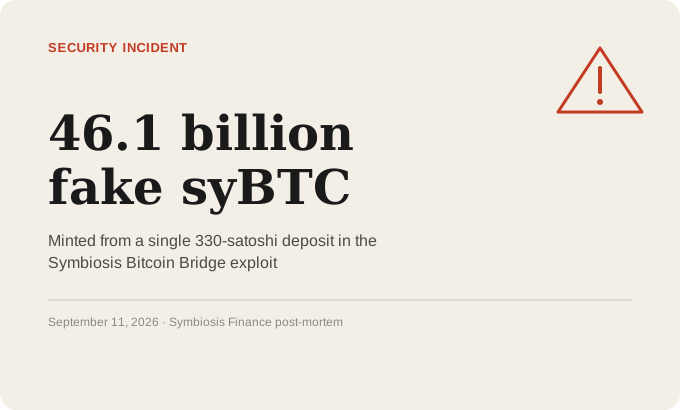
How Did a Hacker Create 46 Billion Fake Bitcoin in the Symbiosis Exploit? Decodes Bitcoin Hacker With WEEX Now
How two Symbiosis bridge bugs let a hacker mint 46.1 billion unbacked syBTC, drain Bitcoin pools and expose critical bridge risks.

CFTC's Selig Emphasizes the Need to Prepare for the Era of Large-Scale Tokenization in the U.S.

The IMF opens an office in Venezuela to supervise an economy that has already migrated to USDT

SOXL Stock Jumped 12% Yesterday: Three Companies Explain the Entire Move

Bitcoin's Hashrate Rises as Miners Reactivate Their Machines

Bitcoin 2x Leveraged ETF Launches on Cboe, But Doesn't Buy Bitcoin: Here's Why

Crypto: The ECB Enters the Tokenized Bond Market
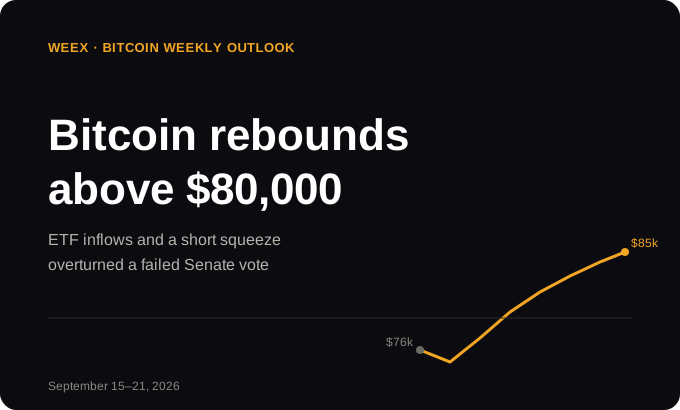
WEEX Bitcoin Weekly Outlook: Why Did Bitcoin Rebound Above $80,000 After the CLARITY Act Vote?
Bitcoin rebounded above $80,000 as SEC and CFTC action, renewed ETF inflows, and a short squeeze outweighed the failed CLARITY Act vote.
Coldcard whitehats move 52.37 BTC to recovery trust

Bitcoin's Rise Does Not Mean the Bull Market Has Returned; Don't Create Stories for Yourself
Deutsche Bank: Markets May Underestimate Rate Peaks After Central Banks' Coordinated Rate Hikes
Hyperliquid Opens Market for Bitcoin Volatility

Tom Lee Discusses Entry into Digital Asset Bull Market and AI Fund Movements

Micron Stock Price Target: Do the $1,500 to $2,000 Estimates Still Make Sense
Micron price targets range from $1,295 consensus to $1,500- lus individual calls, while options pricing implies an 11% swing on September 30 earnings, the actual results will settle which
![[ETH Letter] Ethereum Aims to Activate Sepolia Testnet on October 6](/public-static/26_2e1840f602.png?format=avif)
[ETH Letter] Ethereum Aims to Activate Sepolia Testnet on October 6
Fypher Partners with Korea Medical Tourism Promotion Association for Digital Dollar Payment
TapeOut Ecosystem Overview: From NAND, LATCH to On-Chain Application Ecosystem
[Coin Crime] "If you give us Tether, we will give you oil" - Polish state-owned company falls victim to international fraudsters

Why real-time election odds are misleading prediction market crypto traders

What is PCE and Why September 30 is Important for Cryptocurrencies
Bitcoin: JPMorgan Sees BTC Outperforming Gold

U.S. Treasury Sanctions BitBank Over Iranian Sanctions-Evasion Network
Brazil blocks stablecoins from key cross-border payment rail as $1.1 trillion market faces new limits
RISEx Proposes 20% Retention Condition for Stolen Funds

USDT in Wallets May Be Blocked. What to Do and How to Store Them in Russia
Circle expands CCTP to EURC and cirBTC on Arc
Bitcoin, Sports, and Politics: Predictive Markets Target $10 Trillion
AI Agent Jev Expects On-Chain Innovation Through Automated Judgment
The End of the Blank Prompt: Why Trading AI Needs a Playbook
Stablecoins hold nearly $200 billion in US debt, but money funds bought the surge
How Did a Hacker Create 46 Billion Fake Bitcoin in the Symbiosis Exploit? Decodes Bitcoin Hacker With WEEX Now
How two Symbiosis bridge bugs let a hacker mint 46.1 billion unbacked syBTC, drain Bitcoin pools and expose critical bridge risks.





