
Aptos Validators Decrease by 40% in Two Years, Concentration of Validator Nodes Shifts to Europe and America

 Prefer us on Google


Annual rewards drop from 7% to 2.6%, with USD income evaporating by 96%.
Written by: @r2Jamong
Compiled by: AididiaoJP, Foresight News
The distribution of Aptos validators is narrowing. This is not merely a decline in the number of nodes, but rather a process where network participants are re-evaluating their operational locations due to performance upgrades, reward design, and falling token prices.
As of October 2024, Aptos has 146 validator nodes distributed across 22 countries and 48 cities. Besides Europe and America, there are nodes in Singapore, Tokyo, Seoul, and Hong Kong, as well as in São Paulo, Johannesburg, and Sydney. Overall, it still represents a relatively broad global network.
In less than two years, by September 2026, the number of nodes will drop to 84, a decrease of 42%; the number of countries covered will fall to 13, and cities to 28, with a similar decline rate. The remaining nodes are mostly concentrated in America and Europe. Outside of these regions, only one node remains in Tokyo, with the previous multi-city layout in Asia having largely exited.
Two things are happening simultaneously: chain performance is improving, making it harder for validators to operate stably from remote locations; and the decline in rewards, coupled with falling token prices, has led to financial imbalances for some operators.
Faster Chain, More Important Location
The Baby Raptr upgrade in June 2025, along with AIP-131 (Velociraptr), has compressed Aptos's block time to under 50 milliseconds. This is a clear improvement for users and transactions; for validators, network conditions and server locations are no longer secondary variables.
Aptos rewards are calculated based on "staked amount × reward rate × validator proposal success rate." The further a node is from the validator's main cluster, the easier it is for the proposal success rate to decline under the same staked amount, leading to reduced income. Nodes dispersed across different continents are therefore the first to be constrained by these rules. Shutting down or migrating to Europe or America has become a more rational choice.
Performance improvements have also raised hardware thresholds. Coupled with AI demand driving up memory prices, the fixed costs for validators have further increased. Operators that are remote, small-scale, and have thin profits are the first to struggle to maintain operations.
There is an industry contradiction here: faster consensus mechanisms may inversely compress geographical diversity. Latency is a physical constraint, and rewards are linked to proposal success rates, causing nodes to naturally concentrate in low-latency areas. Decentralized distribution may gradually shrink due to performance goals.
Financial Constraints Determine Node Retention
The direct reason for node exits remains income. Validators earn revenue in tokens but pay for server, bandwidth, operations, and labor in USD. The two cost and income curves are in different market cycles.
Aptos's annual staking rewards have dropped from 7% in October 2024 to 2.6% in September 2026, a decrease of 63%. The path is clear: AIP-119 proposed in April 2025 reduced the rate from 7% to 5.19% starting in June of that year; the foundation's token economic adjustment proposed in February 2026 further lowered it to 2.6%. Validator income comes from commission shares in delegated staking rewards, and the reduction in reward rates synchronously decreases income for both delegators and operators.
What truly breaks financial balance is the price. During the same period, APT dropped from $9.50 to $0.58, a decline of 94%. After the reduction in nodes, the average staked amount per node increased from 5.75 million APT to 8.97 million APT, an increase of 56%. Staking is more concentrated, but the reduction in rewards and falling prices combined lead to a 96% decrease in annualized rewards when measured in USD.
A 56% increase in staking cannot compensate for a 96% evaporation of income. This is the arithmetic basis for the wave of exits.
The shift in token economics towards low issuance and low staking rewards has its rationale from a long-term dilution perspective. However, the cost is that validator businesses become thinner, and network distribution narrows accordingly. Tightening at the issuance end puts pressure on the operational end, making it difficult to balance both.
Other PoS Chains Face Similar Issues
Earning income in tokens while paying costs in fiat currency is not unique to Aptos. When the market weakens, marginal regions and small to medium operators often exit first. What remains are more exchanges, institutions, and professional nodes already located in American and European data centers.
The Ethereum community has similar discussions. EIP-8363 proposes to destroy a portion of newly issued rewards when staking scales up, to curb inflation and excessive staking growth. The direction is similar to Aptos's reduction in rewards, but it also requires assessing the economic resilience of validators.
When measuring decentralization, one cannot only look at the number of nodes and staking rates. The more critical question is: when token prices fall and reward policies adjust, will a sufficiently diverse group of operators still remain? The number of nodes can expand in a bull market but will be reordered by costs in a bear market.
At this stage, participants who can withstand short-term reward fluctuations are more important. Exchanges and institutions have other business supports, long-term service demands, and greater capacity to navigate downturns. Therefore, exchange staking and institutional validators have a positive significance for network stability. However, their increasing proportion may also weaken geographical and subject diversity. Stability and decentralization do not always align.
Another key factor is the entry threshold. Most public chains concentrate engineering resources on improving performance and throughput, and should also invest in efficiency optimization: achieving comparable performance with less hardware, lower electricity costs, and bandwidth. Once the threshold is lowered, new operators can enter, and existing operators can survive under low rewards. Otherwise, "global distribution" may remain only in documents, while actual nodes will still shrink to a few cloud regions.
-- Price
Long-term Decentralization Depends on Three Factors
The changes in Aptos over the past two years do not simply prove a "failure of decentralization," but reveal a set of specific constraints:
- Performance upgrades will change who is suitable to be a validator;
- Rewards and token prices determine who can still bear the operating costs;
- The participants that remain will shape the next phase of the network map.
Long-term decentralization ultimately depends on three points: having validators that can continue to operate during market downturns, effectively lowering operating costs, and keeping the entry environment open to new participants. Lacking any one of these, the number of nodes may look good in the short term, but geographical distribution will first narrow.
This content is provided for general informational purposes only and doesn't constitute financial, investment, legal, or tax advice. Any events, rewards, online promotions, or related information mentioned herein should not be considered a recommendation, solicitation, or invitation to purchase, sell, trade, or otherwise deal in any crypto assets. Crypto assets are highly volatile and may result in loss. The availability of WEEX services, products, and related events may vary by region. You are responsible for ensuring that your participation is in accordance with applicable local laws and regulations.
You may also like

The End of the Blank Prompt: Why Trading AI Needs a Playbook

Cardano proposal slashes fees by 55%, but it comes with a cost for small pools

The Evolution of AI: The Boundaries and Truth of Recursive Self-Improvement (RSI)

The Quantum Issue: You Never Really Know The Future

Security and fees hold back deeper crypto use among wealthy investors: Nexo report

Bitcoin Developers Concerned About Mining Subsidy

VVV Hits All-Time High: Founder’s Perspective on Models, Privacy, and Crypto

XRPL fixes critical pre-mainnet flaw, but client apps remain at risk

Glassnode Indicates Shift Towards Altcoin Season

Crypto: Kalshi accused of inflating its volumes with thousands of identical orders

HODLing ETH: Should You Choose Staking for Yield or Collateralized Lending?

SEC Clarity Meets Fed Rate Hike: How WEEX TradFi Lucky Eggs S2 Taps Into Cross-Market Opportunities

How Significant Are Changes in Overseas AI Investment?
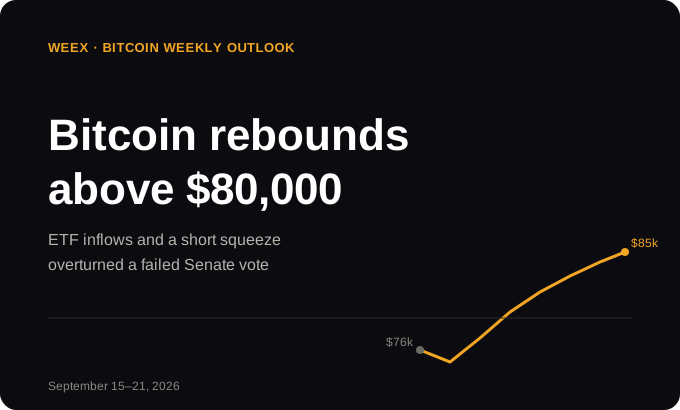
WEEX Bitcoin Weekly Outlook: Why Did Bitcoin Rebound Above $80,000 After the CLARITY Act Vote?
Bitcoin rebounded above $80,000 as SEC and CFTC action, renewed ETF inflows, and a short squeeze outweighed the failed CLARITY Act vote.

$8 Makes a Comeback, This Time X Money Rewrites the Logic of NFT Issuance
AMD Jumps Nearly 10%, Market Cap Tops $1 Trillion| WEEX TradFi Daily Brief (September 22, 2026)
Global markets on September 22 focus on a repair in AI-compute pricing. On September 21 the three major equity indexes closed higher. AMD rose nearly 10% and its market cap crossed $1 trillion for the first time, while Intel and Arm also surged. Brent crude fell about 3.4% to $100.34 and the 10-year Treasury yield eased to about 4.96%, lowering discount-rate pressure on long-duration tech. Bitcoin briefly broke above $87,000 and total crypto market cap returned above $3 trillion. Investors next watch consumer and housing earnings plus PMI flash prints.
Balancer Community Proposes Fork and Rebirth

The Answer to Dreamforce 2026: AI Agent, Has It Finally Turned from Demo to Revenue?
Ethereum: BitMine Approaches 5% of Total ETH Supply
Bitcoin's $84K rally isn't saving miners as difficulty signals already flash caution
ZEC's Largest Mining Company Moves to US Stock Market After Mining 70,000 ZEC in Six Months

Validators Vote on Batch V1.1 After Security Overhaul

SEC Takes Action: Who Can Handle "Compliant ICOs"?

TRON Weekly Industry Report: Regulatory and Interest Rate Pressures Fail to Dampen BTC Bullish Sentiment, Detailed Analysis of PayFi High-Performance Payment Infrastructure Axon Finance

When AI Agents Accelerate into Intranets: The Main Battlefield of Cybersecurity Has Changed
How to Earn Crypto Futures Trading Rewards on WEEX: Daily Lucky Eggs S2

ZetaChain, Linera, Switchboard Cease Operations
WEEX Futures Trading Rewards in Sep 2026: Win Up to 10,000 USDT

The Next Phase of Ethereum from the EF Protocol AMA

TapeOut Ecosystem Overview: From NAND, LATCH to On-Chain Application Ecosystem
The End of the Blank Prompt: Why Trading AI Needs a Playbook
Cardano proposal slashes fees by 55%, but it comes with a cost for small pools
The Evolution of AI: The Boundaries and Truth of Recursive Self-Improvement (RSI)
The Quantum Issue: You Never Really Know The Future
Security and fees hold back deeper crypto use among wealthy investors: Nexo report
Bitcoin Developers Concerned About Mining Subsidy
Contents
Latest articles


Latest coin listings on WEEX


