
Bitcoin Below $80K, Digital Ruble and Hot Topics of the Crypto Forum

 Prefer us on Google


Bitcoin has once again become the center of discussions: participants of the community <
In the community, investors, traders, miners, analysts, and blockchain technology users exchange experiences, analyze market news, and help each other assess risks. Moderators highlight strong comments and boost the ratings of active participants.
What Forum Participants Are Discussing
Bitcoin Drops Below $80K Again
The main question for traders is why the market has entered a correction and how sustainable the pressure on the price might be. For participants, the benchmark has become the level below $80K for 1 BTC: it is precisely the drop below this level that sparked the debate about the reasons for the decline and the scenarios under which the fall may continue.
Crypto Market Forecasts for September
Forum members share their expectations for the market and debate which factors could influence the dynamics of crypto assets in the coming weeks. They separately discuss the likelihood of a change in the Fed's rate in September and the possible market reaction.
Coins in Focus for Traders
Among the assets that frequently appear in discussions are BTC, ETH, GRAM, ARB, APT, ICP, and other coins. Participants quickly align their ideas on trades, compare arguments, and showcase results.
- BTC and ETH: the main benchmarks for assessing market sentiment
- GRAM, ARB, APT, and ICP: altcoins for specific trading ideas
- Other coins: brief theses from participants, entries, exits, and analysis of results
ZEC Above $1000 and Bearish Scenario
A separate topic is the sharp rise of ZEC and the possibility of a drop to $200. Participants analyze what such a scenario is based on and what signals could confirm or refute it.
Portfolios, Drawdowns, and Leveraged Trades
Forum members share what assets they are buying, how they cope with drawdowns, and what conclusions they draw after unsuccessful entries. One participant shared their experience of trading with 200X leverage and reported on % in short trades.
<<The portfolio is still down by --70%>>
Such stories become a reason to discuss risk management, discipline, and the dangers of aggressive trading, especially when the market changes direction sharply.
Crypto Stocks and Infrastructure Stories
In a separate thread, they discuss stocks and instruments related to the crypto market: MARA, GEMI, COIN, SPCX, and others. Participants observe how such instruments react to market movements, company news, and infrastructure events.
- MARA: connection with mining and Bitcoin dynamics
- COIN: interest in exchange infrastructure and activity in the crypto market
- GEMI and SPCX: discussion of specific ideas, news, and market expectations
- Bank stablecoins, lawsuit against Tether, and Bitcoin cycles: topics for assessing the overall background
Digital Ruble, Exchanges, and Memecoins
Among the practical topics are online P2P, physical exchanges, and ways to safely exchange crypto. Participants compare the convenience of different options and discuss the risks that may arise during transactions.
Another line of discussion is the digital ruble and possible scenarios for its use. Participants analyze who might benefit from the domestic CBDC and what nuances users should consider.
Forum members also respond to polls about memecoins, share comments, and post current memes. The editorial team invites subscribers to send in their own options.
<
In the program "Hash and Cash" on Radio RBC, the episode from September 3 is dedicated to volatility and leverage. The main topic is the risks investors face in the cryptocurrency market when using borrowed funds for trading.
Bitcoin's volatility is exacerbated by speculative trades, news about regulators and the Federal Reserve's interest rate, liquidations of leveraged positions, and sudden shifts in sentiment among major participants. Therefore, movements below $80,000, rapid increases of ZEC above $1,000, or discussions about a drop to $200 become not just points of contention but reminders of how quickly expectations can change in the cryptocurrency market.
A collection of episodes of "Hash and Cash" is available for replay. Forum participants can listen to broadcasts and suggest questions for future programs.
Expert Threads on the Forum
The forum features personal threads from experts in various segments of the cryptocurrency market. This format helps participants receive not only news but also a more practical perspective on current events.
- Exclusive content on various topics within the forum
- The opportunity to directly ask a specialist a question and receive a substantive answer
- Personal experiences and unpublished observations from market professionals
- Participation of experts in discussions alongside subscribers
Trader Anatoly Radchenko, head of the Expert Center for Digital Assets of the Association of Banks of Russia Olga Goncharova, and founder of the legal company GMT Legal Andrey Tugarin are already leading their threads. They answer participants' questions, and the forum team is negotiating with new experts.
Participants are invited to take a survey and share which specialists from various fields they would like to see on the platform and what content interests them. The forum format is being developed with this feedback in mind.
Why a Crypto Forum is Needed
The forum was launched in the summer of 2024 to gather a separate community of people interested in cryptocurrencies, investments, trading, mining, and blockchain around "RBC-Crypto". The format is a familiar chat in Telegram but with categories and topics.
Topics and content are largely shaped by subscriber requests. Currently, more than 20,000 people have joined the forum. They share ideas, observations, and practical experiences, while moderators are well-versed in cryptocurrencies and the blockchain sphere.
The main value of the platform is live discussions of market trends with other participants and invited experts. The forum already hosts broadcasts with specialists from various fields: representatives from exchanges, crypto projects, legal and other companies. Subscribers can ask them questions directly.
Brief Context: How Bitcoin Works
Bitcoin is often referred to not just as an asset but as a technological foundation for a new type of transactions. Its history is linked to the name Satoshi Nakamoto: in 2008, he published a whitepaper describing peer-to-peer electronic money, and in 2009, the network was launched, and the first block was created. Subsequently, the first transactions, wallets, exchange trading, halvings, and infrastructure around Bitcoin emerged, including contributions from the community and organizations like the Bitcoin Foundation.
From a technical perspective, it is a peer-to-peer network where the blockchain stores data about transactions, and encryption and a public key cryptosystem help confirm ownership of funds. Transactions are collected into blocks, miners verify them, and compete for the right to add a new block to the chain. Each subsequent block is linked to the previous one, making it extremely difficult to rewrite the history of transactions. The approach is based on open-source software, and the concept itself lies at the intersection of finance, mathematics, and computer science.
For users, cryptocurrency may appear as digital money, but its mechanics differ from traditional services. A bank transaction typically goes through intermediaries, whereas the Bitcoin payment system operates on a different model. Therefore, it is often compared to PayPal, but the direct comparison is conditional: Cryptocurrency as an asset class is built on different principles of trust and transaction confirmation.
How Bitcoin is Mined
Mining Bitcoin is the process in which specialized devices find a solution for a new block, confirm transactions, and maintain the network's operation. This usually involves using ASIC hardware, connecting to a pool, having a wallet to receive rewards, and software to configure the miner. The process is becoming increasingly complex and expensive: electricity, cooling, equipment maintenance, and return on investment calculations are required.
How to Store Bitcoins
Bitcoins are stored through wallets that provide access to private keys. Hot wallets are convenient for frequent transactions but are more dependent on the security of the device and online service. Cold wallets are better suited for long-term storage because private keys remain disconnected from the internet. The choice depends on the amount, frequency of transfers, and willingness to manage backups and access independently.
Where to Buy Bitcoin
Bitcoin can be purchased through cryptocurrency exchanges, online P2P platforms, and physical exchange offices. Typically, the process involves selecting a service, checking the terms of the deal, making a payment, and receiving BTC in the wallet. Before buying, it is important to check the reputation of the platform, fees, limits, wallet address, and return conditions, and in P2P transactions, the counterparty's rating and safe payment rules.
Emission, Forecasts, and Risks of Bitcoin
The maximum emission of Bitcoin is capped at 21 million coins, which makes its issuance predictable. Currently, over 19 million BTC have been mined, and new coins are generated through mining according to predetermined rules. Long-term forecasts for 2030 are usually based on demand, regulation, market cycles, halvings, and interest from large investors, but such estimates remain speculative.
- Volatility: the price of Bitcoin can rise quickly and fall just as fast
- Loss of access: without private keys or a backup, recovering funds may be impossible
- Regulatory risks: decisions by authorities and banks can affect access to services and market sentiment
- Fraud: fake exchanges, counterfeit wallets, and dubious schemes remain a frequent threat
-- Price
This content is provided for general informational purposes only and doesn't constitute financial, investment, legal, or tax advice. Any events, rewards, online promotions, or related information mentioned herein should not be considered a recommendation, solicitation, or invitation to purchase, sell, trade, or otherwise deal in any crypto assets. Crypto assets are highly volatile and may result in loss. The availability of WEEX services, products, and related events may vary by region. You are responsible for ensuring that your participation is in accordance with applicable local laws and regulations.
You may also like

US Bond Market 'Meltdown'... Why Are Interest Rates Soaring?

Sam Price: The Impact of Cryptocurrency Legislation on Market Dynamics

The Quantum Issue: You Never Really Know The Future

Crypto Kidnapping: 6 Suspects Charged in Case Involving a Few Hundred Euros in Val-d’Oise

Security and fees hold back deeper crypto use among wealthy investors: Nexo report
Why leaving your crypto on an exchange is not the same as having it in your own wallet?

Binance Under Scrutiny Again for Iran-Related Trading
Altcoin demand meets $18B threat as flows move into RWA perps as just 19% of traders keep alts
90% of U.S. Treasury Yield Increase Concentrated Around Employment Data and Fed Speeches
Can Kraken's Parent Company Open the Door for Hyperliquid to Enter the U.S. Market?
Gold Price Today in Thailand: XAU/USD Holds Near $4,347 as Key Support Level Tested

Scam AI Bot: 274 ETH Lost in Smart Contract Trap
Why Do You Always Make Small Profits and Then Lose Everything? Taleb Explained It with 'Asymmetric Leverage' Twenty Years Ago
AI has become a tool for a new generation of fraudsters: how deepfakes are stealing millions of dollars - research

Can SOXL Reach $160 as AI and Semiconductor Stocks Rally?
Can PEPE Reach $0.000006 as Meme Coin Momentum Returns?
Meta's Muse: A Slightly Smarter Version of 'AI Ordering Coffee'
Over 70% of South Korean Crypto Investors Oppose Crypto Tax: What Are Their Concerns?

Howard Marks: U.S. Fiscal Discipline Out of Control, Buying Bonds to Suppress Yields is Just 'Putting Ice Packs on a Feverish Patient'
Bitget Conversations with Trader Shiguang: Seeking the Discrepancy Between Price and Value

AI and Crypto: Why BlackRock Sees a Major Convergence
Nomura Warns of 'Double Whammy' Risk: The Next Market Storm May Start with Interest Rate Volatility
What is Travix? An on-chain omnibroker combining AI trading and blockchain verification
VVV Hits All-Time High: Founder’s Perspective on Models, Privacy, and Crypto
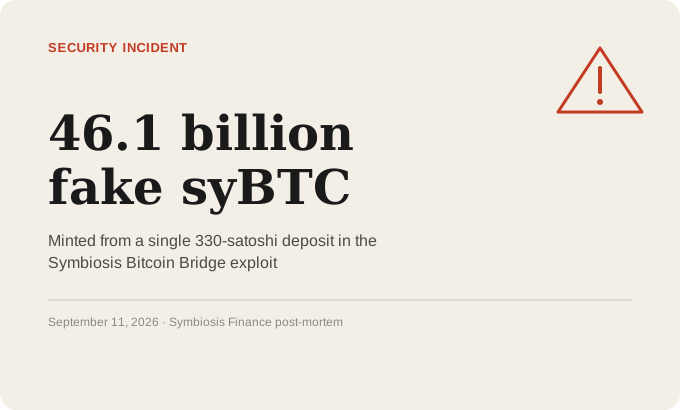
How Did a Hacker Create 46 Billion Fake Bitcoin in the Symbiosis Exploit? Decodes Bitcoin Hacker With WEEX Now
How two Symbiosis bridge bugs let a hacker mint 46.1 billion unbacked syBTC, drain Bitcoin pools and expose critical bridge risks.
This Cycle May Not Be Led by Bitcoin?
Yield Curve Approaches Inversion, TGA and Fed Tools Become New Focus in US Treasury Market

AI Agent Battle Begins: Amazon Blocks Meta's AI Agent, E-commerce Entry War Escalates
![[Interview] Lee Yun-ho, CEO of KIP: "We need to set the stage before the STO market opens... sharing RWA know-how with financial companies"](/public-static/3_1a7f0699b3.png?format=avif)
[Interview] Lee Yun-ho, CEO of KIP: "We need to set the stage before the STO market opens... sharing RWA know-how with financial companies"
Coinmetrics Report: The Competition of Tokenized Stocks and Their Future Development Path
US Bond Market 'Meltdown'... Why Are Interest Rates Soaring?
Sam Price: The Impact of Cryptocurrency Legislation on Market Dynamics
The Quantum Issue: You Never Really Know The Future
Crypto Kidnapping: 6 Suspects Charged in Case Involving a Few Hundred Euros in Val-d’Oise
Security and fees hold back deeper crypto use among wealthy investors: Nexo report
Why leaving your crypto on an exchange is not the same as having it in your own wallet?


