
Bitcoin ETFs Surge Strongly, Reducing Annual Deficit to $1 Billion

 Prefer us on Google


Bitcoin ETFs listed in the United States still show an annual deficit close to $1 billion as of September 8. However, recent dynamics have changed significantly, with nearly $3.8 billion in inflows over three weeks. This acceleration greatly reduces the backlog accumulated since January. It comes after several months marked by significant redemptions. For investors, this evolution primarily demonstrates how quickly flows can alter the annual balance by 2026 and bring the total closer to equilibrium.
In Brief
- American Bitcoin ETFs still report a deficit of about $1 billion since January.
- The funds attracted nearly $3.8 billion in three weeks, significantly reducing this deficit.
- August 2026 marked an annual record with $3.52 billion in net inflows.
- Redemptions of $4.5 billion in June heavily impacted the annual balance.
- Since their launch in January 2024, the ETFs have recorded $55.6 billion in cumulative net inflows.
Since January, American spot Bitcoin ETFs have seen more redemptions than deposits. The deficit reached about $1 billion as of September 8, according to data reported by Cryptopolitan. However, recent weeks have narrowed this gap. Inflows reached approximately $3.8 billion by early September.
The movement has concentrated over a short period rather than several months. On September 3, the funds attracted $730.9 million in a single day. Then, the week ending September 5 generated an additional $986.9 million. This sequence brings the annual total significantly closer to the breakeven point.
August also marked a turning point for this category of funds. Net inflows reached $3.52 billion during the month. This result makes it the best month of the year according to the data. It reversed a trend that had weighed on previous months.
The main deterioration of the annual balance dates back to previous months. Redemptions are estimated to have reached $4.5 billion in June 2026. May already showed losses, which intensified pressure on cumulative flows since January. These outflows then impacted annual results despite the recovery observed in August and September.
The contrast is thus explicitly visible between the beginning of summer and the recent period. Bitcoin ETFs experienced a significant reduction in capital before quickly regaining inflows. This evolution explains why the deficit remains close to $1 billion despite several positive weeks. The current pace plays a central role in the evolution of the annual balance.
The situation concerns several funds followed by investors. BlackRock's IBIT, Fidelity's FBTC, and their competitors remain at the heart of this evolution. The recent increase shows that flows can quickly concentrate over a few sessions. However, results depend on the continuation of this dynamic.
Over a longer period, the balance of Bitcoin ETFs remains very different from that observed in 2026. Since their listing on January 11, 2024, cumulative net inflows have reached approximately $55.6 billion. The category also represents $101.3 billion in assets under management, according to Sosovalue data. These figures on Bitcoin illustrate the gap between the current annual result and the cumulative performance since launch.
BlackRock's IBIT retains the top position among these funds. Fidelity's Wise Origin Fund appears as the driver of the recent increase. ARK 21Shares and Bitwise are also among the affected funds. Meanwhile, Grayscale GBTC continues to lose assets, following the trend observed after its conversion to an open-end fund.
The future will largely depend on the ability of the ETFs to maintain the inflows observed since August. If this pace continues over the coming weeks, the deficit accumulated since January could quickly disappear and give way to a positive annual balance. Conversely, a marked return of redemptions, similar to that recorded in June, could erase some of the recent progress.
The upcoming flows will thus help determine whether the current rebound is merely a catch-up or the beginning of a more sustainable trend. For Bitcoin ETFs, the evolution of incoming and outgoing capital will remain the primary indicator to watch.
-- Price
This content is provided for general informational purposes only and doesn't constitute financial, investment, legal, or tax advice. Any events, rewards, online promotions, or related information mentioned herein should not be considered a recommendation, solicitation, or invitation to purchase, sell, trade, or otherwise deal in any crypto assets. Crypto assets are highly volatile and may result in loss. The availability of WEEX services, products, and related events may vary by region. You are responsible for ensuring that your participation is in accordance with applicable local laws and regulations.
You may also like

Bitcoin, Sports, and Politics: Predictive Markets Target $10 Trillion

AI Agent Jev Expects On-Chain Innovation Through Automated Judgment

The End of the Blank Prompt: Why Trading AI Needs a Playbook

Stablecoins hold nearly $200 billion in US debt, but money funds bought the surge
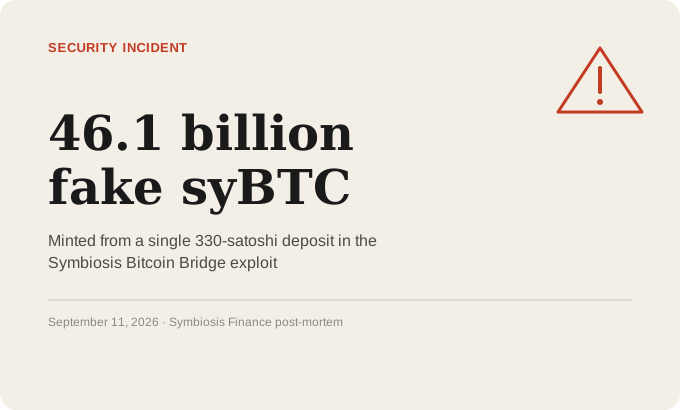
How Did a Hacker Create 46 Billion Fake Bitcoin in the Symbiosis Exploit? Decodes Bitcoin Hacker With WEEX Now
How two Symbiosis bridge bugs let a hacker mint 46.1 billion unbacked syBTC, drain Bitcoin pools and expose critical bridge risks.

CFTC's Selig Emphasizes the Need to Prepare for the Era of Large-Scale Tokenization in the U.S.

The IMF opens an office in Venezuela to supervise an economy that has already migrated to USDT

SOXL Stock Jumped 12% Yesterday: Three Companies Explain the Entire Move

Bitcoin's Hashrate Rises as Miners Reactivate Their Machines

Bitcoin 2x Leveraged ETF Launches on Cboe, But Doesn't Buy Bitcoin: Here's Why

Crypto: The ECB Enters the Tokenized Bond Market
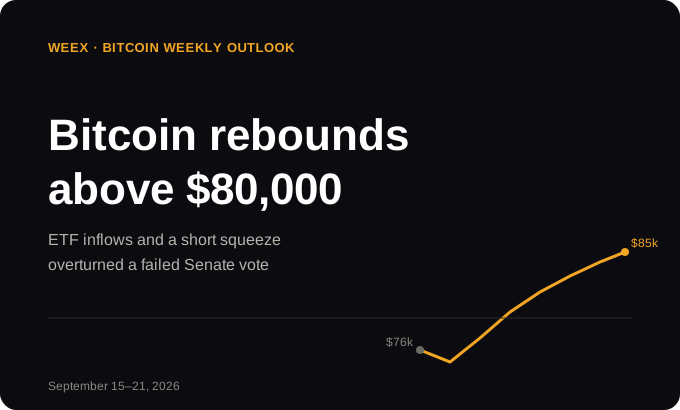
WEEX Bitcoin Weekly Outlook: Why Did Bitcoin Rebound Above $80,000 After the CLARITY Act Vote?
Bitcoin rebounded above $80,000 as SEC and CFTC action, renewed ETF inflows, and a short squeeze outweighed the failed CLARITY Act vote.
Coldcard whitehats move 52.37 BTC to recovery trust

Bitcoin's Rise Does Not Mean the Bull Market Has Returned; Don't Create Stories for Yourself
Deutsche Bank: Markets May Underestimate Rate Peaks After Central Banks' Coordinated Rate Hikes
Hyperliquid Opens Market for Bitcoin Volatility

Tom Lee Discusses Entry into Digital Asset Bull Market and AI Fund Movements

Micron Stock Price Target: Do the $1,500 to $2,000 Estimates Still Make Sense
Micron price targets range from $1,295 consensus to $1,500- lus individual calls, while options pricing implies an 11% swing on September 30 earnings, the actual results will settle which
![[ETH Letter] Ethereum Aims to Activate Sepolia Testnet on October 6](/public-static/26_2e1840f602.png?format=avif)
[ETH Letter] Ethereum Aims to Activate Sepolia Testnet on October 6
Fypher Partners with Korea Medical Tourism Promotion Association for Digital Dollar Payment
TapeOut Ecosystem Overview: From NAND, LATCH to On-Chain Application Ecosystem
[Coin Crime] "If you give us Tether, we will give you oil" - Polish state-owned company falls victim to international fraudsters

Why real-time election odds are misleading prediction market crypto traders

What is PCE and Why September 30 is Important for Cryptocurrencies
Bitcoin: JPMorgan Sees BTC Outperforming Gold

U.S. Treasury Sanctions BitBank Over Iranian Sanctions-Evasion Network

Brazil blocks stablecoins from key cross-border payment rail as $1.1 trillion market faces new limits
RISEx Proposes 20% Retention Condition for Stolen Funds

USDT in Wallets May Be Blocked. What to Do and How to Store Them in Russia

Tokenized stocks face 24/7 pricing gap: RedStone COO
Bitcoin, Sports, and Politics: Predictive Markets Target $10 Trillion
AI Agent Jev Expects On-Chain Innovation Through Automated Judgment
The End of the Blank Prompt: Why Trading AI Needs a Playbook
Stablecoins hold nearly $200 billion in US debt, but money funds bought the surge
How Did a Hacker Create 46 Billion Fake Bitcoin in the Symbiosis Exploit? Decodes Bitcoin Hacker With WEEX Now
How two Symbiosis bridge bugs let a hacker mint 46.1 billion unbacked syBTC, drain Bitcoin pools and expose critical bridge risks.
CFTC's Selig Emphasizes the Need to Prepare for the Era of Large-Scale Tokenization in the U.S.
Contents
Latest articles



Latest coin listings on WEEX


