
China Buys 20 Tons of Gold, Raising Its Reserves to 2366 Tons

 Prefer us on Google


China is no longer content with just gold; it is building the infrastructure for a new monetary order. After 22 consecutive months of acquiring the yellow metal, Beijing is consolidating the bridges between gold and the yuan, while its exposure to U.S. Treasury bonds is declining. We are thus witnessing the beginnings of a "Yuan-Gold" standard that could reduce dependence on the dollar.
In Brief
- China strengthens its gold reserves after 22 consecutive months of accumulation.
- Beijing is developing gold and yuan-related infrastructures, particularly between Hong Kong and Shanghai.
- The internationalization of the yuan and BRICS Pay fuels the debate on an alternative to the dollar-dominated system.
- China is reducing its exposure to U.S. Treasury bonds amid a diversification of its reserves.
- The hypothesis of a yuan-gold standard remains contested, while the dollar retains a dominant place in global reserves.
China Strengthens the Role of Gold in Its Monetary Strategy
China has just accumulated gold for 22 consecutive months. For July, the People's Bank of China (PBoC) announced the addition of 20 tons of gold to its official reserves. Such regular accumulation brings total holdings to nearly 2366 tons, accounting for 8% of China's official reserves. This statistic places Beijing sixth in the world among gold holders, behind the United States, Germany, Italy, France, and Russia.
Hong Kong is said to have set up a government-backed gold compensation system linked to Shanghai. This is the first component of an international network of vaults intended to allow settlements in yuan against gold.
This evolution is tied to China's upcoming presidency of the BRICS and Xi Jinping's announcement of a third "golden decade". Such a reading can be summed up in one formula:
They built the vaults, bought the gold, and named the decade.
Beijing has thus announced the internationalization of the yuan for global trade and settlements. The BRICS Pay payment infrastructure, associated in its narrative with China, Russia, and India, constitutes an alternative to SWIFT and the dollar-dominated system, with a backing of gold. These various elements fuel the thesis of the adoption of a new gold standard by China.
This thesis is based on several interconnected developments:
- China's accumulation of gold for 22 consecutive months;
- A gold compensation system in Hong Kong connected to Shanghai;
- A project for an international network of vaults allowing settlements in yuan against physical metal;
- Increased internationalization of the yuan in trade and settlements;
- BRICS Pay, presented as an alternative to the dollar-dominated system.
The Decline of U.S. Holdings Fuels the Debate on the Dollar
China has sold 70 billion dollars in U.S. Treasury bonds. This is the largest sale since the 2008 financial crisis. Currently, gold has surpassed U.S. Treasuries as a global reserve asset. Thus, this is not an isolated movement. It would participate in a transformation likely to have, in the long term, repercussions on U.S. bond yields.
However, the reading of Chinese holdings in the United States is debated. Thus, U.S. statistics attribute the securities to the country where their custodian is located. Indeed, 618 billion dollars in Treasuries are officially held by China, nearly 450 to 500 billion dollars attributed to Belgium and the Netherlands, and about 460 billion dollars to the Cayman Islands, according to official information.
-- Price
The Hypothesis of a Yuan Linked to Gold Remains Hotly Contested
The assertion that China would officially switch to a new gold standard would be inaccurate for many observers. They contest such a conclusion. They question the idea that BRICS Pay would be backed by gold and remind that the internationalization of the yuan is an old Chinese ambition. Currently, the yuan represents 2% of global reserves, compared to nearly 60% for the dollar.
Beijing may not necessarily have an interest in provoking total dedollarization. A collapse of the greenback would reduce the value of U.S. assets held by China, while a strong appreciation of the yuan would weigh on Chinese exports.
The strategy could thus be more about reducing exposure to the U.S. financial system than a complete break with it. Between diversification of reserves, pursuit of financial autonomy, and a true yuan-gold standard, a decisive step remains to be taken.
This content is provided for general informational purposes only and doesn't constitute financial, investment, legal, or tax advice. Any events, rewards, online promotions, or related information mentioned herein should not be considered a recommendation, solicitation, or invitation to purchase, sell, trade, or otherwise deal in any crypto assets. Crypto assets are highly volatile and may result in loss. The availability of WEEX services, products, and related events may vary by region. You are responsible for ensuring that your participation is in accordance with applicable local laws and regulations.
You may also like

Circle expands CCTP to EURC and cirBTC on Arc

Bitcoin, Sports, and Politics: Predictive Markets Target $10 Trillion

AI Agent Jev Expects On-Chain Innovation Through Automated Judgment

The End of the Blank Prompt: Why Trading AI Needs a Playbook

Stablecoins hold nearly $200 billion in US debt, but money funds bought the surge
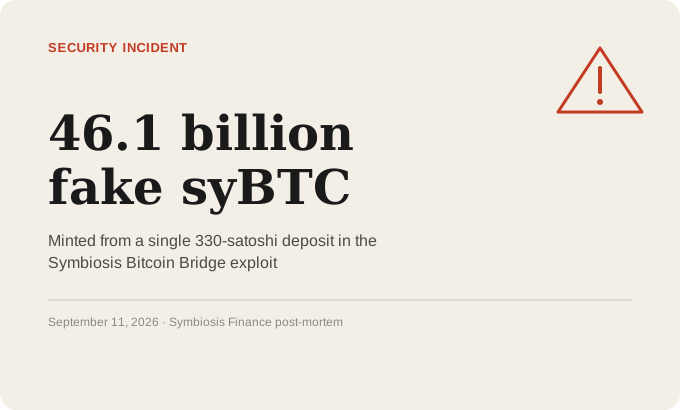
How Did a Hacker Create 46 Billion Fake Bitcoin in the Symbiosis Exploit? Decodes Bitcoin Hacker With WEEX Now
How two Symbiosis bridge bugs let a hacker mint 46.1 billion unbacked syBTC, drain Bitcoin pools and expose critical bridge risks.

CFTC's Selig Emphasizes the Need to Prepare for the Era of Large-Scale Tokenization in the U.S.

The IMF opens an office in Venezuela to supervise an economy that has already migrated to USDT

SOXL Stock Jumped 12% Yesterday: Three Companies Explain the Entire Move

Bitcoin's Hashrate Rises as Miners Reactivate Their Machines

Bitcoin 2x Leveraged ETF Launches on Cboe, But Doesn't Buy Bitcoin: Here's Why

Crypto: The ECB Enters the Tokenized Bond Market
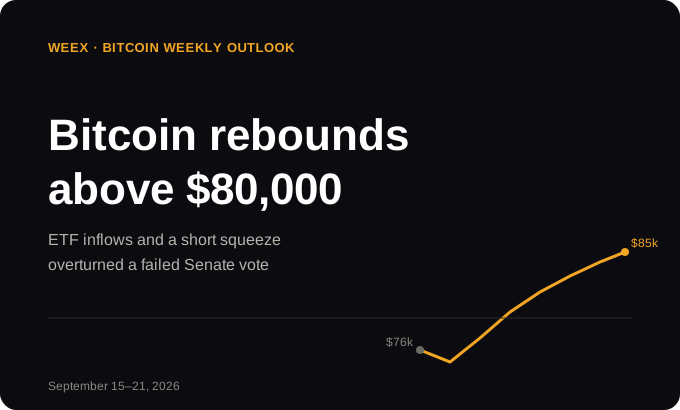
WEEX Bitcoin Weekly Outlook: Why Did Bitcoin Rebound Above $80,000 After the CLARITY Act Vote?
Bitcoin rebounded above $80,000 as SEC and CFTC action, renewed ETF inflows, and a short squeeze outweighed the failed CLARITY Act vote.
Coldcard whitehats move 52.37 BTC to recovery trust

Bitcoin's Rise Does Not Mean the Bull Market Has Returned; Don't Create Stories for Yourself
Deutsche Bank: Markets May Underestimate Rate Peaks After Central Banks' Coordinated Rate Hikes
Hyperliquid Opens Market for Bitcoin Volatility

Tom Lee Discusses Entry into Digital Asset Bull Market and AI Fund Movements

Micron Stock Price Target: Do the $1,500 to $2,000 Estimates Still Make Sense
Micron price targets range from $1,295 consensus to $1,500- lus individual calls, while options pricing implies an 11% swing on September 30 earnings, the actual results will settle which
![[ETH Letter] Ethereum Aims to Activate Sepolia Testnet on October 6](/public-static/26_2e1840f602.png?format=avif)
[ETH Letter] Ethereum Aims to Activate Sepolia Testnet on October 6
Fypher Partners with Korea Medical Tourism Promotion Association for Digital Dollar Payment
TapeOut Ecosystem Overview: From NAND, LATCH to On-Chain Application Ecosystem
[Coin Crime] "If you give us Tether, we will give you oil" - Polish state-owned company falls victim to international fraudsters

Why real-time election odds are misleading prediction market crypto traders

What is PCE and Why September 30 is Important for Cryptocurrencies
Bitcoin: JPMorgan Sees BTC Outperforming Gold

U.S. Treasury Sanctions BitBank Over Iranian Sanctions-Evasion Network
Brazil blocks stablecoins from key cross-border payment rail as $1.1 trillion market faces new limits
RISEx Proposes 20% Retention Condition for Stolen Funds

USDT in Wallets May Be Blocked. What to Do and How to Store Them in Russia
Circle expands CCTP to EURC and cirBTC on Arc
Bitcoin, Sports, and Politics: Predictive Markets Target $10 Trillion
AI Agent Jev Expects On-Chain Innovation Through Automated Judgment
The End of the Blank Prompt: Why Trading AI Needs a Playbook
Stablecoins hold nearly $200 billion in US debt, but money funds bought the surge
How Did a Hacker Create 46 Billion Fake Bitcoin in the Symbiosis Exploit? Decodes Bitcoin Hacker With WEEX Now
How two Symbiosis bridge bugs let a hacker mint 46.1 billion unbacked syBTC, drain Bitcoin pools and expose critical bridge risks.





