
Cryptocurrency Arbitrage and Price Scanning: How Quants Identify Inefficiencies in Funding Rates and Spreads Using Trading APIs

 Prefer us on Google


Cryptocurrency arbitrage scanners utilize trading APIs to compare real-time prices, perpetual futures funding rates, futures basis, and order book liquidity. Rather than predicting the direction of Bitcoin, quants seek market inefficiencies that can persist even after accounting for fees, slippage, funding rate changes, latency, and hedge costs.
A cryptocurrency arbitrage scanner is an automated monitoring system that collects market data, calculates expected returns, and identifies price discrepancies among related products. In its simplest form, it compares the price of the same asset in two different locations. More advanced systems evaluate whether a trade can actually be executed profitably, taking into account practical friction factors.
For quant traders, the visible spread is just the starting point. The crucial question is:
After accounting for all transaction costs and risks, can this price discrepancy be captured at a meaningful size?
A robust scanner typically monitors the following items:
- Spot bid and ask prices
- Perpetual futures prices
- Funding rates and funding times
- Premiums or discounts on futures contracts
- Order book depth
- Transaction fees
- Available margin
- Open positions
- Freshness of market data
- API and execution latency
This is important because the cryptocurrency market is fragmented, highly leveraged, and operates 24/7. A price discrepancy that looks attractive for just a few seconds may disappear before a manual trader can place hedging orders.
Odds scanners compare prices offered for the same outcome across different markets. The goal is not necessarily to predict outcomes but to find situations where pricing inconsistencies create a measurable edge.
Cryptocurrency arbitrage applies this discipline to trading products. Instead of comparing event odds, a cryptocurrency scanner might compare BTC spot and BTC perpetual futures, ETH spot and futures, or funding rates across multiple perpetual contracts. This strategy does not start from bullish or bearish outlooks. The starting point is the question of price. Is there a temporary mismatch between products that should trade at closer prices?
The usefulness of the odds scanning mindset lies in encouraging traders to think in terms of probabilities, execution quality, and net returns, rather than headlines or narratives.
-- Price
This content is provided for general informational purposes only and doesn't constitute financial, investment, legal, or tax advice. Any events, rewards, online promotions, or related information mentioned herein should not be considered a recommendation, solicitation, or invitation to purchase, sell, trade, or otherwise deal in any crypto assets. Crypto assets are highly volatile and may result in loss. The availability of WEEX services, products, and related events may vary by region. You are responsible for ensuring that your participation is in accordance with applicable local laws and regulations.
You may also like

Bitcoin, Sports, and Politics: Predictive Markets Target $10 Trillion

Exclusive Interview with CK Zheng of ZX Squared Capital: How a Wall Street Risk Control Expert Accurately Grasped Market Trends and Outperformed Bitcoin Returns by Double

The End of the Blank Prompt: Why Trading AI Needs a Playbook
Bankless Ventures Partner Claims ZEC Will Attract Bitcoin Funds in 2026

US Bond Market 'Meltdown'... Why Are Interest Rates Soaring?

Sam Price: The Impact of Cryptocurrency Legislation on Market Dynamics

The Quantum Issue: You Never Really Know The Future

Crypto Kidnapping: 6 Suspects Charged in Case Involving a Few Hundred Euros in Val-d’Oise

Security and fees hold back deeper crypto use among wealthy investors: Nexo report

Why leaving your crypto on an exchange is not the same as having it in your own wallet?

Binance Under Scrutiny Again for Iran-Related Trading
Altcoin demand meets $18B threat as flows move into RWA perps as just 19% of traders keep alts
90% of U.S. Treasury Yield Increase Concentrated Around Employment Data and Fed Speeches
Can Kraken's Parent Company Open the Door for Hyperliquid to Enter the U.S. Market?
Gold Price Today in Thailand: XAU/USD Holds Near $4,347 as Key Support Level Tested

Scam AI Bot: 274 ETH Lost in Smart Contract Trap

Why Do You Always Make Small Profits and Then Lose Everything? Taleb Explained It with 'Asymmetric Leverage' Twenty Years Ago
AI has become a tool for a new generation of fraudsters: how deepfakes are stealing millions of dollars - research

Can SOXL Reach $160 as AI and Semiconductor Stocks Rally?
Can PEPE Reach $0.000006 as Meme Coin Momentum Returns?
Meta's Muse: A Slightly Smarter Version of 'AI Ordering Coffee'

Over 70% of South Korean Crypto Investors Oppose Crypto Tax: What Are Their Concerns?

Howard Marks: U.S. Fiscal Discipline Out of Control, Buying Bonds to Suppress Yields is Just 'Putting Ice Packs on a Feverish Patient'
Bitget Conversations with Trader Shiguang: Seeking the Discrepancy Between Price and Value

AI and Crypto: Why BlackRock Sees a Major Convergence

Nomura Warns of 'Double Whammy' Risk: The Next Market Storm May Start with Interest Rate Volatility
What is Travix? An on-chain omnibroker combining AI trading and blockchain verification
VVV Hits All-Time High: Founder’s Perspective on Models, Privacy, and Crypto
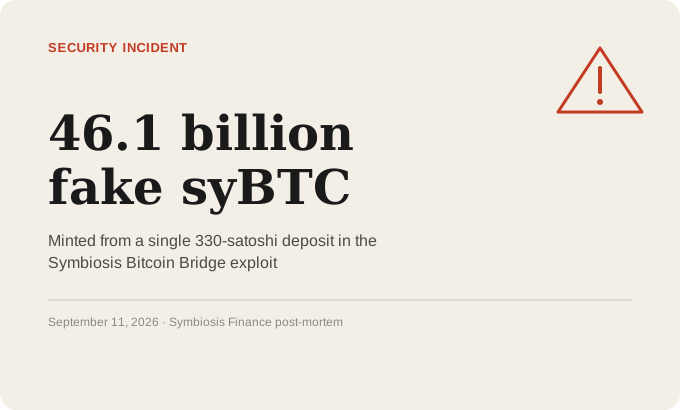
How Did a Hacker Create 46 Billion Fake Bitcoin in the Symbiosis Exploit? Decodes Bitcoin Hacker With WEEX Now
How two Symbiosis bridge bugs let a hacker mint 46.1 billion unbacked syBTC, drain Bitcoin pools and expose critical bridge risks.
This Cycle May Not Be Led by Bitcoin?
Bitcoin, Sports, and Politics: Predictive Markets Target $10 Trillion
Exclusive Interview with CK Zheng of ZX Squared Capital: How a Wall Street Risk Control Expert Accurately Grasped Market Trends and Outperformed Bitcoin Returns by Double
The End of the Blank Prompt: Why Trading AI Needs a Playbook
Bankless Ventures Partner Claims ZEC Will Attract Bitcoin Funds in 2026
US Bond Market 'Meltdown'... Why Are Interest Rates Soaring?
Sam Price: The Impact of Cryptocurrency Legislation on Market Dynamics


