
Ether.fi Cash Spending Reaches $103 Million, Buyback Proposal Vote Concludes

 Prefer us on Google


Ether.fi's cash spending for July reached $103 million (approximately 135.4 billion KRW). The staking-focused protocol is expanding its business scope by bundling card payments, transactions, and loans into an on-chain financial account, with the structure of returning profits in Ether.fi (ETHFI) tokens becoming a key issue.
According to Paymentscan, Ether.fi's monthly spending increased from $54.3 million in January to $103 million in July. During the same period, the number of monthly active addresses rose from 21,898 to 40,040. The spending per address saw little change, moving from $2,479 to $2,505.
Most of the increase in spending is attributed to the expansion of the user base. The card spending market tracked by Paymentscan grew by 81% during the same period, and Ether.fi's market share slightly increased from 9.5% to 9.7%. Paymentscan explained that the aggregated data includes self-reported off-chain data, and some card markets were excluded from the sample.
On August 13, Ether.fi launched a new app that includes tokenized stock and metal trading, AAVE-integrated lending markets, and over 30 currencies and payment methods. The company reported that its membership exceeded 500,000, with an annual transaction execution rate reaching $2 billion (approximately 27 trillion KRW). Tokenized stock and metal trading are not available in some markets, including the U.S.
This shift in direction moves away from a structure that only explained profits through staking rewards. Users can store assets in self-custody vaults and use them as collateral to secure liquidity for cash card payments. The trading function adds cryptocurrency and tokenized asset trading, while the lending function connects to AAVE-based markets.
Earlier, it was reported that Ether.fi's new app added features for trading tokenized assets, portfolio-backed loans, and fiat currency account functionalities. The focus of that report was on the structure that allows users to trade assets, recognize collateral, and execute on-chain paths within the app, rather than the RWA products themselves.
The revenue structure has also changed. According to DefiLlama, Ether.fi's adapter estimates cash revenue at 1.38% of spending. If annual spending reaches $1 billion, the company's revenue before expenses would be $13.8 million (approximately 18.6 billion KRW).
Alea Research reported that as of August 30, Ether.fi's 30-day moving annualized revenue was $38.5 million (approximately 52 billion KRW), with cash accounting for $17.6 million (approximately 23.8 billion KRW). Although cash's annualized execution rate has nearly doubled since January 1, the total tracked revenue has decreased by 22% due to weakened staking and falling ETH prices.
A proposal submitted to AAVE governance on July 14 suggested a protocol fee distribution of 80% to Ether.fi and 20% to AAVE for the Ether.fi exclusive market. This distribution applies to protocol fees excluding the principal of loans and interest paid to lenders. If lending is linked to cash spending, card spending, swaps, staking, and loan fees will be bundled within one account.
The ETHFI buyback proposal is a mechanism to return this revenue in tokens. Alea Research reported that the Ether.fi Foundation proposed on August 30 to use the contributions from card, swap, and staking revenues for weekly ETHFI buybacks through CoW Swap. Based on July data, the example indicates a monthly buyback of $1.33 million, or an annualized $16 million (approximately 21.6 billion KRW). This figure is an example before approval and execution and is the amount before user reward distribution.
The proposal's example specifically outlined the flow of fees. If a swap of $10,000 (approximately 13.5 million KRW) incurs a 0.5% fee, a total of $50 would be generated. Of this, $20 would be retained by Labs, and the remaining $30 would be used for ETHFI buybacks. Of the buyback amount, $15 would remain in the foundation's treasury, and $15 would be allocated for user rewards.
The proposal also included provisions to allow the treasury to use up to 20 million ETHFI to cover any shortfall in rewards. The foundation can adjust the distribution of rewards and fees, as well as the speed of buybacks. However, the actual impact of this structure on token holders can only be assessed once the actual contribution amounts and reward distribution methods are confirmed.
Token prices and business metrics have not moved in the same direction. Alea Research noted that ETHFI rebounded by 45% from August 13 to August 30, reaching $0.55, but is still 21% lower compared to January 1. The reference value, based on the same price and a maximum supply of 1 billion, was calculated at $545 million (approximately 735.8 billion KRW).
The voting on the Ether.fi Foundation proposal concluded on September 3. The proposal included a quorum of 1 million ETHFI. Alea Research reported that as of August 31, voting rights were approximately 245,800 ETHFI, about 25% of the quorum.
For domestic investors, this matter aligns with the trend of combining tokenized asset trading, self-custody payments, and collateralized loans within one account. However, the buyback resources are an example before company expenses and user reward distribution, and ETHFI holders do not have a claim to equity in Labs. The next points to verify are whether the vote is valid, the actual execution method, and the scale of contributions.
-- Price
This content is provided for general informational purposes only and doesn't constitute financial, investment, legal, or tax advice. Any events, rewards, online promotions, or related information mentioned herein should not be considered a recommendation, solicitation, or invitation to purchase, sell, trade, or otherwise deal in any crypto assets. Crypto assets are highly volatile and may result in loss. The availability of WEEX services, products, and related events may vary by region. You are responsible for ensuring that your participation is in accordance with applicable local laws and regulations.
You may also like
Is the 1 Billion POL Burn Just a Joke?

Bitcoin Pulls Back From $87,000| WEEX TradFi Daily Brief (September 24, 2026)
Bitcoin pulled back from about $87,000 to about $84,000, with Ethereum near $2,680. S&P Global PMI on September 23 ET far exceeded forecasts. The 10-year yield broke above 5.00%, while the 5-year and 30-year touched highs last seen in 2007 and 2004. The S&P 500 and Nasdaq slipped. Energy moved with oil and crypto-treasury stocks followed bitcoin lower. Investors await earnings from COST, BB, and others.

WEEX Exclusive:Bitcoin Pulls Back From $87,000| WEEX TradFi Daily Brief (September 24, 2026)
MIT Warns AI Bubble May Require 2.7x Productivity Increase by 2030
Davie Reveals BTC Strategy Data, Volume 205.42K, Rate +0.0016%

Stablecoins hold nearly $200 billion in US debt, but money funds bought the surge

Coin Metrics revises 19 months of Bitcoin ETF wallet data

HTX Research Analyst WZ: Crypto Market Pricing Extends Beyond Crypto, Regulation and Liquidity Become Key Variables

Ye Tan: The Internet Era is Coming to an End, the AI Era has Already Begun

Chainalysis: Crypto Economic Activity Down 1.6%, Market Value Shrinks by $2.1 Trillion

$1.7 Billion Inflow to Bitcoin ETFs in Two Days

Why Do You Always Make Small Profits and Then Lose Everything? Taleb Explained It with 'Asymmetric Leverage' Twenty Years Ago

Coinbase traced $1.1 million crypto trail behind AI phishing service EvilTokens
Over 70% of South Korean Crypto Investors Oppose Crypto Tax: What Are Their Concerns?
Nomura Warns of 'Double Whammy' Risk: The Next Market Storm May Start with Interest Rate Volatility

VVV Hits All-Time High: Founder’s Perspective on Models, Privacy, and Crypto

Binance Research Team: A Bull Market Requires the Resonance of Monetary Easing and Paradigm Innovation, with RWA as a Key Driving Force

Bitpace Partners with Fireblocks for Cross-Border Payments with Stablecoins
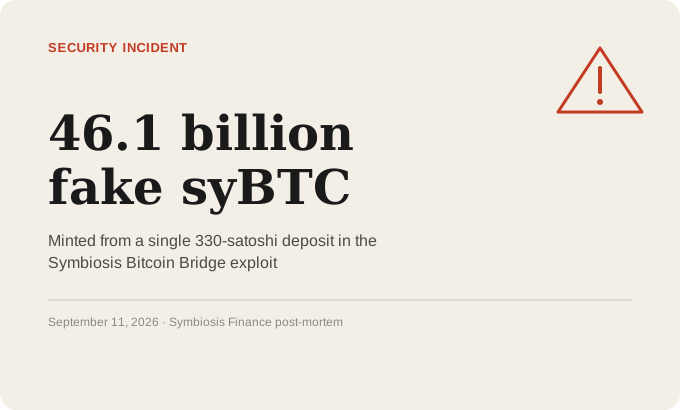
How Did a Hacker Create 46 Billion Fake Bitcoin in the Symbiosis Exploit? Decodes Bitcoin Hacker With WEEX Now
How two Symbiosis bridge bugs let a hacker mint 46.1 billion unbacked syBTC, drain Bitcoin pools and expose critical bridge risks.
[Interview] Lee Yun-ho, CEO of KIP: "We need to set the stage before the STO market opens... sharing RWA know-how with financial companies"
What is Fin.com? Understanding Cross-Border Payment Infrastructure via API

Uniswap (UNI) Price Jumps Toward $10 as CME Futures Launch Nears: What Traders Need to Know
Bernstein Research Report: Why Can Gold Still Surge to $5,700 Even with Continued Rate Hikes by the Fed?
Masayoshi Son is borrowing money again, betting billions on OpenAI

Hashed invests in $300 million digital-asset private credit fund
The IMF opens an office in Venezuela to supervise an economy that has already migrated to USDT

The Link Between Bitcoin and Stocks Strengthened by ETF Effects
Crypto firms still face full AML rules after CLARITY Act vote
Discord Cointribune: The New Crypto Hub of France?
Glassnode Indicates Shift Towards Altcoin Season
Is the 1 Billion POL Burn Just a Joke?
Bitcoin Pulls Back From $87,000| WEEX TradFi Daily Brief (September 24, 2026)
Bitcoin pulled back from about $87,000 to about $84,000, with Ethereum near $2,680. S&P Global PMI on September 23 ET far exceeded forecasts. The 10-year yield broke above 5.00%, while the 5-year and 30-year touched highs last seen in 2007 and 2004. The S&P 500 and Nasdaq slipped. Energy moved with oil and crypto-treasury stocks followed bitcoin lower. Investors await earnings from COST, BB, and others.
WEEX Exclusive:Bitcoin Pulls Back From $87,000| WEEX TradFi Daily Brief (September 24, 2026)
MIT Warns AI Bubble May Require 2.7x Productivity Increase by 2030
Davie Reveals BTC Strategy Data, Volume 205.42K, Rate +0.0016%
Stablecoins hold nearly $200 billion in US debt, but money funds bought the surge
Contents
Latest articles


Latest coin listings on WEEX


