
Fed Balance Sheet at 21% of GDP: Central Banks Deflate, Liquidity Persists

 Prefer us on Google


Stored away, the pipe from 2020. Not cut. The latest weekly report from the Fed (H.4.1, published every Thursday) confirms the trend that has been underway for two years: major central banks are deflating their balance sheets inflated by Covid, each at its own pace. However, this has nothing to do with a return to the pre-2020 world. Key points of this article: * Major central banks, including the Fed, have deflated their massive balance sheets accumulated during the Covid crisis, marking a notable change from 2020. * The U.S. Treasury has taken over from central banks by purchasing debt to influence market liquidity, a role previously played by the Fed. According to the Federal Reserve, its assets accounted for 21% of U.S. GDP at the end of March 2026, down from a peak of nearly 37% in 2021. The balance sheet remains considerable: approximately $6.73 trillion as of August 26, according to the latest H.4.1 report cited by The Kobeissi Letter. Thus, it is far from negligible. In the spring of 2020, the Fed doubled its balance sheet in a few months to prevent the collapse of the U.S. bond market. Six years later, the urgency has disappeared. The stock of accumulated assets has remained on the books. A similar movement is seen elsewhere, albeit at different speeds. The ECB has fallen below 40% of Eurozone GDP, a first since the first quarter of 2020, far from the 65% reached in 2022. The Bank of Japan still hovers around 103% of Japanese GDP, down from a peak of nearly 130% in 2021. As the guardian of the world's most massive quantitative easing program, the BoJ is deflating. Nevertheless, it still holds a colossal lead over its Western counterparts. The Bank of England has dropped to about 21% of British GDP, a floor not seen since 2016, after peaking at 40% in 2021. And while the post-Covid stimulus has largely faded, liquidity has not disappeared. It has simply changed taps. Quantitative tightening (QT, the voluntary reduction of a central bank's balance sheet) is over or has significantly slowed in most areas. Bank reserves are still described as "ample" by the Fed itself, preventing any hiccups in the repurchase agreement (repo) market, where the fall of 2019 had already turned into panic. Most importantly, the U.S. Treasury has taken over, with Scott Bessent now buying up to $4 billion of long-term debt per operation, while the Treasury General Account (TGA, the federal government's cash held at the Fed) hovers around $950 billion in mobilizable reserves. This allows the market to be watered without the Fed needing to reopen the pipe. This mechanism explains why the price of Bitcoin rose after the announcement of Bessent's buybacks, not after a monetary policy decision from the Fed. Confusing the two is like applauding the wrong orchestra. The channel has changed shape. It is no longer the central bank that prints; it is the Treasury buying back its own debt to loosen the grip on long-term rates. The shortcut circulating, that of a dead stimulus that would mechanically condemn Bitcoin, overlooks one detail. The asset has risen during the monetary tightening phases of the past four years, not just during QE. Its short-term price follows the net liquidity flows, those that enter and exit the system day by day, much more than the gross size of a central bank balance sheet that has been frozen for months. Central banks have stored away the pipe from 2020. The tap has now passed to the Treasury. Kevin Warsh, the new Fed chair, will hold his inaugural speech this Friday, August 28, in Jackson Hole, before a market that is paying less attention to his words on rates than to those about who, between the Fed or Bessent, will truly steer liquidity in 2027.
-- Price
This content is provided for general informational purposes only and doesn't constitute financial, investment, legal, or tax advice. Any events, rewards, online promotions, or related information mentioned herein should not be considered a recommendation, solicitation, or invitation to purchase, sell, trade, or otherwise deal in any crypto assets. Crypto assets are highly volatile and may result in loss. The availability of WEEX services, products, and related events may vary by region. You are responsible for ensuring that your participation is in accordance with applicable local laws and regulations.
You may also like

Circle expands CCTP to EURC and cirBTC on Arc

Bitcoin, Sports, and Politics: Predictive Markets Target $10 Trillion

AI Agent Jev Expects On-Chain Innovation Through Automated Judgment

The End of the Blank Prompt: Why Trading AI Needs a Playbook

Stablecoins hold nearly $200 billion in US debt, but money funds bought the surge
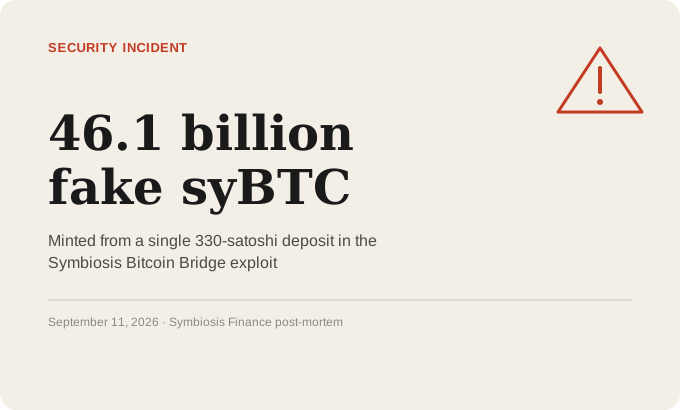
How Did a Hacker Create 46 Billion Fake Bitcoin in the Symbiosis Exploit? Decodes Bitcoin Hacker With WEEX Now
How two Symbiosis bridge bugs let a hacker mint 46.1 billion unbacked syBTC, drain Bitcoin pools and expose critical bridge risks.

CFTC's Selig Emphasizes the Need to Prepare for the Era of Large-Scale Tokenization in the U.S.

The IMF opens an office in Venezuela to supervise an economy that has already migrated to USDT

SOXL Stock Jumped 12% Yesterday: Three Companies Explain the Entire Move

Bitcoin's Hashrate Rises as Miners Reactivate Their Machines

Bitcoin 2x Leveraged ETF Launches on Cboe, But Doesn't Buy Bitcoin: Here's Why

Crypto: The ECB Enters the Tokenized Bond Market
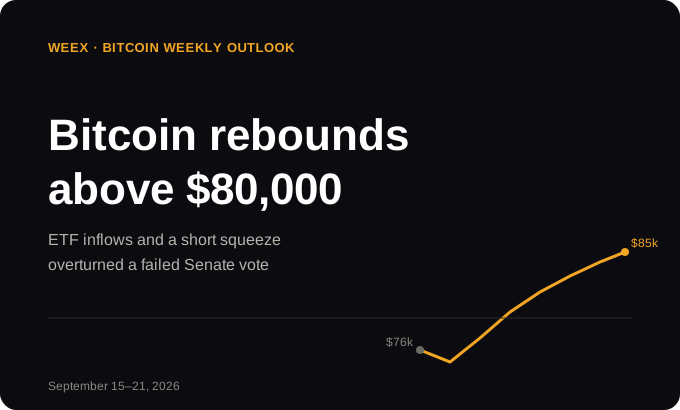
WEEX Bitcoin Weekly Outlook: Why Did Bitcoin Rebound Above $80,000 After the CLARITY Act Vote?
Bitcoin rebounded above $80,000 as SEC and CFTC action, renewed ETF inflows, and a short squeeze outweighed the failed CLARITY Act vote.
Coldcard whitehats move 52.37 BTC to recovery trust

Bitcoin's Rise Does Not Mean the Bull Market Has Returned; Don't Create Stories for Yourself
Deutsche Bank: Markets May Underestimate Rate Peaks After Central Banks' Coordinated Rate Hikes
Hyperliquid Opens Market for Bitcoin Volatility

Tom Lee Discusses Entry into Digital Asset Bull Market and AI Fund Movements

Micron Stock Price Target: Do the $1,500 to $2,000 Estimates Still Make Sense
Micron price targets range from $1,295 consensus to $1,500- lus individual calls, while options pricing implies an 11% swing on September 30 earnings, the actual results will settle which
![[ETH Letter] Ethereum Aims to Activate Sepolia Testnet on October 6](/public-static/26_2e1840f602.png?format=avif)
[ETH Letter] Ethereum Aims to Activate Sepolia Testnet on October 6
Fypher Partners with Korea Medical Tourism Promotion Association for Digital Dollar Payment
TapeOut Ecosystem Overview: From NAND, LATCH to On-Chain Application Ecosystem
[Coin Crime] "If you give us Tether, we will give you oil" - Polish state-owned company falls victim to international fraudsters

Why real-time election odds are misleading prediction market crypto traders

What is PCE and Why September 30 is Important for Cryptocurrencies
Bitcoin: JPMorgan Sees BTC Outperforming Gold

U.S. Treasury Sanctions BitBank Over Iranian Sanctions-Evasion Network
Brazil blocks stablecoins from key cross-border payment rail as $1.1 trillion market faces new limits
RISEx Proposes 20% Retention Condition for Stolen Funds

USDT in Wallets May Be Blocked. What to Do and How to Store Them in Russia
Circle expands CCTP to EURC and cirBTC on Arc
Bitcoin, Sports, and Politics: Predictive Markets Target $10 Trillion
AI Agent Jev Expects On-Chain Innovation Through Automated Judgment
The End of the Blank Prompt: Why Trading AI Needs a Playbook
Stablecoins hold nearly $200 billion in US debt, but money funds bought the surge
How Did a Hacker Create 46 Billion Fake Bitcoin in the Symbiosis Exploit? Decodes Bitcoin Hacker With WEEX Now
How two Symbiosis bridge bugs let a hacker mint 46.1 billion unbacked syBTC, drain Bitcoin pools and expose critical bridge risks.





