
Fed Hikes Rates to 4% for the First Time in Three Years — And Why WEEX's "One Account, All Markets" Is Built for This Exact Moment

 Prefer us on Google


TL;DR
- The decision: The Fed voted 12-0 to raise rates 25bps to 3.75%–4.00% on September 16, 2026 — its first hike since 2023.
- The signal: The updated dot plot puts the median rate at 4.1% through both 2026 and 2027 — more hikes may be coming, and cuts aren't currently on the table.
- The market reaction: The Dow fell 1.21%, the S&P 500 dropped 0.45%, the Nasdaq was roughly flat, and the 10-year Treasury yield pushed back above 5%.
- The chip stock split: Nvidia and AMD edged higher, while Intel jumped on reports of SK Hynix talks over memory chip production — proof that stock-specific news can move against the macro grain.
- The WEEX angle: With markets moving across stocks, metals, indices, commodities, and crypto all at once, WEEX's "One Account. All Markets." design lets traders access roughly 300 TradFi assets alongside crypto — no separate brokerage account, no switching platforms.
The Rate Decision: A Unanimous Hike, and a Dot Plot That Isn't Done Yet
On September 16, 2026, the Federal Open Market Committee voted 12-0 to raise the federal funds target range by 25 basis points to 3.75%–4.00%, marking the Fed's first rate increase since July 2023.
The Committee's statement described the economy as expanding at a solid pace, with consumer spending resilient, productivity growth strong, and job gains keeping pace with a growing labor force — while explicitly framing the hike as a move to support "a timelier return of inflation to 2 percent."
What matters more than the hike itself is where officials think rates are headed next. The updated Summary of Economic Projections put the median federal funds rate at 4.1% for both year-end 2026 and year-end 2027 — up sharply from June's projections — implying the Fed isn't finished tightening and isn't currently penciling in cuts for next year either.
In its implementation notes released alongside the decision, the Fed also lifted the interest rate paid on reserve balances to 3.90%, effective September 17, 2026. In short: this wasn't a one-and-done move — it was the Fed re-opening a tightening cycle that markets had assumed was long over.
Wall Street's Reaction: Stocks Slip, Yields Break Above 5%
Markets don't wait for confirmation — they price the path immediately, and September 16 was no exception. All three major indexes closed lower after the decision: the Dow Jones Industrial Average fell 1.21% to 51,461.90, the S&P 500 dropped 0.45% to 7,551.81, and the Nasdaq Composite slipped a marginal 0.01% to 25,978.42, essentially flat as tech held up better than the broader market.
Bond markets moved even more decisively: the 10-year Treasury yield pushed back above 5%, extending a climb that had already taken it to its highest level since the 2008 financial crisis earlier in the week. The message from the bond market was unambiguous: with the Fed's own dots pointing to 4.1% through 2027, "higher for longer" is now the base case, not just a hedge.
The takeaway for traders isn't "sell everything" — it's that volatility clusters around policy pivots, and that's exactly the kind of environment where being able to react across multiple asset classes at once, rather than being stuck in a single market, becomes a real edge.
-- Price
The Chip Stock Divergence: One Fed Decision, Two Very Different Stories
Not every stock reads a rate hike the same way, and September 16 was a clean example of company-specific news overriding the macro mood. Nvidia rose 0.8% and AMD climbed 1.6%, clawing back some of their losses from earlier in the week even as the broader market fell on the Fed news. The real standout, though, was Intel, which jumped roughly 3.75%–5% intraday on reports that South Korea's SK Hynix is in talks to manufacture memory chips at Intel's long-delayed Ohio facility — a deal that could see SK Hynix lease part of the plant or form a joint venture with major cloud companies to secure memory supply. Both companies were careful to stress the talks remain exploratory, with SK Hynix stating plainly that "no matters have been determined at this stage."
Optical networking names tied to the AI buildout also moved sharply, with Lumentum and Coherent both posting strong gains as capital rotated back into AI infrastructure plays even on a day when the broader tape was red. The lesson here is a familiar one for anyone trading through a Fed cycle: macro sets the tone, but idiosyncratic catalysts — M&A speculation, AI capex headlines, supply chain deals — can send individual names in the opposite direction entirely. Capturing both the macro hedge and the stock-specific opportunity in real time usually means having exposure to indexes, single stocks, and alternative assets side by side, not siloed across separate brokerage logins.
Why This Is Exactly the Moment for "One Account. All Markets."
Nights like September 16 reveal a structural problem most traders live with: the Fed moves markets everywhere at once, but most platforms only let you react in one place. A trader who wanted to hedge equity exposure with gold, rotate into an AI semiconductor stock, and simultaneously manage a BTC position on the same news cycle would typically need a stock brokerage account, a separate metals or futures account, and a crypto exchange login — three logins, three KYC processes, three withdrawal queues. WEEX's TradFi market was built specifically to remove that friction.
On WEEX, traders can access roughly 300 TradFi assets directly alongside crypto, spanning:
- Spot-style stock and ETF trading — including names like Tesla, Dell, Palantir, GE Vernova, SanDisk, SK Hynix, and Micron, plus ETFs such as SPY, QQQ, and the semiconductor-focused SOXX
- USDT-margined stock futures — with the same underlying names (SanDisk, SpaceX, Intel, Micron and more) tradable as perpetual contracts, some with leverage up to 100x
- Precious metals — gold (XAU), tokenized gold (PAXG), silver (XAG), platinum, palladium, copper and nickel, with select metals contracts offering up to 400x leverage
- Global indices — including the S&P 500 and semiconductor-sector indices, tradable the same way as crypto perpetuals
- Commodities — Brent and WTI crude oil, and natural gas, letting traders react to energy-driven inflation narratives (like the ones Fed Chair Kevin Warsh has flagged) without leaving the platform
This is the practical meaning behind One Account. All Markets. — a single login, a single balance, and a single interface for moving between a Tesla position, a gold hedge, an S&P 500 index trade, and a Bitcoin perpetual, all without switching apps, re-verifying identity, or waiting on a transfer between exchanges. When a Fed decision moves equities, bonds, commodities, and crypto simultaneously — as it did on September 16 — the platform that lets you act on all of it in one place isn't a convenience. It's a genuine trading advantage.
Quick Takeaway for WEEX Traders
The Fed's first hike in three years wasn't just about 25 basis points — it was a signal that the tightening cycle markets thought was closed is very much still open, with ripple effects spanning equities, bonds, and individual stocks that reacted in opposite directions on the very same day. In a market that trades everything at once, the traders who move fastest are the ones who don't have to choose which market to watch. That's the whole idea behind WEEX: one account, every market, minimal friction — because the next Fed headline won't wait for you to log into three different apps.
About WEEX
Founded in 2018, WEEX has developed into a global crypto exchange with over 10 million users across more than 170 countries. The platform emphasizes security, liquidity, and usability, providing 1,700+ spot trading pairs and offering up to 400x leverage in crypto futures trading. In addition to the traditional spot and derivatives markets, WEEX is expanding rapidly in the AI era delivering real time AI news, empowering users with AI trading tools, and exploring innovative trade to earn models that make intelligent trading more accessible to everyone. Its 1,000 BTC Protection Fund further strengthens asset safety and transparency, while features such as copy trading and advanced trading tools allow users to follow professional traders and experience a more efficient, intelligent trading journey.
Follow WEEX on social media
Instagram: @WEEX Exchange
Tiktok: @weex_global
Youtube: @WEEX_Official
Discord: WEEX Community
Telegram: WeexGlobal Group
This content is provided for general informational purposes only and doesn't constitute financial, investment, legal, or tax advice. Any events, rewards, online promotions, or related information mentioned herein should not be considered a recommendation, solicitation, or invitation to purchase, sell, trade, or otherwise deal in any crypto assets. Crypto assets are highly volatile and may result in loss. The availability of WEEX services, products, and related events may vary by region. You are responsible for ensuring that your participation is in accordance with applicable local laws and regulations.
You may also like

Bitcoin, Sports, and Politics: Predictive Markets Target $10 Trillion
Exclusive Interview with CK Zheng of ZX Squared Capital: How a Wall Street Risk Control Expert Accurately Grasped Market Trends and Outperformed Bitcoin Returns by Double

The End of the Blank Prompt: Why Trading AI Needs a Playbook
Bankless Ventures Partner Claims ZEC Will Attract Bitcoin Funds in 2026

US Bond Market 'Meltdown'... Why Are Interest Rates Soaring?
Sam Price: The Impact of Cryptocurrency Legislation on Market Dynamics

The Quantum Issue: You Never Really Know The Future
Crypto Kidnapping: 6 Suspects Charged in Case Involving a Few Hundred Euros in Val-d’Oise

Security and fees hold back deeper crypto use among wealthy investors: Nexo report

Why leaving your crypto on an exchange is not the same as having it in your own wallet?
Binance Under Scrutiny Again for Iran-Related Trading
Altcoin demand meets $18B threat as flows move into RWA perps as just 19% of traders keep alts
90% of U.S. Treasury Yield Increase Concentrated Around Employment Data and Fed Speeches
Can Kraken's Parent Company Open the Door for Hyperliquid to Enter the U.S. Market?
Gold Price Today in Thailand: XAU/USD Holds Near $4,347 as Key Support Level Tested

Scam AI Bot: 274 ETH Lost in Smart Contract Trap
Why Do You Always Make Small Profits and Then Lose Everything? Taleb Explained It with 'Asymmetric Leverage' Twenty Years Ago
AI has become a tool for a new generation of fraudsters: how deepfakes are stealing millions of dollars - research

Can SOXL Reach $160 as AI and Semiconductor Stocks Rally?
Can PEPE Reach $0.000006 as Meme Coin Momentum Returns?
Meta's Muse: A Slightly Smarter Version of 'AI Ordering Coffee'

Over 70% of South Korean Crypto Investors Oppose Crypto Tax: What Are Their Concerns?

Howard Marks: U.S. Fiscal Discipline Out of Control, Buying Bonds to Suppress Yields is Just 'Putting Ice Packs on a Feverish Patient'
Bitget Conversations with Trader Shiguang: Seeking the Discrepancy Between Price and Value

AI and Crypto: Why BlackRock Sees a Major Convergence
Nomura Warns of 'Double Whammy' Risk: The Next Market Storm May Start with Interest Rate Volatility
What is Travix? An on-chain omnibroker combining AI trading and blockchain verification
VVV Hits All-Time High: Founder’s Perspective on Models, Privacy, and Crypto
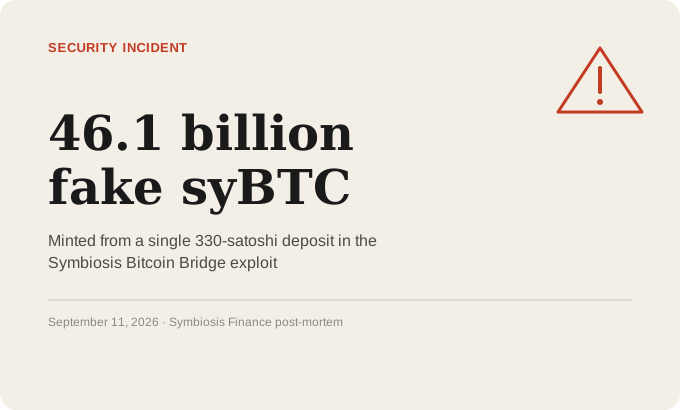
How Did a Hacker Create 46 Billion Fake Bitcoin in the Symbiosis Exploit? Decodes Bitcoin Hacker With WEEX Now
How two Symbiosis bridge bugs let a hacker mint 46.1 billion unbacked syBTC, drain Bitcoin pools and expose critical bridge risks.
This Cycle May Not Be Led by Bitcoin?
Bitcoin, Sports, and Politics: Predictive Markets Target $10 Trillion
Exclusive Interview with CK Zheng of ZX Squared Capital: How a Wall Street Risk Control Expert Accurately Grasped Market Trends and Outperformed Bitcoin Returns by Double
The End of the Blank Prompt: Why Trading AI Needs a Playbook
Bankless Ventures Partner Claims ZEC Will Attract Bitcoin Funds in 2026
US Bond Market 'Meltdown'... Why Are Interest Rates Soaring?
Sam Price: The Impact of Cryptocurrency Legislation on Market Dynamics


