
Ondo Turns Away from Its L1 Blockchain and Now Focuses on Off-Chain Execution

 Prefer us on Google


Ondo Finance launched Ondo Network, an off-chain execution network that replaces the L1 blockchain announced in 2025, on Monday, July 27. The real asset tokenization platform believes that a dedicated blockchain is no longer necessary today. This shift reignites the debate on the actual utility of on-chain infrastructures for traditional finance.
In Brief
- Ondo Network takes the place of Ondo Chain, the L1 blockchain for institutions unveiled in February 2025.
- Transactions go through secure enclaves (TEEs) rather than distributed validator nodes.
- JPMorgan and Chainlink had completed the first transaction of the Ondo Chain testnet, a settlement of tokenized Treasury bonds.
An Unexpected Pivot
Ondo Finance made a significant impact in February 2025 by unveiling Ondo Chain, a layer 1 blockchain designed to host traditional financial assets in tokenized form. A few months later, the platform reached the testnet stage and completed a notable inaugural transaction: a settlement of tokenized U.S. Treasury bonds, orchestrated by JPMorgan through its subsidiary Kinexys and the decentralized oracle Chainlink.
On Monday, July 27, 2026, Ondo Finance unveiled Ondo Network, a system that abandons the classic blockchain architecture for secure computing enclaves, the Trusted Execution Environments. The company is straightforward: "This is not a blockchain today, and it is not necessary," said Ondo.
A classic blockchain mobilizes a network of computers that collectively validate transactions and maintain a shared state. Ondo Network operates differently. The trading software runs in protected enclaves, environments where data remains encrypted even against the host operating system.
Transfers still land on public blockchains at the end of the process. However, Ondo did not specify the identity or number of the operators of these enclaves. This silence on governance raises questions about the actual decentralization of the network.
Ondo Network is already running Ondo Perps, the company's perpetual futures platform. Hedging and speculation on tokenized assets thus follow this off-chain circuit, with a final on-chain settlement.
Do Institutions Really Need Dedicated Blockchains?
Ondo Finance's turnaround is not just a case study. It challenges the notion that institutions will massively adopt custom-built blockchains. Ondo Chain illustrates a dilemma: on-chain infrastructures offer transparency and decentralization, but their operational heaviness drives the search for lighter alternatives.
The fact that JPMorgan, Chainlink, and Ondo successfully completed a test transaction in 2025 makes this episode more notable. The testnet held up, and the technology worked. Yet, Ondo chose to stop the expenses.
Other institutional tokenization projects might recalibrate their ambitions if an actor of this caliber concludes that a dedicated L1 is not worth its complexity. The promise of a blockchain for each class of financial assets recedes in favor of a more down-to-earth logic: off-chain execution, on-chain settlement.
In summary, Ondo Finance prioritizes operational efficiency over blockchain orthodoxy. The tokenization of real assets continues to attract finance giants, the U.S. regulator is refining its framework for stablecoins, and on-chain derivatives volumes are rising month after month. Three trends that, if they converge, will vindicate Ondo sooner than expected.
-- Price
This content is provided for general informational purposes only and doesn't constitute financial, investment, legal, or tax advice. Any events, rewards, online promotions, or related information mentioned herein should not be considered a recommendation, solicitation, or invitation to purchase, sell, trade, or otherwise deal in any crypto assets. Crypto assets are highly volatile and may result in loss. The availability of WEEX services, products, and related events may vary by region. You are responsible for ensuring that your participation is in accordance with applicable local laws and regulations.
You may also like

Bankless Ventures Partner Claims ZEC Will Attract Bitcoin Funds in 2026

US Bond Market 'Meltdown'... Why Are Interest Rates Soaring?

Sam Price: The Impact of Cryptocurrency Legislation on Market Dynamics

The Quantum Issue: You Never Really Know The Future

Crypto Kidnapping: 6 Suspects Charged in Case Involving a Few Hundred Euros in Val-d’Oise

Security and fees hold back deeper crypto use among wealthy investors: Nexo report

Why leaving your crypto on an exchange is not the same as having it in your own wallet?

Binance Under Scrutiny Again for Iran-Related Trading
Altcoin demand meets $18B threat as flows move into RWA perps as just 19% of traders keep alts
90% of U.S. Treasury Yield Increase Concentrated Around Employment Data and Fed Speeches
Can Kraken's Parent Company Open the Door for Hyperliquid to Enter the U.S. Market?
Gold Price Today in Thailand: XAU/USD Holds Near $4,347 as Key Support Level Tested

Scam AI Bot: 274 ETH Lost in Smart Contract Trap

Why Do You Always Make Small Profits and Then Lose Everything? Taleb Explained It with 'Asymmetric Leverage' Twenty Years Ago
AI has become a tool for a new generation of fraudsters: how deepfakes are stealing millions of dollars - research

Can SOXL Reach $160 as AI and Semiconductor Stocks Rally?
Can PEPE Reach $0.000006 as Meme Coin Momentum Returns?
Meta's Muse: A Slightly Smarter Version of 'AI Ordering Coffee'

Over 70% of South Korean Crypto Investors Oppose Crypto Tax: What Are Their Concerns?

Howard Marks: U.S. Fiscal Discipline Out of Control, Buying Bonds to Suppress Yields is Just 'Putting Ice Packs on a Feverish Patient'
Bitget Conversations with Trader Shiguang: Seeking the Discrepancy Between Price and Value

AI and Crypto: Why BlackRock Sees a Major Convergence

Nomura Warns of 'Double Whammy' Risk: The Next Market Storm May Start with Interest Rate Volatility
What is Travix? An on-chain omnibroker combining AI trading and blockchain verification
VVV Hits All-Time High: Founder’s Perspective on Models, Privacy, and Crypto
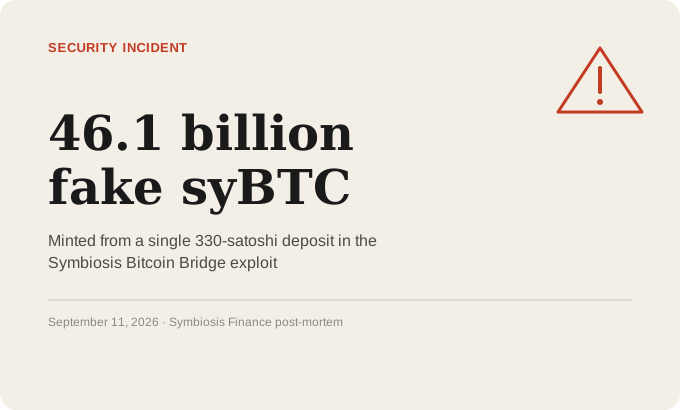
How Did a Hacker Create 46 Billion Fake Bitcoin in the Symbiosis Exploit? Decodes Bitcoin Hacker With WEEX Now
How two Symbiosis bridge bugs let a hacker mint 46.1 billion unbacked syBTC, drain Bitcoin pools and expose critical bridge risks.
This Cycle May Not Be Led by Bitcoin?

Yield Curve Approaches Inversion, TGA and Fed Tools Become New Focus in US Treasury Market

AI Agent Battle Begins: Amazon Blocks Meta's AI Agent, E-commerce Entry War Escalates
![[Interview] Lee Yun-ho, CEO of KIP: "We need to set the stage before the STO market opens... sharing RWA know-how with financial companies"](/public-static/3_1a7f0699b3.png?format=avif)
[Interview] Lee Yun-ho, CEO of KIP: "We need to set the stage before the STO market opens... sharing RWA know-how with financial companies"
Bankless Ventures Partner Claims ZEC Will Attract Bitcoin Funds in 2026
US Bond Market 'Meltdown'... Why Are Interest Rates Soaring?
Sam Price: The Impact of Cryptocurrency Legislation on Market Dynamics
The Quantum Issue: You Never Really Know The Future
Crypto Kidnapping: 6 Suspects Charged in Case Involving a Few Hundred Euros in Val-d’Oise
Security and fees hold back deeper crypto use among wealthy investors: Nexo report


