
The forex complex: How retail traders are adapting to volatile 2026 markets

 Prefer us on Google


Disclosure: This article does not represent investment advice. The content and materials featured on this page are for educational purposes only.
Market volatility in 2026 is shortening reaction windows, pushing retail traders toward smaller exposure and clearer risk rules.
Summary
- 2026 volatility is shortening reaction windows, making smaller positions, tighter information filters, and clear risk rules increasingly important.
- Faster repricing and leverage raise risks for retail traders, highlighting the need for disciplined sizing, event planning, and selective information.
- Volatile markets reward preparation over urgency, with defined losses, smaller exposure, scenario planning, and disciplined trading helping manage risk.
Market volatility 2026 is giving retail traders less time to interpret events, but speed is not always the best response. The Bank of England's July 2026 Financial Stability Report described an unpredictable global environment shaped by energy shocks, geopolitical conflict, and trade-policy uncertainty.
The practical shift is towards smaller exposure, tighter information filters, and clearer rules.
Why 2026 feels different for retail traders
Several market drivers can now change at once. For traders seeking organised context, The Forex Complex is one example of a resource combining forex education, trading ideas, and community discussion. Such resources can support research, but should not replace independent analysis or risk limits.
Faster repricing and shorter reaction windows
Currencies react to interest-rate expectations, politics, and economic data. In July 2026, the Bank of England reported that an energy shock had pushed market rates higher across advanced economies before they partly reversed. Global trade-policy uncertainty also remained well above its 20-year average.
The Bank for International Settlements measured average over-the-counter FX turnover at $9.6 trillion per day in April 2025, 28% above 2022. Retail orders therefore enter a market dominated by banks and other institutions while new information is absorbed rapidly.
Opportunity comes with behavioural risk
Volatility describes the scale and speed of price movement. Larger moves may create setups, but can also widen spreads, worsen stop execution, and reverse before a late entrant defines the risk.
Urgency encourages traders to chase momentum, increase size, or recover a loss immediately. Missing a move costs nothing; forcing a trade can create a real drawdown.
How behaviour changes under pressure
Fast markets expose weaknesses in money management and information habits. Two are especially common: using leverage without measuring its account-level effect and monitoring so many sources that decisions become less selective.
Leverage and information overload
Leverage lets a small deposit control a larger position. At 20:1, £500 of margin provides £10,000 of exposure, so a 1% market move has a much larger effect on the deposit. The UK Financial Conduct Authority applies leverage limits, margin close-out rules, and negative balance protection to retail CFDs, including rolling spot forex. These safeguards do not make leveraged trading low risk.
Information can create a similar illusion of control. A practical stack may contain an official calendar, primary releases, one dependable news source, and a charting platform. Social posts can flag an event, but the original source should confirm it.
Practical adaptations for trading in volatile markets
Risk management for traders converts uncertainty into limits and conditional decisions. The aim is to prevent one mistake from causing disproportionate damage.
Reduce size and define maximum loss
Position sizing in forex starts with affordable loss, not hoped-for profit. If the maximum loss is £20 and a setup needs a 40-pip stop, the size must make 40 pips equal £20. If the forex market volatility requires an 80-pip stop, the size should be roughly halved.
Drawdown is the decline from a previous account peak. Reducing exposure after losses can slow that decline and ease the pressure that often triggers further rule-breaking.
Plan around events and review decisions
An economic calendar is most useful before a release. Traders can mark central-bank decisions, inflation data, and political deadlines, then decide whether to reduce, close, or retain exposure.
Scenario planning uses conditional responses: act only if the result and price behaviour match a defined setup; wait if the initial move reverses; stay out if conditions remain unclear.
|--------------------|------------------------|------------------------------| | Pressure point | Impulsive response | More controlled response | | Breaking news | Trade immediately | Wait for a defined scenario | | Sharp move | Increase size | Set maximum loss first | | Recent losses | Trade to recover | Pause and review | | Too many alerts | Follow every source | Use a vetted stack |
A journal should separate a planned loss from poor execution or rule-breaking. That evidence is more useful than judging a process from one outcome.
-- Price
Education and community as filters
Structured learning and trading communities help when they organise information and encourage independent reasoning. Signals may identify a setup, but the sender cannot know each recipient's balance, existing exposure, or tolerance for loss.
Before paying for a service, check the legal entity, registration, fees, cancellation terms, and presentation of results. The CFTC's forex-fraud guidance highlights secret strategies, automated systems, and unrealistic return claims. Testimonials and screenshots are not independently verified records.
Automation and AI: Assistants, not forecasts
AI trading tools and conventional automation can scan pairs, calculate size, place alerts, log trades, and enforce exits. These narrow tasks may improve consistency and reduce clerical work.
They do not remove market or execution risk. Bots can fail when spreads widen, liquidity thins, correlations change, or historical relationships stop working. Signals also depend on delivery speed and execution price. Sensible controls include maximum exposure, approved instruments, permitted hours, and a manual kill switch.
A volatility-ready workflow
A repeatable process separates preparation, live control, and review:
- Before: define the setup, invalidation point, scheduled events, and position size.
- During: do not widen the stop; monitor combined correlated exposure; stop at the session loss limit.
- After: record actual execution, slippage, and rule changes, then classify whether the plan was followed.
This turns trading discipline into observable behaviour. A profitable rule-breaking trade is not proof of skill, just as a controlled loss does not automatically discredit a sound method.
Final thoughts: Adaptation matters more than prediction
Trading in volatile markets requires flexible exposure, not permanent caution or aggression. Communities, signals, and automation may support individual steps, but responsibility for the decision remains with the trader.
Before the next fast move, define the event, invalidation point, maximum loss, and review method. Those rules cannot remove uncertainty, but they can stop uncertainty from controlling the process.
Read more: World Liberty says $4B USD1 growth comes from demand, not Trump ties
Disclosure: This content is provided by a third party. Neither crypto.news nor the author of this article endorses any product mentioned on this page. Users should conduct their own research before taking any action related to the company.
This content is provided for general informational purposes only and doesn't constitute financial, investment, legal, or tax advice. Any events, rewards, online promotions, or related information mentioned herein should not be considered a recommendation, solicitation, or invitation to purchase, sell, trade, or otherwise deal in any crypto assets. Crypto assets are highly volatile and may result in loss. The availability of WEEX services, products, and related events may vary by region. You are responsible for ensuring that your participation is in accordance with applicable local laws and regulations.
You may also like

Why Did Sui (SUI) Crypto Price Jump 44%? Crypto OI and Leverage Explain the Rally
See why Sui (SUI) jumped 44%, how crypto OI and leverage amplified the rally, what the pullback means, and how to trade SUI on WEEX.

Circle expands CCTP to EURC and cirBTC on Arc

Bitcoin, Sports, and Politics: Predictive Markets Target $10 Trillion

AI Agent Jev Expects On-Chain Innovation Through Automated Judgment

The End of the Blank Prompt: Why Trading AI Needs a Playbook

Stablecoins hold nearly $200 billion in US debt, but money funds bought the surge
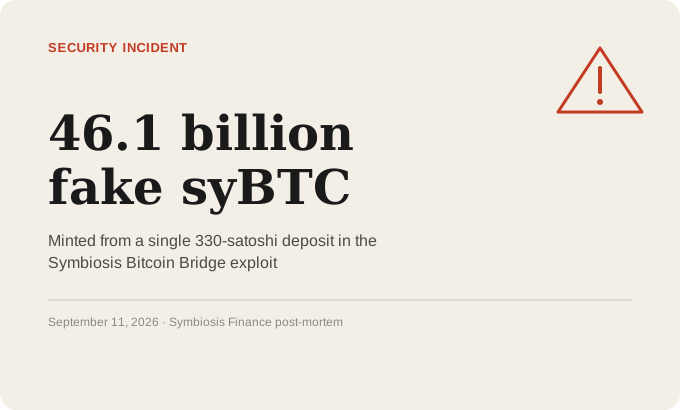
How Did a Hacker Create 46 Billion Fake Bitcoin in the Symbiosis Exploit? Decodes Bitcoin Hacker With WEEX Now
How two Symbiosis bridge bugs let a hacker mint 46.1 billion unbacked syBTC, drain Bitcoin pools and expose critical bridge risks.

CFTC's Selig Emphasizes the Need to Prepare for the Era of Large-Scale Tokenization in the U.S.

The IMF opens an office in Venezuela to supervise an economy that has already migrated to USDT

SOXL Stock Jumped 12% Yesterday: Three Companies Explain the Entire Move

Bitcoin's Hashrate Rises as Miners Reactivate Their Machines

Bitcoin 2x Leveraged ETF Launches on Cboe, But Doesn't Buy Bitcoin: Here's Why

Crypto: The ECB Enters the Tokenized Bond Market
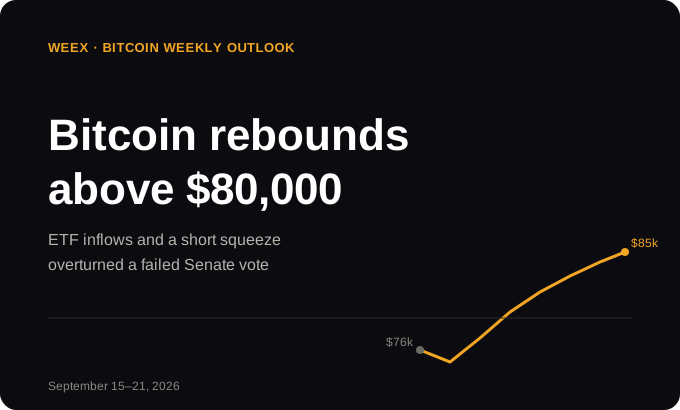
WEEX Bitcoin Weekly Outlook: Why Did Bitcoin Rebound Above $80,000 After the CLARITY Act Vote?
Bitcoin rebounded above $80,000 as SEC and CFTC action, renewed ETF inflows, and a short squeeze outweighed the failed CLARITY Act vote.
Coldcard whitehats move 52.37 BTC to recovery trust

Bitcoin's Rise Does Not Mean the Bull Market Has Returned; Don't Create Stories for Yourself
Deutsche Bank: Markets May Underestimate Rate Peaks After Central Banks' Coordinated Rate Hikes
Hyperliquid Opens Market for Bitcoin Volatility

Tom Lee Discusses Entry into Digital Asset Bull Market and AI Fund Movements

Micron Stock Price Target: Do the $1,500 to $2,000 Estimates Still Make Sense
Micron price targets range from $1,295 consensus to $1,500- lus individual calls, while options pricing implies an 11% swing on September 30 earnings, the actual results will settle which
![[ETH Letter] Ethereum Aims to Activate Sepolia Testnet on October 6](/public-static/26_2e1840f602.png?format=avif)
[ETH Letter] Ethereum Aims to Activate Sepolia Testnet on October 6
Fypher Partners with Korea Medical Tourism Promotion Association for Digital Dollar Payment
TapeOut Ecosystem Overview: From NAND, LATCH to On-Chain Application Ecosystem
[Coin Crime] "If you give us Tether, we will give you oil" - Polish state-owned company falls victim to international fraudsters

Why real-time election odds are misleading prediction market crypto traders

What is PCE and Why September 30 is Important for Cryptocurrencies
Bitcoin: JPMorgan Sees BTC Outperforming Gold

U.S. Treasury Sanctions BitBank Over Iranian Sanctions-Evasion Network
Brazil blocks stablecoins from key cross-border payment rail as $1.1 trillion market faces new limits
RISEx Proposes 20% Retention Condition for Stolen Funds
Why Did Sui (SUI) Crypto Price Jump 44%? Crypto OI and Leverage Explain the Rally
See why Sui (SUI) jumped 44%, how crypto OI and leverage amplified the rally, what the pullback means, and how to trade SUI on WEEX.
Circle expands CCTP to EURC and cirBTC on Arc
Bitcoin, Sports, and Politics: Predictive Markets Target $10 Trillion
AI Agent Jev Expects On-Chain Innovation Through Automated Judgment
The End of the Blank Prompt: Why Trading AI Needs a Playbook
Stablecoins hold nearly $200 billion in US debt, but money funds bought the surge




