
Post-quantum Bitcoin Protection: QuFi Tests Bitcoin Security Without Blockchain Changes

 Prefer us on Google


Post-quantum Bitcoin protection from QuFi Network demonstrates how digital assets can be prepared for future quantum risks without rewriting existing settlement networks. The company launched a post-quantum verification platform and showcased its operation on Bitcoin Testnet4. The overall principle of this protection is to preemptively replace or supplement vulnerable cryptographic elements with more robust schemes, without disrupting the operation of the network and wallets.
Verification Beyond the Blockchain
The main idea of QuFi Network is not to force the blockchain itself to perform all the heavy cryptographic work. The platform separates the verification of an operation from its final execution: independent nodes conduct cryptographic verification in advance and then transmit a compact proof to the network.
This approach is intended to reduce the load on base networks if they need to transition to post-quantum cryptography. Post-quantum schemes often require more data, computations, and resources than traditional public key cryptography mechanisms, so directly embedding new signatures into each blockchain could increase storage, bandwidth, and transaction processing requirements. In addition to the load, migration may face compatibility issues with wallets, exchanges, bridges, and nodes: users will need to update tools, carefully transfer keys, and avoid errors when transitioning to new formats.
QuFi Network relies on standards prepared under the initiative of the National Institute of Standards and Technology. NIST acts as the coordinator for standardization in this area: it collects candidates, opens them for public cryptanalysis, compares their resilience and practicality, and then approves the selected algorithms as standards.
If we break down the schemes used by QuFi Network by roles, we get the following picture:
- ML-DSA-65 --- lattice cryptography; digital signature; NIST standardization.
- SLH-DSA --- hash signatures; additional digital signature scheme; NIST standardization.
- ML-KEM-1024 --- lattice cryptography; secure key exchange; NIST standardization.
- Kyber --- a benchmark for post-quantum key exchange in the same area.
Among the well-known families of post-quantum algorithms, Dilithium, Falcon, and SPHINCS+ are also frequently mentioned. Dilithium and Falcon belong to lattice signatures: their resilience is based on problems that are considered difficult for quantum attacks. SPHINCS+ uses hash signatures and does not rely on lattices, but generally requires heavier signatures and careful tuning.
How QuFi Network Tested the System on Bitcoin
For demonstration, the team created uBTC --- a proof-of-concept that verifies the presence of BTC as collateral and generates cryptographic proofs for subsequent value transfer. The full cycle of uBTC includes issuance, burning, and redemption.
All of this operates on Bitcoin Testnet4. Upon redemption, the funds are ultimately sent via a regular Bitcoin transaction, which can be independently verified on the network. The protocol of the first cryptocurrency has not changed in this process.
This is where the key boundary lies between QuFi Network's approach and attempts to directly embed post-quantum algorithms into the blockchain. Some post-quantum signatures are significantly larger than traditional ones, which can increase the requirements for storage, communication channels, and transaction processing on nodes. Among other approaches to securing Bitcoin, updating signature rules at the protocol level, hybrid schemes with classical and post-quantum cryptography, additional layers of verification, and more cautious key management in wallets are typically considered.
Why Quantum Threat is Important for the Crypto Market
Post-quantum cryptography is a set of algorithms that are expected to remain secure even against attacks using powerful quantum computers. It is important because some classical protection schemes are based on mathematical problems that quantum algorithms can theoretically solve much faster than classical computers.
This refers to a scenario known in the industry as the quantum threat. Quantum computing changes the risk model for computer security: a sufficiently powerful computer with stable physical and logical qubits could theoretically attack several classical schemes, including RSA through integer factorization and elliptic curve cryptography through discrete logarithms. In this context, Shor's algorithm, qubits, cryptanalysis, and logarithms are often mentioned.
Such computers will not become a practical threat to old schemes simply after an increase in the number of qubits, but when stable logical qubits, working error correction, available computational power, and effective implementation of attack algorithms emerge. Therefore, the timelines are usually described as long-term and dependent on progress in hardware, engineering, and cryptanalysis, but preparations must begin in advance: replacing cryptography in wallets, protocols, and financial infrastructure takes a lot of time.
For cryptocurrencies, several levels of protection are critical:
- Signatures.
- Key management.
- Authentication.
- Privacy.
- Protection of cryptocurrency wallets.
- Public key certificates.
- Communication protocols.
- Cryptographic protocols.
- Key exchange.
- Diffie-Hellman key exchange.
Vulnerabilities at any of these levels can affect wallets, communication channels, and cryptographic protocols. A specific risk is known as "Harvest now, decrypt later": an attacker collects encrypted data in advance to decrypt it later when suitable hardware becomes available. Protection against such a scenario is built on transitioning to post-quantum or hybrid encryption schemes, regularly updating protocols, reducing the lifespan of sensitive data, and careful key rotation.
Transitioning to post-quantum cryptography should begin early: digital assets must remain protected not only today but also when quantum attacks become a practical risk.
In this context, encryption remains a multi-layered task. Symmetric methods like the Advanced Encryption Standard and symmetric algorithms are considered a separate class of protection, while cryptographic hash functions help build proofs and verification schemes. Hardware security modules and zero-knowledge proofs can also be applied in the infrastructure, but QuFi Network focuses specifically on a separate layer of post-quantum verification for different networks.
While This is a Test Environment, Not a Mainnet Protection
It is still too early to talk about full post-quantum protection for Bitcoin: the test was conducted in a testnet, not in the main network. QuFi Network plans to expand the solution to EVM networks, Stellar, and Solana.
Bitcoin users currently do not need to change the protocol themselves or transfer funds to experimental schemes. Practical steps are simpler: keep an eye on wallet updates, securely store seed phrases and keys, avoid disclosing public keys unnecessarily, and, if possible, do not keep large amounts for long on addresses from which transactions have already been sent, and prepare for migration when verified solutions become available in main wallets.
The company has also launched a Genesis Node program for operators who will support a decentralized verification network. In the future, QuFi Network expects to use a single verification layer for multiple blockchains and financial systems.
In August, StarkWare conducted the first quantum-resistant transaction on the Bitcoin mainnet. Various market participants and technology stakeholders, including Google, the Ethereum Foundation, and Coinbase, are involved in broader research around this topic. For other networks, preparation typically begins with testnets, verification of new signatures, hybrid schemes, and wallet updates, as resilience to quantum risks is gradually becoming part of the long-term agenda for cryptocurrencies and digital asset infrastructure.
-- Price
This content is provided for general informational purposes only and doesn't constitute financial, investment, legal, or tax advice. Any events, rewards, online promotions, or related information mentioned herein should not be considered a recommendation, solicitation, or invitation to purchase, sell, trade, or otherwise deal in any crypto assets. Crypto assets are highly volatile and may result in loss. The availability of WEEX services, products, and related events may vary by region. You are responsible for ensuring that your participation is in accordance with applicable local laws and regulations.
You may also like

BitGo CEO: Tokenization Expands Access, Dollar Depreciation Intensifies K-Shaped Economy

Bitwise Report Shows 15 Institutions Did Not Reduce Holdings During 50% Crypto Market Drawdown
Quantum Threat to Bitcoin Explained by Shinobi
Dave Weisberger Discusses Bitcoin FOMO and Collateral Treatment
BitMEX Ends Operations After 11 Years, Clients Must Withdraw Funds

Bitcoin Layer Citrea Acquires Privacy Wallet Crest

Why Did DOGE Jump 15%? Dogecoin Price Rally Explained

Citigroup: SEC New Regulations Will Be a Focus for the Crypto Market

EU Financial Regulators Warn of Quantum Computing Threats to Blockchain Security

Bitcoin Developers Concerned About Mining Subsidy
$1.7 Billion Inflow to Bitcoin ETFs in Two Days
UN Digital Cooperation Day Features Blockchain Session, Focus on Financial Inclusion and Sovereign Infrastructure

Scam AI Bot: 274 ETH Lost in Smart Contract Trap

Can PEPE Reach $0.000006 as Meme Coin Momentum Returns?
CryptoQuant Predicts More Moderate Gains for This Bitcoin Cycle
Zest Protocol Launches Bitcoin Collateral Vaults Mainnet Demo

BlackRock Redefines Crypto Money for Machines with Bitcoin and Stablecoins

DeFi Researcher Says Meme Coins Should Be Traded Short-Term, Not Held Long-Term

X Sues Two for Fraudulent Acquisition of Creator Rewards, Seeks Return of $278,000

US Spot Ethereum ETFs See 270 Million Net Inflows Led by BlackRock

Strategy Stock's Bitcoin Bet Swung From a $10 Billion Loss to an $8 Billion Profit: Bitcoin Hitting $87K Did It
Strategy's Bitcoin holdings swung from a $10 billion loss to $8.5 billion in profit as BTC briefly touched $87K. Here's the math behind why the stock moves this violently.

Starcloud Plans to Mine Bitcoin in Space by Year-End

Hyperliquid open interest reaches record $18 billion: What’s driving activity?
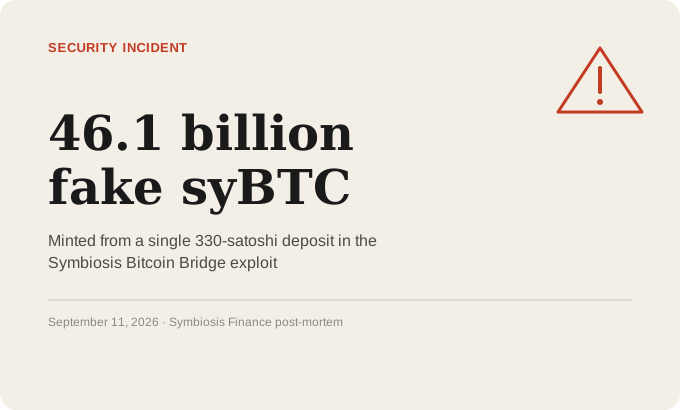
How Did a Hacker Create 46 Billion Fake Bitcoin in the Symbiosis Exploit? Decodes Bitcoin Hacker With WEEX Now
How two Symbiosis bridge bugs let a hacker mint 46.1 billion unbacked syBTC, drain Bitcoin pools and expose critical bridge risks.
This Cycle May Not Be Led by Bitcoin?

Ki Young Ju Predicts Bitcoin Growth of 3-5 Times
In 12 tests, PQLN makes Bitcoin's Lightning Network communication levels resistant to quantum computers

Circle Foundation launches first U.S. grants for AI
CME Plans BCH and UNI Futures on October 19 | WEEX TradFi Daily Brief (September 23, 2026)
Global markets on September 23 focus on a Nasdaq high and an expansion of crypto futures. The Nasdaq closed higher on September 22 for a second straight closing high. Memory names such as Micron and SanDisk plus AI hardware lifted risk appetite. Brent eased to about $98 and WTI to about $94.6. Bitcoin was near $86,200 and Ethereum near $2,750. Investors are watching CME’s planned October 19 BCH/UNI futures and the impact of delayed compute-futures review on NVDA and CME.

WEEX Exclusive:CME Plans BCH and UNI Futures on October 19 | WEEX TradFi Daily Brief (September 23, 2026)
BitGo CEO: Tokenization Expands Access, Dollar Depreciation Intensifies K-Shaped Economy
Bitwise Report Shows 15 Institutions Did Not Reduce Holdings During 50% Crypto Market Drawdown
Quantum Threat to Bitcoin Explained by Shinobi
Dave Weisberger Discusses Bitcoin FOMO and Collateral Treatment
BitMEX Ends Operations After 11 Years, Clients Must Withdraw Funds
Bitcoin Layer Citrea Acquires Privacy Wallet Crest


