
Rate Hikes Are Not the End: The Real Test for the Federal Reserve and the U.S. Bond Market Has Just Begun

 Prefer us on Google


On September 16, the Federal Reserve's policy decision is entering its final stages, but market focus has gradually shifted away from whether or not to raise interest rates. What is more noteworthy is how the Federal Reserve explains its subsequent policies to the market and whether this action can re-establish expectations for controlling inflation. As the yield on the 10-year U.S. Treasury bond surpasses 5%, market pricing is no longer just about short-term policy rates, but is reassessing inflation, fiscal, and capital demand in the U.S. for the coming years.
This also represents a core limitation facing recent policy operations by the Federal Reserve. The Treasury Department is attempting to stabilize financial markets by expanding long-term Treasury bond repurchases and coordinating yen policies, but the actual effects show that while the government can influence market liquidity, it cannot directly determine long-term funding costs. As the scale of the deficit continues to expand, and with AI and infrastructure continuously absorbing capital, coupled with global investors reducing allocations to traditional long bonds, the market's demand for higher yields is no longer just a short-term sentiment but may gradually reflect a new equilibrium price.
Energy risks further complicate this issue. The conflict in the Middle East is not just pushing up oil prices; both major energy transport routes in Saudi Arabia are under pressure, and the Russia-Ukraine battlefield is further disrupting diesel and refining supplies. Energy supply itself is beginning to affect transportation and manufacturing, turning inflation from a price issue into a supply capacity issue. This will make it more difficult for central banks to quickly resolve issues through demand management.
At the same time, global capital markets are facing another structural change: AI continues to absorb a large amount of capital, but investors are starting to more carefully distinguish between "the actual productivity brought by AI" and "how much capital AI needs to maintain growth." If corporate capital expenditures continue to increase while simultaneously facing higher financing costs, the market will require not just revenue growth in the future, but also higher capital returns.
Therefore, what is truly worth paying attention to today is not the 25 basis points from the Federal Reserve, but whether policy actions can change the chain reaction between long-term interest rates, energy supply, and global capital allocation. If short-term policies tighten and long-term yields remain high, it indicates that the market's pricing of U.S. long-term inflation and fiscal risks may have diverged from a purely Federal Reserve cycle; conversely, if long-term yields stabilize again, it would mean that the market is beginning to believe that policies are sufficient to control inflation expectations. This will become a more significant watershed for asset pricing in September than a single rate hike.
-- Price
This content is provided for general informational purposes only and doesn't constitute financial, investment, legal, or tax advice. Any events, rewards, online promotions, or related information mentioned herein should not be considered a recommendation, solicitation, or invitation to purchase, sell, trade, or otherwise deal in any crypto assets. Crypto assets are highly volatile and may result in loss. The availability of WEEX services, products, and related events may vary by region. You are responsible for ensuring that your participation is in accordance with applicable local laws and regulations.
You may also like

Bitcoin, Sports, and Politics: Predictive Markets Target $10 Trillion

Exclusive Interview with CK Zheng of ZX Squared Capital: How a Wall Street Risk Control Expert Accurately Grasped Market Trends and Outperformed Bitcoin Returns by Double

The End of the Blank Prompt: Why Trading AI Needs a Playbook
Bankless Ventures Partner Claims ZEC Will Attract Bitcoin Funds in 2026

US Bond Market 'Meltdown'... Why Are Interest Rates Soaring?

Sam Price: The Impact of Cryptocurrency Legislation on Market Dynamics

The Quantum Issue: You Never Really Know The Future

Crypto Kidnapping: 6 Suspects Charged in Case Involving a Few Hundred Euros in Val-d’Oise

Security and fees hold back deeper crypto use among wealthy investors: Nexo report

Why leaving your crypto on an exchange is not the same as having it in your own wallet?

Binance Under Scrutiny Again for Iran-Related Trading
Altcoin demand meets $18B threat as flows move into RWA perps as just 19% of traders keep alts
90% of U.S. Treasury Yield Increase Concentrated Around Employment Data and Fed Speeches
Can Kraken's Parent Company Open the Door for Hyperliquid to Enter the U.S. Market?
Gold Price Today in Thailand: XAU/USD Holds Near $4,347 as Key Support Level Tested

Scam AI Bot: 274 ETH Lost in Smart Contract Trap

Why Do You Always Make Small Profits and Then Lose Everything? Taleb Explained It with 'Asymmetric Leverage' Twenty Years Ago
AI has become a tool for a new generation of fraudsters: how deepfakes are stealing millions of dollars - research

Can SOXL Reach $160 as AI and Semiconductor Stocks Rally?
Can PEPE Reach $0.000006 as Meme Coin Momentum Returns?
Meta's Muse: A Slightly Smarter Version of 'AI Ordering Coffee'

Over 70% of South Korean Crypto Investors Oppose Crypto Tax: What Are Their Concerns?

Howard Marks: U.S. Fiscal Discipline Out of Control, Buying Bonds to Suppress Yields is Just 'Putting Ice Packs on a Feverish Patient'
Bitget Conversations with Trader Shiguang: Seeking the Discrepancy Between Price and Value

AI and Crypto: Why BlackRock Sees a Major Convergence

Nomura Warns of 'Double Whammy' Risk: The Next Market Storm May Start with Interest Rate Volatility
What is Travix? An on-chain omnibroker combining AI trading and blockchain verification
VVV Hits All-Time High: Founder’s Perspective on Models, Privacy, and Crypto
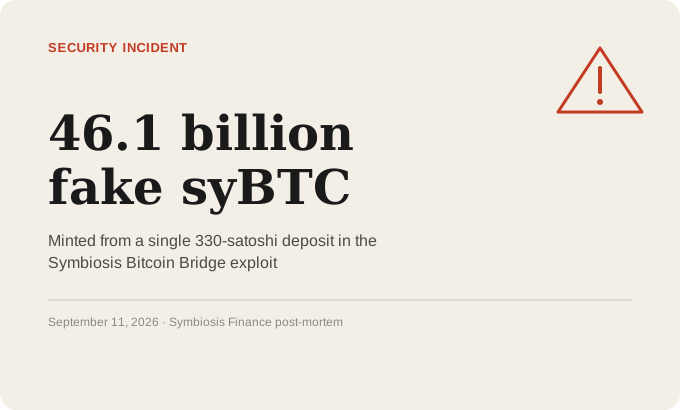
How Did a Hacker Create 46 Billion Fake Bitcoin in the Symbiosis Exploit? Decodes Bitcoin Hacker With WEEX Now
How two Symbiosis bridge bugs let a hacker mint 46.1 billion unbacked syBTC, drain Bitcoin pools and expose critical bridge risks.
This Cycle May Not Be Led by Bitcoin?
Bitcoin, Sports, and Politics: Predictive Markets Target $10 Trillion
Exclusive Interview with CK Zheng of ZX Squared Capital: How a Wall Street Risk Control Expert Accurately Grasped Market Trends and Outperformed Bitcoin Returns by Double
The End of the Blank Prompt: Why Trading AI Needs a Playbook
Bankless Ventures Partner Claims ZEC Will Attract Bitcoin Funds in 2026
US Bond Market 'Meltdown'... Why Are Interest Rates Soaring?
Sam Price: The Impact of Cryptocurrency Legislation on Market Dynamics


