
Sovereign Debt: The Secret of Gold That Governments Don't Tell

 Prefer us on Google



The growing concern over Sovereign Debt and its economic implications is a recurring theme among financial analysts. Recently, @SternDrewCrypto published an intriguing analysis on X, highlighting Ray Dalio's projection on the monetization of debt and the consequent capital flight to assets that cannot be printed. This reading underscores a critical moment for the global economy, where trust in fiat currencies is in question.
Dalio, a prominent figure in the financial landscape, warns of the consequences of prolonged government deficits. He argues that eventually, governments run out of willing buyers for all the new debt. Thus, they resort to creating new money to absorb it. This process, known as debt monetization, not only dilutes the value of the currency but also drives inflation, silently eroding the purchasing power of the population and those holding paper assets.
Ray Dalio's Warning on Monetary Printing
Ray Dalio, one of the most respected investors in the world, emphasizes a line he considers the most frightening: "They will monetize the debt and capital will flee to what they cannot print." This statement captures the essence of the current dynamics. When governments sustain such large deficits for so long, the practice of selling new debt to willing buyers becomes unsustainable.
Consequently, the solution found is the printing of more money. This additional monetary flow does not remain contained within the official economy. It leaks into the prices of goods and services, generating inflation and diminishing purchasing power. Furthermore, holders of debt securities realize they are holding papers that yield less than inflation. Their savings, once seen as safe, lose value year after year, turning conservative investment into a real loss.
The Reaction of Capital and the Call for Scarce Assets
It is at this point that capital begins to move decisively. Investors lose interest in holding sovereign debt and actively seek assets that cannot be created with a simple keystroke. Historically, gold has played this role for 5,000 years. Its supply is limited and grows slowly, preventing uncontrolled printing. Gold has no CEO, expiration date, or promises that can be broken, giving it a unique resilience.
Many central banks around the world, aware of this reality, maintain and even expand their gold reserves. This practice signals an inherent distrust in fiat currencies and a search for tangible backing. Therefore, in a scenario of negative real yields for paper assets, gold does not need explosive appreciation. It just needs to maintain its value while everything else is diluted by inflation and monetary printing.
Brad Garlinghouse and the Complexity of Physical Gold
Brad Garlinghouse, CEO of Ripple, also reinforced these alarms. He cited the case of the Dutch Central Bank, which reportedly spent months moving $11 billion in gold from New York to London. According to Garlinghouse, approximately 70% of this gold never left its physical location. It was sold in New York and repurchased in London, highlighting the complexities and logistical costs of moving large volumes of precious metals.
He also recalled an episode from 2013 when Germany took four years to move 674 tons of gold, valued at $36 billion, from vaults in Paris and New York. This illustrates the immense operational difficulties and the slow pace involved in the physical transport of large fortunes in gold. These stories reveal that despite its intrinsic value, physical gold presents significant challenges in terms of:
- Logistics and Security: The transportation and custody of large quantities of gold require complex and high-cost operations.
- Transfer Time: Physical movement can take years, as seen in the German case, limiting liquidity and agility.
- Dependence on Third Parties: Even when "moved," gold often remains under the custody of financial or governmental institutions in remote locations, raising questions about the true sovereignty of ownership.
- Hidden Costs: Sales and repurchases to "move" gold generate transaction costs and potential losses.
These observations from Garlinghouse complement Dalio's thesis on the search for unattainable assets. However, they also raise questions about the efficiency of gold custody and movement in the digital age. Some point out that custody in distant locations, even when attempting to "repatriate" the metal, still leaves assets subject to jurisdictions and political decisions outside the owner's control.
The Revolution of Tokenized Gold: Mobility and Sovereignty
In this scenario, the innovation of tokenized gold emerges. The original post by @Trensik_com, cited by @SternDrewCrypto, highlights that "the best way to move value should not be to move it physically." This idea applies perfectly to gold, transforming it into a digital asset that can be transacted with the agility of blockchain.
The token $XAUa, for example, is backed by physical gold and tokenized on the XRPL (XRP Ledger). It can be exchanged for $XRP and $RLUSD in seconds. The advantages of this approach are clear:
- The metal remains untouched: The physical custody of gold is simplified, as it does not need to be moved for ownership to change hands.
- Ownership travels: The transfer of ownership is instantaneous and global, conducted digitally.
- Self-custody: Tokens are held in the user's own wallet, ensuring sovereignty over the asset.
- Efficiency: Drastic reduction in costs and time associated with logistics, security, and auditing of physical gold.
This approach represents a significant advancement for investors seeking the security of gold, but with the efficiency and sovereignty of the digital world. It allows capital to move freely, without the bureaucratic and physical constraints that have historically limited the ownership of precious metals.
Editorial Analysis by Bitcoin Block Team
The analysis by Ray Dalio and Brad Garlinghouse, amplified by @SternDrewCrypto, resonates deeply with the editorial line of BitcoinBlock.com.br. Sovereign debt and compulsory monetization are clear manifestations of a state that expands beyond its capabilities, resulting in the erosion of private property and individual financial freedom. The printing of money is a silent but insidious form of confiscation, depreciating the savings and hard work of the population.
This is the core of the libertarian critique of the state-controlled fiat monetary system. The search for assets that "cannot be printed" is a natural and rational response to governmental fiscal irresponsibility. Gold, with its millennia-long history as a store of value, is a natural refuge. However, its physical custody and mobility have always been weaknesses, as evidenced by the dilemmas faced by central banks.
It is here that Bitcoin and the tokenization of assets like gold emerge as revolutionary solutions for individual sovereignty. Bitcoin, in its essence, is the perfect materialization of digital scarcity and self-custody, a direct response to uncontrolled printing. It offers:
- Programmed Scarcity: A finite and verifiable supply, with no possibility of being printed by any central authority.
- Decentralization and Resistance to Censorship: Transactions and ownership outside the control of governments and intermediaries.
- Unbreakable Self-Custody: "Not your keys, not your coins" --- direct control over one's own assets, without relying on third parties.
- Global Mobility and Liquidity: Instant and low-cost value transfer anywhere in the world.
Tokenization of gold, in turn, modernizes a traditional asset, combining the millennia-old trust in the scarcity of the metal with the efficiency and sovereignty of blockchain. It serves as a bridge for those who still value physical backing but understand the importance of self-custody and the agility of the digital market. This shifts power away from central planners and back to individuals, who can choose where and how their capital will be protected.
The Choice Between Paper Promises and Digital Sovereignty
In summary, Dalio's message, echoed by Garlinghouse and highlighted by @SternDrewCrypto, is a warning about the inevitable monetization of Sovereign Debt and its consequences for purchasing power. The flight of capital to assets that cannot be printed is not speculation, but an economic trend grounded in the search for security and value preservation.
Gold, whether physical or tokenized, and especially Bitcoin, represent the antithesis of paper promises diluted by monetary printing. They offer an escape route and a path to financial sovereignty. The choice between holding assets in systems controlled by central planners or migrating to technologies that ensure scarcity and self-custody will determine the future of individual wealth in an increasingly uncertain economic landscape.
Source: original analysis published by @SternDrewCrypto on X.
Disclaimer: The opinions, as well as all information shared in this price analysis or articles mentioning projects, are published in good faith. Readers should conduct their own research and due diligence. Any action taken by the reader is detrimental to their account and at their own risk. Bitcoin Block will not be responsible for any direct or indirect loss or damage.
-- Price
This content is provided for general informational purposes only and doesn't constitute financial, investment, legal, or tax advice. Any events, rewards, online promotions, or related information mentioned herein should not be considered a recommendation, solicitation, or invitation to purchase, sell, trade, or otherwise deal in any crypto assets. Crypto assets are highly volatile and may result in loss. The availability of WEEX services, products, and related events may vary by region. You are responsible for ensuring that your participation is in accordance with applicable local laws and regulations.
You may also like

Circle expands CCTP to EURC and cirBTC on Arc

Bitcoin, Sports, and Politics: Predictive Markets Target $10 Trillion

AI Agent Jev Expects On-Chain Innovation Through Automated Judgment

The End of the Blank Prompt: Why Trading AI Needs a Playbook

Stablecoins hold nearly $200 billion in US debt, but money funds bought the surge
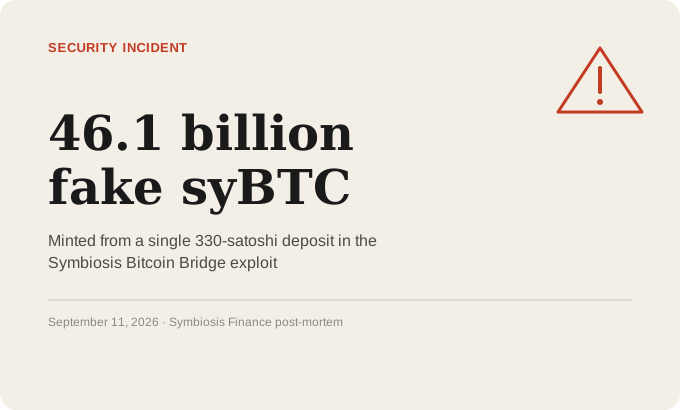
How Did a Hacker Create 46 Billion Fake Bitcoin in the Symbiosis Exploit? Decodes Bitcoin Hacker With WEEX Now
How two Symbiosis bridge bugs let a hacker mint 46.1 billion unbacked syBTC, drain Bitcoin pools and expose critical bridge risks.

CFTC's Selig Emphasizes the Need to Prepare for the Era of Large-Scale Tokenization in the U.S.

The IMF opens an office in Venezuela to supervise an economy that has already migrated to USDT

SOXL Stock Jumped 12% Yesterday: Three Companies Explain the Entire Move

Bitcoin's Hashrate Rises as Miners Reactivate Their Machines

Bitcoin 2x Leveraged ETF Launches on Cboe, But Doesn't Buy Bitcoin: Here's Why

Crypto: The ECB Enters the Tokenized Bond Market
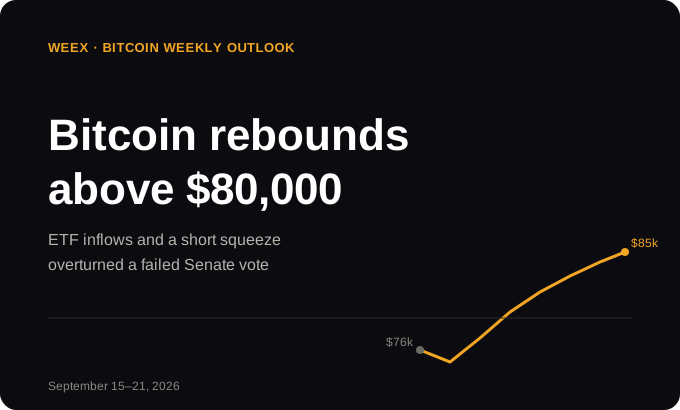
WEEX Bitcoin Weekly Outlook: Why Did Bitcoin Rebound Above $80,000 After the CLARITY Act Vote?
Bitcoin rebounded above $80,000 as SEC and CFTC action, renewed ETF inflows, and a short squeeze outweighed the failed CLARITY Act vote.
Coldcard whitehats move 52.37 BTC to recovery trust

Bitcoin's Rise Does Not Mean the Bull Market Has Returned; Don't Create Stories for Yourself
Deutsche Bank: Markets May Underestimate Rate Peaks After Central Banks' Coordinated Rate Hikes
Hyperliquid Opens Market for Bitcoin Volatility

Tom Lee Discusses Entry into Digital Asset Bull Market and AI Fund Movements

Micron Stock Price Target: Do the $1,500 to $2,000 Estimates Still Make Sense
Micron price targets range from $1,295 consensus to $1,500- lus individual calls, while options pricing implies an 11% swing on September 30 earnings, the actual results will settle which
![[ETH Letter] Ethereum Aims to Activate Sepolia Testnet on October 6](/public-static/26_2e1840f602.png?format=avif)
[ETH Letter] Ethereum Aims to Activate Sepolia Testnet on October 6
Fypher Partners with Korea Medical Tourism Promotion Association for Digital Dollar Payment
TapeOut Ecosystem Overview: From NAND, LATCH to On-Chain Application Ecosystem
[Coin Crime] "If you give us Tether, we will give you oil" - Polish state-owned company falls victim to international fraudsters

Why real-time election odds are misleading prediction market crypto traders

What is PCE and Why September 30 is Important for Cryptocurrencies
Bitcoin: JPMorgan Sees BTC Outperforming Gold

U.S. Treasury Sanctions BitBank Over Iranian Sanctions-Evasion Network
Brazil blocks stablecoins from key cross-border payment rail as $1.1 trillion market faces new limits
RISEx Proposes 20% Retention Condition for Stolen Funds

USDT in Wallets May Be Blocked. What to Do and How to Store Them in Russia
Circle expands CCTP to EURC and cirBTC on Arc
Bitcoin, Sports, and Politics: Predictive Markets Target $10 Trillion
AI Agent Jev Expects On-Chain Innovation Through Automated Judgment
The End of the Blank Prompt: Why Trading AI Needs a Playbook
Stablecoins hold nearly $200 billion in US debt, but money funds bought the surge
How Did a Hacker Create 46 Billion Fake Bitcoin in the Symbiosis Exploit? Decodes Bitcoin Hacker With WEEX Now
How two Symbiosis bridge bugs let a hacker mint 46.1 billion unbacked syBTC, drain Bitcoin pools and expose critical bridge risks.


