
Sui Co-founder Ventures into "Side Business" as Havenex Targets Institutional Crypto Financial Infrastructure

 Prefer us on Google

Author: Jae, PANews
On August 26, a message from Kostas Kryptos, co-founder of the Sui development team Mysten Labs, brought a new trading platform named Havenex into the spotlight. The market quickly labeled it as "Sui co-founder entering the exchange business," but peeling back the layers reveals that this is actually an initiative aimed at positioning infrastructure for traditional financial institutions.
According to Kostas, Havenex is nearing the completion of its Series A funding, with the amount already becoming tight. At the same time, the platform has entered the authorization process with the Austrian Financial Market Authority (FMA). He emphasized that rather than becoming the next Coinbase or Binance, Havenex aims to be a digital asset infrastructure provider behind FinTechs, banks, asset management firms, and family offices.
As the retail trading market's benefits gradually peak and traditional financial institutions accelerate their entry, compliance infrastructure services targeting institutions are becoming a new incremental market.
Not Competing for C-end Users, Acting as Institutional "Back-end Infrastructure Provider"
The most common misconception in the market is to categorize Havenex as a new cryptocurrency exchange, but its positioning diverges from that of Coinbase and Kraken.
Traditional leading exchanges follow a B2C route: building their own brand, aggregating retail liquidity, and offering a full range of trading products, with users and assets embedded within the platform ecosystem.
In contrast, Havenex targets the B2B infrastructure market. It does not need to directly face end users but can provide underlying capabilities to FinTechs, banks, and asset management institutions. Institutions can retain their brand to offer digital asset services to clients, while the underlying wallet, custody, trading, compliance, and risk control are handled by Havenex.
This positioning addresses the core issues of traditional financial institutions' digital asset businesses.
In recent years, banks, brokerages, and asset management firms have shown increasing interest in digital asset businesses, but the cost of building a complete technology stack is prohibitively high: from wallet management and custody architecture to compliance processes and risk control systems, as well as regulatory adaptations across different jurisdictions, each component requires significant investment and time. For most medium-sized institutions, building from scratch is neither economical nor realistic.
Havenex's approach is to standardize and productize the necessary technical capabilities, then output them through a single interface, allowing institutions to provide digital asset services without reinventing the wheel.
However, trading and brokerage businesses inherently possess network effects, where liquidity depth, market-making resources, and asset coverage significantly influence clients' willingness to use the service. For the newcomer Havenex, this presents a serious challenge.
Compliance as Admission Ticket, Security as Barrier
In Havenex's business logic, compliance is not a bonus; it is the admission ticket.
Choosing Austria as its registration location and applying for FMA authorization reflects the new industry landscape following the EU's Markets in Crypto-Assets Regulation (MiCA). MiCA establishes a unified regulatory framework for crypto asset service providers, and the Austrian FMA is one of the faster regulatory bodies in Europe: by the end of last year, it had authorized eight crypto asset service providers, increasing to nine this year.
Obtaining authorization is just the starting point. Since February of this year, the FMA's regulatory actions against KuCoin EU Exchange indicate that even with MiCA authorization, if governance structure, anti-money laundering, and key management functions do not meet requirements, business may still face restrictions.
For Havenex, applying for a license is only the first step; what truly determines its commercial value is whether it can establish a governance system that meets regulatory requirements and pass the strict due diligence of banks and institutions to enter their vendor lists.
This is a slow business that cannot rely on traffic stories for quick breakthroughs.
In addition to regulatory compliance, security and transparency are another differentiation barrier that Havenex aims to build.
Notably, Havenex's supervisory board includes two co-founders of Mysten Labs, Kostas Kryptos and Adeniyi Abiodun. Kostas is the chief cryptographer at Mysten Labs, with a cryptographic background from the Meta Libra project and experience in blockchain security research; Adeniyi is the chief product officer (CPO) at Mysten Labs, having overseen product design for Meta Novi and accumulated extensive product management experience at Oracle and VMware. This background may lend some credibility to Havenex's technical roadmap.
Havenex currently emphasizes technical solutions including verifiable custody, continuous solvency proof, default multi-signature, quantum-resistant keys, hardware two-factor authentication (2FA), as well as self-custody and key loss protection mechanisms.
Among these, the "continuous solvency proof" is particularly noteworthy.
After the FTX collapse, the transparency of reserves at centralized exchanges (CEX) has become a long-term concern for the market. Their asset proofs are typically disclosed in stages, while Havenex hopes to design solvency verification as a continuous proof mechanism, which could reduce counterparty risk for institutional clients.
However, Havenex's technical roadmap is still at the product design and technical goal level and has not yet undergone independent audits or large-scale real business validation. Whether the platform can publicly prove its mechanisms, audit standards, and operational data will determine the extent of institutional recognition it can achieve.
Not Aligning with Sui, Multi-chain Compatibility to Adapt to Institutional Needs
Another discussion surrounding Havenex is its relationship with the Sui ecosystem. The market tends to interpret it as a "Sui-based exchange," but that is not the case.
From a role perspective, Kostas and Adeniyi serve as supervisory board members at Havenex, but their focus remains on Mysten Labs and Sui. From a technical standpoint, Kostas has stated that Havenex will utilize Sui technology in suitable scenarios while also integrating assets, cross-chain protocols, and infrastructure from other public chain ecosystems. This statement indicates that Havenex is a multi-chain infrastructure rather than an exclusive platform for Sui.
In fact, this positioning is a pragmatic choice that meets institutional needs. Traditional financial institutions prioritize capability, compliance, and stability when choosing infrastructure service providers; they will not migrate all assets and businesses simply because the underlying tech stack is based on a particular public chain. Multi-chain compatibility is, in fact, a necessary condition for entering the institutional market.
Of course, if Havenex receives regulatory approval and is adopted by institutions, it will greatly enhance Sui's value beyond being just an ordinary application: it could become the entry point for Sui into the supply chain of traditional financial institutions, allowing Sui's technical capabilities to permeate into a broader range of institutional businesses through the identity of an infrastructure service provider.
However, this is merely an optimistic prospect and cannot directly drive the current growth of the Sui ecosystem.
Over the past decade, the competitiveness of infrastructure providers has been based on liquidity, currencies, products, and user scale. As traditional financial institutions become the incremental main force in the digital asset market, the importance of custody, compliance, asset segregation, risk management, and cross-chain security is rapidly rising. Those who can excel as the "back-end service providers" for institutions will be able to draw new growth curves.
The playing field on Havenex is not easy. Compliance processes are slow, customer acquisition cycles are long, and the infrastructure business relies not on explosive growth but on long-term stability, security, and trust. Whether Havenex can play its cards well ultimately depends on the speed of license issuance, breakthroughs with initial institutional clients, and validation of actual business operations.
-- Price
This content is provided for general informational purposes only and doesn't constitute financial, investment, legal, or tax advice. Any events, rewards, online promotions, or related information mentioned herein should not be considered a recommendation, solicitation, or invitation to purchase, sell, trade, or otherwise deal in any crypto assets. Crypto assets are highly volatile and may result in loss. The availability of WEEX services, products, and related events may vary by region. You are responsible for ensuring that your participation is in accordance with applicable local laws and regulations.
You may also like

Bitcoin, Sports, and Politics: Predictive Markets Target $10 Trillion

Exclusive Interview with CK Zheng of ZX Squared Capital: How a Wall Street Risk Control Expert Accurately Grasped Market Trends and Outperformed Bitcoin Returns by Double

The End of the Blank Prompt: Why Trading AI Needs a Playbook
Bankless Ventures Partner Claims ZEC Will Attract Bitcoin Funds in 2026

US Bond Market 'Meltdown'... Why Are Interest Rates Soaring?

Sam Price: The Impact of Cryptocurrency Legislation on Market Dynamics

The Quantum Issue: You Never Really Know The Future

Crypto Kidnapping: 6 Suspects Charged in Case Involving a Few Hundred Euros in Val-d’Oise

Security and fees hold back deeper crypto use among wealthy investors: Nexo report

Why leaving your crypto on an exchange is not the same as having it in your own wallet?

Binance Under Scrutiny Again for Iran-Related Trading
Altcoin demand meets $18B threat as flows move into RWA perps as just 19% of traders keep alts
90% of U.S. Treasury Yield Increase Concentrated Around Employment Data and Fed Speeches
Can Kraken's Parent Company Open the Door for Hyperliquid to Enter the U.S. Market?
Gold Price Today in Thailand: XAU/USD Holds Near $4,347 as Key Support Level Tested

Scam AI Bot: 274 ETH Lost in Smart Contract Trap

Why Do You Always Make Small Profits and Then Lose Everything? Taleb Explained It with 'Asymmetric Leverage' Twenty Years Ago
AI has become a tool for a new generation of fraudsters: how deepfakes are stealing millions of dollars - research

Can SOXL Reach $160 as AI and Semiconductor Stocks Rally?
Can PEPE Reach $0.000006 as Meme Coin Momentum Returns?
Meta's Muse: A Slightly Smarter Version of 'AI Ordering Coffee'

Over 70% of South Korean Crypto Investors Oppose Crypto Tax: What Are Their Concerns?

Howard Marks: U.S. Fiscal Discipline Out of Control, Buying Bonds to Suppress Yields is Just 'Putting Ice Packs on a Feverish Patient'
Bitget Conversations with Trader Shiguang: Seeking the Discrepancy Between Price and Value

AI and Crypto: Why BlackRock Sees a Major Convergence

Nomura Warns of 'Double Whammy' Risk: The Next Market Storm May Start with Interest Rate Volatility
What is Travix? An on-chain omnibroker combining AI trading and blockchain verification
VVV Hits All-Time High: Founder’s Perspective on Models, Privacy, and Crypto
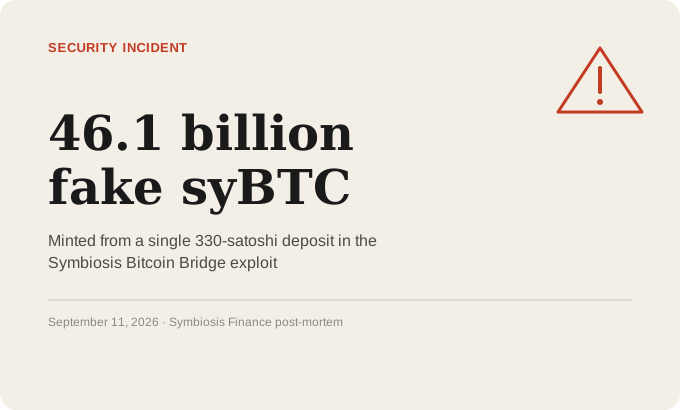
How Did a Hacker Create 46 Billion Fake Bitcoin in the Symbiosis Exploit? Decodes Bitcoin Hacker With WEEX Now
How two Symbiosis bridge bugs let a hacker mint 46.1 billion unbacked syBTC, drain Bitcoin pools and expose critical bridge risks.
This Cycle May Not Be Led by Bitcoin?
Bitcoin, Sports, and Politics: Predictive Markets Target $10 Trillion
Exclusive Interview with CK Zheng of ZX Squared Capital: How a Wall Street Risk Control Expert Accurately Grasped Market Trends and Outperformed Bitcoin Returns by Double
The End of the Blank Prompt: Why Trading AI Needs a Playbook
Bankless Ventures Partner Claims ZEC Will Attract Bitcoin Funds in 2026
US Bond Market 'Meltdown'... Why Are Interest Rates Soaring?
Sam Price: The Impact of Cryptocurrency Legislation on Market Dynamics


