
Switchboard Halts Oracle Operations On SUI And Aptos After Potential Compromise

 Prefer us on Google

Switchboard has halted oracle operations on several networks, including SUI and Aptos, after detecting a potential security compromise.
The precautionary halt also affects IOTA and Movement, according to the validated incident materials. The key detail is scope: Switchboard's oracle services were halted on affected chains, not the chains themselves.
That distinction matters.
This should not be framed as SUI, Aptos, IOTA, or Movement halting block production. It is an oracle infrastructure incident, and the impact depends on which applications rely on Switchboard feeds or services.
Still, oracle halts can be serious because DeFi applications depend on accurate, timely data to function safely.
TL;DR
- Switchboard halted oracle operations on SUI, Aptos, IOTA, and Movement.
- The move followed a potential security compromise.
- The affected chains did not necessarily halt; the issue concerns oracle infrastructure.
Why Oracle Incidents Matter
Oracles are critical infrastructure.
They bring external data into blockchain applications. Lending markets need prices. Perpetuals platforms need market data. Structured products need reference rates. DeFi protocols depend on oracles to decide liquidations, collateral values, and trading conditions.
If an oracle is compromised, stale, or unreliable, applications can become dangerous quickly.
That is why shutting down operations can be the safer move. A temporary halt may be disruptive, but bad data can cause far worse damage.
Switchboard's response appears to fit that risk-management logic.
A Precautionary Halt Is Not A Confirmed Exploit
The language matters.
A potential compromise is not automatically the same as a confirmed exploit. Until the provider publishes full incident details, the safer wording is that operations were halted as a precaution after a possible security issue.
That protects readers from assuming funds were lost, chains were hacked, or every dependent application failed.
The incident may still be serious, but it needs to be described accurately.
Security coverage should clarify what is known, what is not known, and which systems are affected.
-- Price
SUI And Aptos Depend On Reliable Data Layers
SUI and Aptos are both high-performance chains with growing DeFi ecosystems.
For these networks, oracle reliability matters because applications need trusted data to support lending, swaps, collateral, derivatives, and structured products. If oracle services are paused, some protocols may need to pause markets, adjust risk parameters, or rely on fallback systems.
That can affect users even if the base chain keeps running normally.
The same applies to IOTA and Movement if applications there rely on Switchboard services.
Multi-Chain Oracle Risk Cuts Across Ecosystems
One important lesson is that infrastructure incidents can span multiple chains.
A protocol like Switchboard may serve several ecosystems at once. That creates efficiency, but it also means a security concern can affect many networks simultaneously.
This is a broader DeFi risk.
Projects often think in chain-specific terms, but shared infrastructure can become a cross-chain dependency. Oracles, bridges, RPC providers, indexers, wallets, and middleware can all create shared points of failure.
Switchboard's halt is a reminder of that.
The Next Signals To Watch
Users and developers will be watching for a full incident explanation.
The important questions are straightforward: what was compromised, what services were affected, whether any data was manipulated, whether any protocols took losses, and when operations will resume.
Until then, applications using Switchboard feeds may need to remain cautious.
For the wider market, the incident shows why oracle security remains one of DeFi's most important issues.
Blockchains can keep producing blocks, but applications still need reliable data. When the data layer stops, the application layer can feel it immediately.
This article is based on Switchboard status materials and public incident information.
This content is provided for general informational purposes only and doesn't constitute financial, investment, legal, or tax advice. Any events, rewards, online promotions, or related information mentioned herein should not be considered a recommendation, solicitation, or invitation to purchase, sell, trade, or otherwise deal in any crypto assets. Crypto assets are highly volatile and may result in loss. The availability of WEEX services, products, and related events may vary by region. You are responsible for ensuring that your participation is in accordance with applicable local laws and regulations.
You may also like

LTC Airdrop 2026: How to Claim 50,000 USDT Rewards on WEEX

Raiffeisen’s crypto deal could reach 18 million customers. How many can actually trade?

TRON Surpasses $30T in Total Transaction Volume as it Secures its Place as Leading Chain for Stablecoins

HTX DeepThink: Opportunities Concentrate on Profitable and Fund-Supported Assets, BTC Still Has Room for Recovery After Consolidation

Why Did Sui (SUI) Crypto Price Jump 44%? Crypto OI and Leverage Explain the Rally
See why Sui (SUI) jumped 44%, how crypto OI and leverage amplified the rally, what the pullback means, and how to trade SUI on WEEX.

Circle expands CCTP to EURC and cirBTC on Arc
Bitcoin, Sports, and Politics: Predictive Markets Target $10 Trillion

AI Agent Jev Expects On-Chain Innovation Through Automated Judgment

The End of the Blank Prompt: Why Trading AI Needs a Playbook

Stablecoins hold nearly $200 billion in US debt, but money funds bought the surge
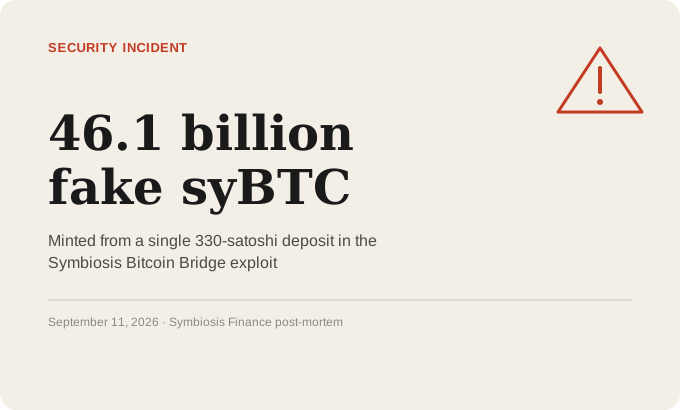
How Did a Hacker Create 46 Billion Fake Bitcoin in the Symbiosis Exploit? Decodes Bitcoin Hacker With WEEX Now
How two Symbiosis bridge bugs let a hacker mint 46.1 billion unbacked syBTC, drain Bitcoin pools and expose critical bridge risks.
CFTC's Selig Emphasizes the Need to Prepare for the Era of Large-Scale Tokenization in the U.S.

The IMF opens an office in Venezuela to supervise an economy that has already migrated to USDT

SOXL Stock Jumped 12% Yesterday: Three Companies Explain the Entire Move

Bitcoin's Hashrate Rises as Miners Reactivate Their Machines

Bitcoin 2x Leveraged ETF Launches on Cboe, But Doesn't Buy Bitcoin: Here's Why
Crypto: The ECB Enters the Tokenized Bond Market
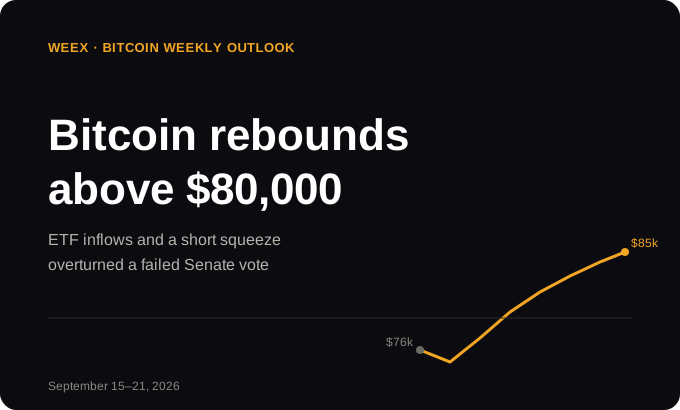
WEEX Bitcoin Weekly Outlook: Why Did Bitcoin Rebound Above $80,000 After the CLARITY Act Vote?
Bitcoin rebounded above $80,000 as SEC and CFTC action, renewed ETF inflows, and a short squeeze outweighed the failed CLARITY Act vote.
Coldcard whitehats move 52.37 BTC to recovery trust
Bitcoin's Rise Does Not Mean the Bull Market Has Returned; Don't Create Stories for Yourself
Deutsche Bank: Markets May Underestimate Rate Peaks After Central Banks' Coordinated Rate Hikes
Hyperliquid Opens Market for Bitcoin Volatility
Tom Lee Discusses Entry into Digital Asset Bull Market and AI Fund Movements

Micron Stock Price Target: Do the $1,500 to $2,000 Estimates Still Make Sense
Micron price targets range from $1,295 consensus to $1,500- lus individual calls, while options pricing implies an 11% swing on September 30 earnings, the actual results will settle which
![[ETH Letter] Ethereum Aims to Activate Sepolia Testnet on October 6](/public-static/26_2e1840f602.png?format=avif)
[ETH Letter] Ethereum Aims to Activate Sepolia Testnet on October 6
Fypher Partners with Korea Medical Tourism Promotion Association for Digital Dollar Payment
TapeOut Ecosystem Overview: From NAND, LATCH to On-Chain Application Ecosystem
[Coin Crime] "If you give us Tether, we will give you oil" - Polish state-owned company falls victim to international fraudsters

Why real-time election odds are misleading prediction market crypto traders
What is PCE and Why September 30 is Important for Cryptocurrencies
LTC Airdrop 2026: How to Claim 50,000 USDT Rewards on WEEX
Raiffeisen’s crypto deal could reach 18 million customers. How many can actually trade?
TRON Surpasses $30T in Total Transaction Volume as it Secures its Place as Leading Chain for Stablecoins
HTX DeepThink: Opportunities Concentrate on Profitable and Fund-Supported Assets, BTC Still Has Room for Recovery After Consolidation
Why Did Sui (SUI) Crypto Price Jump 44%? Crypto OI and Leverage Explain the Rally
See why Sui (SUI) jumped 44%, how crypto OI and leverage amplified the rally, what the pullback means, and how to trade SUI on WEEX.
Circle expands CCTP to EURC and cirBTC on Arc
Contents
Latest articles



Latest coin listings on WEEX


