
The 'Gambling Nature' of Koreans is Actually a Product of Life's Pressures

 Prefer us on Google


Author: danny
Did you know? There are 33 direct flights from South Korea to Macau every week, while there are about 21 direct flights from Incheon Airport to London Heathrow. The number of flights connecting Seoul to Macau is greater than those connecting to London.
Can you guess why?
Macau does not have the universities that South Koreans aspire to, nor does it have the headquarters of Samsung. After a four-hour flight from Seoul, South Korean citizens can enter casinos that are otherwise restricted by their own laws.
But the gambling tables for Koreans are not just in Macau.
They are also hidden in the mortgage payments of Seoul apartments, in the credit financing of brokerage accounts. They are also concealed in cryptocurrency exchanges and the double-leverage products of Samsung Electronics and SK Hynix.
II. What Kind of Life Do Koreans Want?
Some say Koreans have a strong "gambling nature"? Is that true? Before discussing the "gambling nature" of Koreans, let’s first look at how they evaluate their own lives.
According to the World Happiness Report 2026, which evaluates life from 2023 to 2025, South Korea ranks 67th globally with a score of 6.040. South Korea ranks high among developed economies in terms of per capita income and healthy life expectancy, but the "sense of freedom to choose a lifestyle" ranks 101st—interestingly, this indicator measures whether respondents feel they have the space to choose their own life paths (aka whether their fate is in their own hands).
It is important to note that South Koreans do not live in a poor country, nor do they lack education and healthcare. The problem is that many people have a good social foundation but feel that the paths available to them are limited.
A 2025 social survey by the Korean Statistical Office shows that only 15.6% of heads of households believe that their family income is relatively sufficient to meet the minimum living needs. Only 27% believe that their family finances will improve in the next year. The overall job satisfaction rate among wage workers is 38.3%. In career choices, 40% prioritize income. The most desired workplaces for those aged 13 to 34 are large corporations, accounting for 28.7%; public enterprises and government agencies follow behind.
Their aspirations for life are not unusual. Koreans want to travel and also want time to cultivate interests. In the survey, 65.7% listed travel as a leisure activity they wish to pursue in the future, and 41.7% hope to develop interests or engage in self-improvement. Among those dissatisfied with their leisure life, 48.7% cited economic burdens as the reason.
What people want is a stable job with a reliable income, a suitable place to live, and the flexibility to arrange their lives. The problem in Korea is:
The prices of these ordinary desires are increasingly determined by the asset market.
Entering a large corporation can provide a stable salary, but job positions are limited. Those who do not enter the chaebol system can buy chaebol stocks. Those who cannot afford an apartment in Seoul can increase their loan ratios. Those with insufficient principal who want to participate in the semiconductor cycle can rely on brokerage firms for credit financing and double ETFs.
When life goals need to be achieved through asset prices, investing becomes a mandatory question.
III. Life and Death, Taxes, and Samsung
Franklin said that in life, one cannot escape death and taxes. In Korea, one must also add Samsung to the list. (Now, double ETFs must be included as well.)
A South Korean can live without a Samsung phone, but it is hard to escape the economic structure represented by the chaebols. Large corporations dominate exports, R&D, and quality employment. The weight of Samsung Electronics and SK Hynix in the index links pensions, funds, and personal accounts to the stock prices of these two companies.
This structure and development path stem from Korea's development history.
During the industrialization period, Korea lacked capital, and the government supported the export industry through the banking system and foreign debt. Companies built steel mills, shipyards, and semiconductor factories with loans, then repaid the debts with future export revenues. Leverage shortened the time needed for industrialization and also promoted the expansion of chaebols.
By the end of 1997, the debt-to-equity ratio of Korea's top 30 chaebols reached 509%. The overall debt-to-equity ratio of the manufacturing industry rose from about 300% in 1996 to about 400% in 1997. After foreign currency financing was interrupted, many companies went bankrupt. (Don’t laugh; this is similar to the situation after foreign capital withdrew from Kospi in the past two weeks.)
The state once built factories with future export revenues. Ordinary families later bought apartments with future wages. This method created growth in Korea's history and shaped a social understanding: waiting to accumulate takes time, and borrowing funds is necessary to catch up with cycles—over time, Korea gradually formed a path dependence.
IV. Policies Encourage Entering the Future with Loans
The South Korean government strictly controls gambling, so it is even less likely to issue policies encouraging gambling. But for the clever Korean public, does this really make a difference?
The South Korean government encourages home buying, the development of capital markets, and the localization of financial products. The goals in policy documents have legitimate reasons, but in execution, they have lowered the threshold for using leverage.
In 2022, the Financial Services Commission of Korea raised the maximum loan-to-value ratio for first-time homebuyers to 80%, no longer distinguishing between regions and prices of residential properties. The policy also extended the maximum term for government-supported mortgage loans from 40 years to 50 years and designed a repayment method for young people and newlyweds that starts low and ends high. Officials explained these measures as reducing the initial burden of home buying and helping residents enter the "housing ladder."
The special policy mortgage in 2023 allows eligible first-time homebuyers to borrow up to 80% of the home price, with a loan term of up to 50 years, and some loans are exempt from the usual debt-to-income ratio rules. Extending the loan term can lower monthly payments and allow families to write more future income into the home purchase contract.
These policies aim to help families with genuine needs. However, the results extend beyond just the genuine need level. After the ability to borrow increases, families can accept higher home prices. Sellers know that buyers can borrow more money, and new credit may enter the housing market.
The government later began tightening loans in the Seoul area, limiting mortgage amounts and lowering the loan-to-value ratios in some regions. This back-and-forth policy illustrates that the South Korean authorities have been trying to resolve the conflict between two goals: they want families to afford homes, but they cannot let credit drive up housing prices.
The problem is not about a single instance of loosening or tightening. South Korea's housing policy has long treated loans as a solution to housing burdens. When houses are too expensive, the policy's answer is often to extend repayment periods or allow homebuyers to increase their loan ratios.
But the result is that housing prices have not decreased; they have merely secured a longer time to repay.
V. Housing Brings Leverage into Households
As of March 2026, South Korea's household credit balance reached 1,993.1 trillion won, with household loans accounting for 1,865.8 trillion won. In one quarter, household loans increased by 12.9 trillion won.
Korean housing leverage also includes the entire rental system. Tenants pay landlords a deposit equivalent to 50% to 70% of the property value in exchange for lower monthly rent. Tenants may raise the deposit through bank loans, while landlords use the deposit to repay mortgages or purchase another property.
Assuming an apartment is worth 1 billion won. The landlord invests 100 million won, borrows 400 million from the bank, and collects a 500 million won full rental deposit from the tenant. The landlord controls 1 billion won in assets with 100 million won of their own funds.
If housing prices rise by 10%, the asset appreciates by 100 million won, equal to the original investment. If housing prices fall by 10%, the landlord's equity goes to zero. If the next tenant is only willing to pay a 400 million won deposit, the landlord must find 100 million won to refund the old tenant.
During the phase of rising housing prices, this structure is referred to as the asset appreciation path; when prices fall, the hidden oil tank under the apartment may explode. Especially when landlords use tenants' rent to speculate in stocks or cryptocurrencies and end up losing everything, the bank will reclaim the property.
Interestingly, in Korea, taking on a "mortgage" is a socially recognized act. If a person borrows money to buy stocks, family members will question the risks; but if they borrow money to buy a house, it is often understood as starting a family. Korean society connects real estate with marriage, education, and retirement arrangements, and leverage thus gains a meaning in life.
VI. A Mobile Phone Delivers Double Products to Everyone
In the past, leveraged products belonged to trading halls and professional investors. Korean mobile brokers have changed the way they reach investors.
In April 2026, the Financial Services Commission of Korea approved single-stock ETFs and ETNs to enter the domestic market, offering up to double daily exposure. The regulatory authorities provided reasons including meeting investor demand, preventing capital from flowing overseas, and improving trading convenience. The policy documents also noted that Korean investors had previously been able to purchase similar products listed in the US and Hong Kong through domestic brokers' mobile applications.
Investors only need to complete a course, add an hour of intensive learning, and maintain a basic margin of 10 million won in their accounts to trade single-stock leveraged products. Double Samsung Electronics and double SK Hynix have thus entered thousands of households.
Risk warnings have been extensively communicated, but they have not informed investors that this position may impact marriage and housing.
A 24-year-old South Korean university student once told Reuters that he used margin financing to grow a principal of 10 million to 20 million won to nearly 300 million won. After the market reversed, the profits disappeared within weeks. He still plans to borrow money to try again. This case does not represent all retail investors but illustrates how leveraged products change people's perception of principal.
When the first success comes from borrowing, people easily view leverage as part of their ability. The profits from increased positions are interpreted as correct judgment, while the amplifying effects of debt fade from memory.
VII. Hynix Becomes National Wealth News
Faith requires a figure, and leveraged products need a target. In 2026, SK Hynix took on this role.
On April 23, SK Hynix announced a quarterly operating profit of 37.61 trillion won, a 405% year-on-year increase. This performance made it into television news and prompted brokerages to raise their target prices. A well-known investment bank raised its target price from 1.6 million won to 2 million won.
In May, SK Hynix's stock price broke through 2 million won during trading, and "Two Million Hynix" became a news headline. The stock price later reached 2.5 million won. As the stock price repeatedly broke through integer thresholds, this contagion and dissemination were no less than Faker winning the LOL World Championship.
The income of company employees also became social news. SBS estimated that if the relevant profit and bonus distribution formula were fulfilled, the average performance bonus for SK Hynix employees could exceed 600 million won. Various memes emerged during this time. There were also negotiations between Hynix and employees regarding salary issues, which were only calmed by government intervention.
Another report referred to the admission competition for Hynix-related disciplines as the "Hynix Exam," with the average application competition ratio for three related institutions reaching 30.98 to 1.
These social events are not advertisements, but they are better than advertisements.
The content seen by an ordinary family is very direct: Hynix's profits grew fourfold, stock prices crossed one integer after another, and employee bonuses reached the scale of many years of ordinary people's income. Corporate performance transformed from financial news into a demonstration of wealth.
Those without holdings do not feel a stock's rise. They may doubt that they have missed Korea's next industrial upgrade.
This sentiment enters family chat groups and lunch discussions. Friends hold Hynix stocks while they only have salaries; colleagues buy double products, making their ordinary stocks seem too slow. Leverage is no longer viewed as a dangerous tool; it has become a method to catch up with others.
VIII. Policies Bring Products Back Domestic, Then Start to Hit the Brakes
Single-stock leveraged products entered the South Korean market at the end of May. Regulators hoped to bring overseas demand back home. After the influx of funds, double products of Samsung Electronics and SK Hynix became the center of retail trading.
By the end of May, the scale of stock borrowing formed by Korean investors through financing and leveraged products reached about 60 trillion won. In July, regulatory authorities announced a suspension of new single-stock leveraged ETFs and raised the minimum cash margin from 10 million won to 30 million won.
On July 28, KOSPI closed down 10.84%, with Samsung Electronics and SK Hynix both down about 14%. The next day, the index fell another 12.6% during trading. Leveraged ETFs needed to adjust positions, and credit accounts faced margin requirements, leading to the next round of selling.
On July 29, the South Korean finance minister and the chairman of the Financial Services Commission publicly apologized for approving single-stock leveraged ETFs. They admitted that the policy design did not fully consider the risks that the products might bring.
From opening products to public apology, the time span was less than three months.
IX. Cryptocurrency, Gold, and the Dollar
The leveraged life does not stop at Korean stocks.
In the second half of 2025, the daily trading volume and total market value of the Korean cryptocurrency market declined, but the number of tradable users increased by 360,000, and deposits in exchanges grew by 31%. After the market weakened, accounts and funds did not leave. Participants are waiting for the next opportunity.
Cryptocurrency is suitable for this waiting. It trades 24/7, requires no down payment, and has no chaebol recruitment thresholds. Small amounts of principal can buy high-volatility outcomes. Most people do not change their lives through tokens, but every market cycle generates a few success stories that can be spread.
Gold has also entered the same mobile phone. Korean exchanges allow investors to trade gold by the gram through computer or mobile securities systems. Assets that previously required a trip to a gold store to purchase have become real-time prices in accounts.
The scale of South Korean residents purchasing overseas securities reached $140.3 billion in 2025, up from $67 billion in 2024. The proportion of overseas securities investment to GDP rose from 3.6% to 7.5%. Buying US stocks is not only an investment in companies but also a way to hold dollars.
After the depreciation of the won, those holding US stocks and gold gained exchange rate profits. Those without overseas assets saw their purchasing power decline and thus joined in currency exchange. Individual self-protection forms capital flows, and capital flows in turn influence exchange rate expectations.
A South Korean's salary is settled in won, and mortgage payments are also made in won. However, their imagination of wealth is jointly determined by Seoul housing prices, Hynix stock prices, and the dollar exchange rate.
X. Gambling Nature or System
Are Koreans really "strong gamblers"?!
Flights, gambling, and leveraged accounts can prove the level of participation, but this is just the tip of the iceberg. Koreans face a system environment with its own history. The state relies on credit to complete industrialization, housing policies use loans to help families enter the market, and capital market policies use leveraged products to retain funds.
Each policy has its reasons. Together, they convey a signal: insufficient principal is not a problem; future income can be utilized.
The happiness index presents another side. Koreans' life evaluations do not match their economic scale, and the "sense of freedom to choose a lifestyle" ranks even lower. In family surveys, fewer than one in six believe their income is sufficient, and fewer than four in ten are satisfied with their work. Many want to travel and pursue personal lives but first need to address housing and retirement.
When people believe that wages cannot achieve these goals, the asset market will take on the task of social mobility. Policies provide loans and products, news provides success samples, and mobile applications complete transactions.
Thus, Korea's leverage culture cannot be explained by a simple "love to gamble." It is the result of a system and individual choices driving each other.
For those with sufficient capital, leverage is a financing tool. When ordinary families use leverage, they are mortgaging wages not yet earned. The two seem to be purchasing the same asset, but the waiting time they possess is different.
Korea's industrialization proves that leverage can compress the time needed to build industries. The limitations faced by families and retail investors are that they do not have the tax authority of the state or the banking relationships of chaebols. When prices fall, debts do not get postponed just because the long-term outlook is good.
The 33 flights to Macau are just the entry point of this article. Korea's gambling tables are not only set in casinos but also exist in the life plans of ordinary people. When housing, retirement, and social status must be achieved through asset appreciation, refusing to place bets can also be understood as a risk.
Leverage can allow people to enter the market early, but it cannot allow value to be realized early.
However, if you say all the responsibility lies with leverage, Archimedes would certainly disagree.
Postscript
Even in today's widespread lament, (American) leveraged ETF products remain a favorite among South Korean stock investors.
-- Price
This content is provided for general informational purposes only and doesn't constitute financial, investment, legal, or tax advice. Any events, rewards, online promotions, or related information mentioned herein should not be considered a recommendation, solicitation, or invitation to purchase, sell, trade, or otherwise deal in any crypto assets. Crypto assets are highly volatile and may result in loss. The availability of WEEX services, products, and related events may vary by region. You are responsible for ensuring that your participation is in accordance with applicable local laws and regulations.
You may also like

XRPL to Implement Major Upgrade on October 5: Adding Permission Delegation Feature

67% of the wealthy own digital assets, but the crypto adoption gap remains huge

How to Rewrite Internet Rules When Everyone Has an Indefatigable Agent

The End of the Blank Prompt: Why Trading AI Needs a Playbook

Cardano proposal slashes fees by 55%, but it comes with a cost for small pools

The Evolution of AI: The Boundaries and Truth of Recursive Self-Improvement (RSI)
The Quantum Issue: You Never Really Know The Future

Security and fees hold back deeper crypto use among wealthy investors: Nexo report

Bitcoin Developers Concerned About Mining Subsidy

VVV Hits All-Time High: Founder’s Perspective on Models, Privacy, and Crypto

XRPL fixes critical pre-mainnet flaw, but client apps remain at risk

Glassnode Indicates Shift Towards Altcoin Season
Crypto: Kalshi accused of inflating its volumes with thousands of identical orders

HODLing ETH: Should You Choose Staking for Yield or Collateralized Lending?

SEC Clarity Meets Fed Rate Hike: How WEEX TradFi Lucky Eggs S2 Taps Into Cross-Market Opportunities

How Significant Are Changes in Overseas AI Investment?
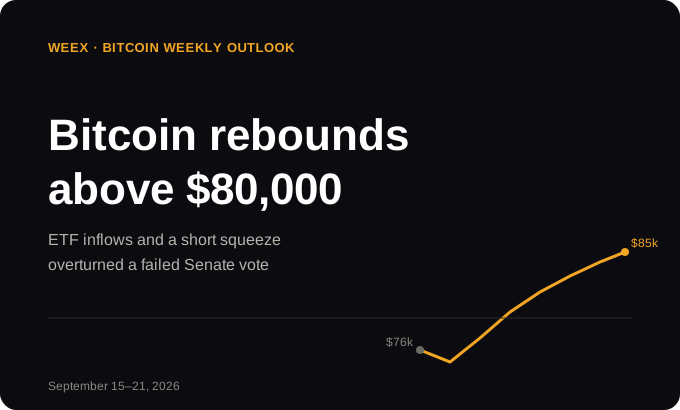
WEEX Bitcoin Weekly Outlook: Why Did Bitcoin Rebound Above $80,000 After the CLARITY Act Vote?
Bitcoin rebounded above $80,000 as SEC and CFTC action, renewed ETF inflows, and a short squeeze outweighed the failed CLARITY Act vote.
$8 Makes a Comeback, This Time X Money Rewrites the Logic of NFT Issuance
AMD Jumps Nearly 10%, Market Cap Tops $1 Trillion| WEEX TradFi Daily Brief (September 22, 2026)
Global markets on September 22 focus on a repair in AI-compute pricing. On September 21 the three major equity indexes closed higher. AMD rose nearly 10% and its market cap crossed $1 trillion for the first time, while Intel and Arm also surged. Brent crude fell about 3.4% to $100.34 and the 10-year Treasury yield eased to about 4.96%, lowering discount-rate pressure on long-duration tech. Bitcoin briefly broke above $87,000 and total crypto market cap returned above $3 trillion. Investors next watch consumer and housing earnings plus PMI flash prints.
Balancer Community Proposes Fork and Rebirth

The Answer to Dreamforce 2026: AI Agent, Has It Finally Turned from Demo to Revenue?
Ethereum: BitMine Approaches 5% of Total ETH Supply
Bitcoin's $84K rally isn't saving miners as difficulty signals already flash caution
ZEC's Largest Mining Company Moves to US Stock Market After Mining 70,000 ZEC in Six Months

Validators Vote on Batch V1.1 After Security Overhaul

Aptos Validators Decrease by 40% in Two Years, Concentration of Validator Nodes Shifts to Europe and America

SEC Takes Action: Who Can Handle "Compliant ICOs"?

TRON Weekly Industry Report: Regulatory and Interest Rate Pressures Fail to Dampen BTC Bullish Sentiment, Detailed Analysis of PayFi High-Performance Payment Infrastructure Axon Finance

When AI Agents Accelerate into Intranets: The Main Battlefield of Cybersecurity Has Changed
How to Earn Crypto Futures Trading Rewards on WEEX: Daily Lucky Eggs S2
XRPL to Implement Major Upgrade on October 5: Adding Permission Delegation Feature
67% of the wealthy own digital assets, but the crypto adoption gap remains huge
How to Rewrite Internet Rules When Everyone Has an Indefatigable Agent
The End of the Blank Prompt: Why Trading AI Needs a Playbook
Cardano proposal slashes fees by 55%, but it comes with a cost for small pools
The Evolution of AI: The Boundaries and Truth of Recursive Self-Improvement (RSI)


