
The Milky Way May Have Changed Orientation After an Ancient Galactic Collision

 Prefer us on Google

The Milky Way may have changed its orientation after an ancient collision with another galaxy. This is the possibility arising from simulations conducted with supercomputers by researchers at Durham University in the UK, whose results were presented at the national astronomy conference of the Royal Astronomical Society in Birmingham.
The study analyzed galaxies similar to ours to try to explain a characteristic observed in the Milky Way: the very slow rotation of its stellar halo. This halo surrounds the spiral disk where most of the stars in the galaxy are located and is largely composed of stars that formed in smaller galaxies that were later absorbed through galactic mergers.
Observations from the Gaia mission of the European Space Agency (ESA) had shown that the stellar halo of the Milky Way rotates at a very low speed. To understand this behavior, researchers studied the evolution of 25 similar galaxies using the Auriga cosmological simulation set.
The analysis followed the evolution of these galaxies over billions of years. The researchers found that galaxies with slower rotating stellar halos had undergone a significant head-on merger with another galaxy.
During this process, their disks changed orientation throughout their evolution. From this relationship, the team proposed that something similar may have occurred with the Milky Way.
"We already know that the Milky Way had a massive head-on collision with a galaxy known as the Sausage or Gaia-Enceladus. For this reason, we believe that the disk of the Milky Way likely flipped in the past," explained astronomer Kirill Batrakov.
Gaia-Enceladus was a massive dwarf galaxy that collided with the primordial Milky Way about 10 to 11 billion years ago. It was then absorbed by our galaxy as part of a merger that, according to the study, was the largest event in the early history of the Milky Way.
This collision transformed the galactic structure and left billions of stars orbiting in very elongated trajectories. This movement pattern was named "Sausage" due to its characteristic shape.
The new study links this episode to the orientation of the galactic disk and the slow rotation of the stellar halo. According to the simulations, a significant head-on merger can alter the subsequent evolution of a galaxy and modify the position of its disk.
Batrakov's work also indicates that the rotation of the stellar halo of the Milky Way is linked to the rotation of its dark matter halo.
This relationship suggests that both components would have evolved together during the growth of the galaxy. The stellar halo, formed by stars captured from smaller galaxies, and the dark matter halo would be part of the same accumulation and merger story.
The hypothesis aims to reconstruct how the Milky Way took shape over billions of years. The simulations do not show a direct observation of the galactic past, but they allow for comparisons of the evolution of similar galaxies and assess what processes may explain the current structure.
Most of the stars in the Milky Way are found in its flat spiral disk. However, the stellar halo surrounding it retains signals of ancient mergers and absorptions of smaller galaxies.
Therefore, studying its movement provides information about events that occurred in the early stages of the galaxy. In this case, the slow rotation of the halo and the possible flipping of the disk appear to be associated with the ancient collision with Gaia-Enceladus.
The results of the simulations add a new clue about the formation of the Milky Way. According to the researchers, the galaxy we inhabit today may have changed its orientation as a consequence of one of the most significant impacts in its history.
-- Price
This content is provided for general informational purposes only and doesn't constitute financial, investment, legal, or tax advice. Any events, rewards, online promotions, or related information mentioned herein should not be considered a recommendation, solicitation, or invitation to purchase, sell, trade, or otherwise deal in any crypto assets. Crypto assets are highly volatile and may result in loss. The availability of WEEX services, products, and related events may vary by region. You are responsible for ensuring that your participation is in accordance with applicable local laws and regulations.
You may also like
Stablecoins hold nearly $200 billion in US debt, but money funds bought the surge

How Did a Hacker Create 46 Billion Fake Bitcoin in the Symbiosis Exploit? Decodes Bitcoin Hacker With WEEX Now
How two Symbiosis bridge bugs let a hacker mint 46.1 billion unbacked syBTC, drain Bitcoin pools and expose critical bridge risks.

CFTC's Selig Emphasizes the Need to Prepare for the Era of Large-Scale Tokenization in the U.S.
The IMF opens an office in Venezuela to supervise an economy that has already migrated to USDT

SOXL Stock Jumped 12% Yesterday: Three Companies Explain the Entire Move
Bitcoin's Hashrate Rises as Miners Reactivate Their Machines
Bitcoin 2x Leveraged ETF Launches on Cboe, But Doesn't Buy Bitcoin: Here's Why
Crypto: The ECB Enters the Tokenized Bond Market
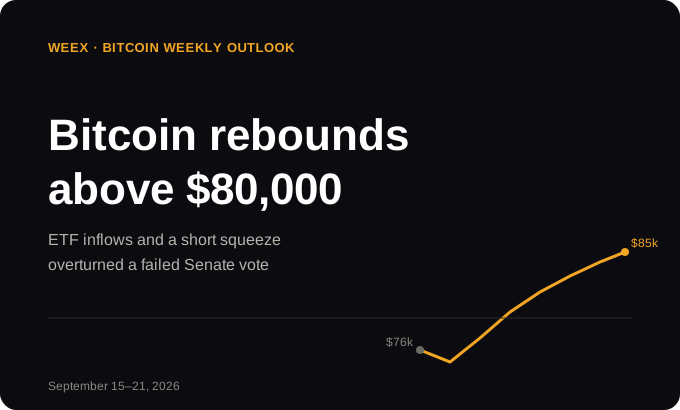
WEEX Bitcoin Weekly Outlook: Why Did Bitcoin Rebound Above $80,000 After the CLARITY Act Vote?
Bitcoin rebounded above $80,000 as SEC and CFTC action, renewed ETF inflows, and a short squeeze outweighed the failed CLARITY Act vote.
Coldcard whitehats move 52.37 BTC to recovery trust
Bitcoin's Rise Does Not Mean the Bull Market Has Returned; Don't Create Stories for Yourself
Deutsche Bank: Markets May Underestimate Rate Peaks After Central Banks' Coordinated Rate Hikes
Hyperliquid Opens Market for Bitcoin Volatility
Tom Lee Discusses Entry into Digital Asset Bull Market and AI Fund Movements

Micron Stock Price Target: Do the $1,500 to $2,000 Estimates Still Make Sense
Micron price targets range from $1,295 consensus to $1,500- lus individual calls, while options pricing implies an 11% swing on September 30 earnings, the actual results will settle which
![[ETH Letter] Ethereum Aims to Activate Sepolia Testnet on October 6](/public-static/26_2e1840f602.png?format=avif)
[ETH Letter] Ethereum Aims to Activate Sepolia Testnet on October 6
Fypher Partners with Korea Medical Tourism Promotion Association for Digital Dollar Payment
TapeOut Ecosystem Overview: From NAND, LATCH to On-Chain Application Ecosystem
[Coin Crime] "If you give us Tether, we will give you oil" - Polish state-owned company falls victim to international fraudsters

Why real-time election odds are misleading prediction market crypto traders

What is PCE and Why September 30 is Important for Cryptocurrencies
Bitcoin: JPMorgan Sees BTC Outperforming Gold

U.S. Treasury Sanctions BitBank Over Iranian Sanctions-Evasion Network

Brazil blocks stablecoins from key cross-border payment rail as $1.1 trillion market faces new limits
RISEx Proposes 20% Retention Condition for Stolen Funds

USDT in Wallets May Be Blocked. What to Do and How to Store Them in Russia

Tokenized stocks face 24/7 pricing gap: RedStone COO
Has the Macroeconomic Pricing of BTC Changed? A Nine-Year Review of the Federal Reserve, the Dollar, the Nasdaq, ETFs, and Stablecoins
What Does the Fed's Hawkish Rate Hike Mean for the Dollar?
Galaxy launches 2 stablecoin vaults on Kamino
Stablecoins hold nearly $200 billion in US debt, but money funds bought the surge
How Did a Hacker Create 46 Billion Fake Bitcoin in the Symbiosis Exploit? Decodes Bitcoin Hacker With WEEX Now
How two Symbiosis bridge bugs let a hacker mint 46.1 billion unbacked syBTC, drain Bitcoin pools and expose critical bridge risks.
CFTC's Selig Emphasizes the Need to Prepare for the Era of Large-Scale Tokenization in the U.S.
The IMF opens an office in Venezuela to supervise an economy that has already migrated to USDT
SOXL Stock Jumped 12% Yesterday: Three Companies Explain the Entire Move
Bitcoin's Hashrate Rises as Miners Reactivate Their Machines
Contents
Latest articles



Latest coin listings on WEEX


