
The Surge of 'Buybacks' in the Cryptocurrency Market

 Prefer us on Google


Cryptocurrency (digital asset) projects have reportedly invested the largest amount ever in 'buybacks', similar to stock market buybacks, by purchasing their own issued tokens from the market. This trend reflects a growing movement to utilize profits generated by projects to buy back tokens, thereby linking business performance to token value.
According to a report by the Financial Times (FT) citing blockchain data analysis firm Allium Labs, digital asset projects have invested approximately $638 million (about 890 billion KRW) in their own token buybacks this year, marking the largest scale ever.
In the same period last year, the buyback amount was $545 million (about 760 billion KRW). In 2024, the total annual buyback amount was only $366,000 (about 500 million KRW). Comparing this year's buyback scale to the total annual amount in 2024 shows an increase of about 1,740 times.
The increasing interest in a structure that returns profits generated by protocols to token holders is cited as a reason for the active buybacks by digital asset projects. In the past, even when protocols generated profits, there were many cases where they were not directly linked to the value of their own tokens. However, recently, more projects are using money earned from fees to buy back tokens.
Matt Hogan, Chief Investment Officer (CIO) of Bitwise, predicted in a report last August that "the value of digital assets, excluding Bitcoin, will gradually be determined by profits, just like stocks or bonds." He explained that in the past, even when digital asset projects secured millions of users and billions of dollars in revenue, it was rare for that money to return to tokens or token holders, but this structure is changing.
A representative project leading this year's buyback market is the decentralized exchange (DEX) Hyperliquid. Hyperliquid allocates most of the fees generated from trading to an 'Assistance Fund' and uses it to continuously buy back its own token HYPE from the market. Currently, 99% of the fees generated by the protocol are allocated to this fund. As of the 23rd of last month, the Assistance Fund has bought back approximately 46.7 million HYPE tokens, permanently removing them from circulation, which corresponds to 4.7% of the initial total issuance.
The structure is relatively simple. As trading on Hyperliquid increases, fee revenue grows, and as revenue increases, the amount of HYPE bought back from the market also rises. This directly links the project's business performance to the demand for its own tokens.
The token issuance platform Pump.fun is also gaining attention as an active buyback project. Pump.fun has announced that it plans to invest 50% of its current revenue into the market purchase and burning of its own token PUMP.
As these two projects lead the growth of the buyback market this year, the prices of related tokens have also risen significantly. The fact that projects are actually using their earned revenue for token buybacks is becoming a new valuation factor for investors.
This structure is spreading to other major projects as well. The Ethereum Layer 2 project Optimism has decided to use 50% of the revenue generated from its Superchain for the buyback of its own token OP over the next year. The Superchain is a blockchain ecosystem utilizing Optimism's technology, OP Stack, and the bought OP tokens will not be burned but stored in Optimism's treasury.
Ethena, which operates the stablecoin USDe, also announced a similar plan on the 27th of last month. Ethena proposed to increase the buyback ratio each time the circulating supply of USDe reaches certain criteria, and when the first criterion is met, to use 95% of the net profit returning to the foundation from core business for the purchase of ENA (Ethena). However, this proposal is still in the proposal stage and needs to go through governance procedures, so its execution remains to be seen.
There are also projects that are already operating buybacks. The decentralized lending protocol Aave has been running an AAVE buyback program using funds from Aave DAO. Since starting the program in April last year, it has bought back more than 205,000 AAVE tokens in the first 10 months, which is about 1.28% of the total supply.
Fidelity Digital Assets, the digital asset division of global asset management firm Fidelity, evaluated this trend in its outlook report this year as one of the 'changes in token holder rights'. In the past, even when protocols generated profits, there was a lack of structures connecting them to token holders, but token buybacks funded by profits are beginning to bridge this gap.
However, just because funds are invested in buybacks does not guarantee that token prices will rise. The Solana-based DEX aggregator Jupiter is a representative case. Although it conducted buybacks, it could not prevent the price decline of its own token JUP. If the market's selling pressure or new token supply exceeds the buying demand from the buybacks, it becomes difficult to support the price.
Rex Sokolins, co-founder of digital asset investment firm Generative Ventures, pointed out in an interview with The Block that "we need to look at not only the scale of buybacks but also the market's trading volume and selling pressure." For example, even if a buyback of $100 million is conducted annually, if the daily trading volume reaches $20 million and there is significant selling pressure due to unlocks, the impact on the market may be limited.
Amir Hajian, a researcher at digital asset liquidity provider Keyrock, also cited selling pressure from unlocks and new issuances as variables. He analyzed that even if the buyback structure is well-designed, if the selling pressure from unfavorable tokenomics significantly exceeds the buying pressure from buybacks, it will be difficult to achieve effectiveness.
How the bought tokens are handled is also an aspect that needs to be examined. If tokens are burned after buybacks, the supply is permanently removed from circulation, but if the project stores them in a separate wallet or treasury, there remains a possibility that they could return to the market in the future.
For this reason, it is necessary to conduct additional analysis rather than simply judging the value of tokens based on the scale of buybacks. The first thing to consider is where the buyback funds come from. If a project consistently invests profits generated from actual business, such as fees received from users, into buybacks, then the increase in transactions and users can serve as the basis for expanding buybacks.
Amir Hajian from Keyrock also analyzed that for buybacks to be effective, the scale of purchases must be sufficiently large compared to the project value, and the funds must be recurring protocol revenue rather than one-time funds.
Whether a project can continuously generate profits, how much of that is invested in buybacks, whether the bought tokens are actually burned, and whether the buyback scale is sufficiently large compared to the new issuance and unlock volumes that will be released to the market in the future are all factors that can determine the actual effectiveness. Whether the cryptocurrency market's 'buyback' trend can establish itself as a sustainable token value return structure beyond a simple price support measure ultimately depends on whether these conditions can be met.
-- Price
This content is provided for general informational purposes only and doesn't constitute financial, investment, legal, or tax advice. Any events, rewards, online promotions, or related information mentioned herein should not be considered a recommendation, solicitation, or invitation to purchase, sell, trade, or otherwise deal in any crypto assets. Crypto assets are highly volatile and may result in loss. The availability of WEEX services, products, and related events may vary by region. You are responsible for ensuring that your participation is in accordance with applicable local laws and regulations.
You may also like

Circle expands CCTP to EURC and cirBTC on Arc

Bitcoin, Sports, and Politics: Predictive Markets Target $10 Trillion

AI Agent Jev Expects On-Chain Innovation Through Automated Judgment

The End of the Blank Prompt: Why Trading AI Needs a Playbook

Stablecoins hold nearly $200 billion in US debt, but money funds bought the surge
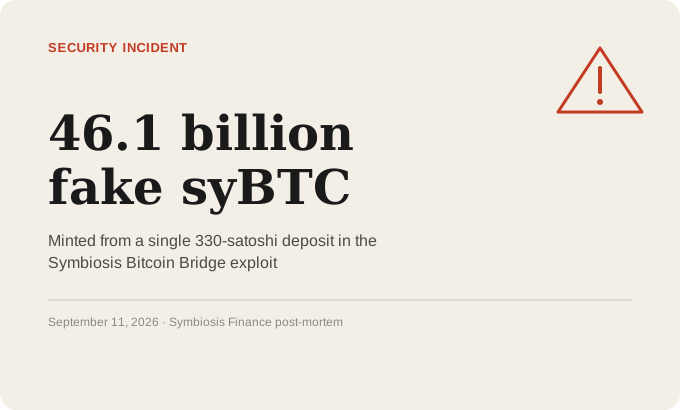
How Did a Hacker Create 46 Billion Fake Bitcoin in the Symbiosis Exploit? Decodes Bitcoin Hacker With WEEX Now
How two Symbiosis bridge bugs let a hacker mint 46.1 billion unbacked syBTC, drain Bitcoin pools and expose critical bridge risks.
CFTC's Selig Emphasizes the Need to Prepare for the Era of Large-Scale Tokenization in the U.S.

The IMF opens an office in Venezuela to supervise an economy that has already migrated to USDT

SOXL Stock Jumped 12% Yesterday: Three Companies Explain the Entire Move
Bitcoin's Hashrate Rises as Miners Reactivate Their Machines

Bitcoin 2x Leveraged ETF Launches on Cboe, But Doesn't Buy Bitcoin: Here's Why

Crypto: The ECB Enters the Tokenized Bond Market
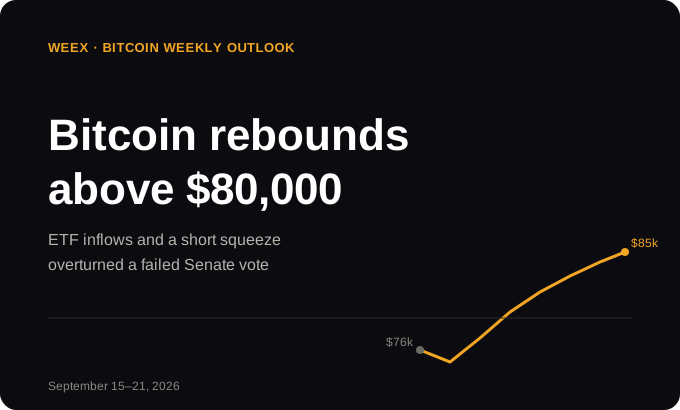
WEEX Bitcoin Weekly Outlook: Why Did Bitcoin Rebound Above $80,000 After the CLARITY Act Vote?
Bitcoin rebounded above $80,000 as SEC and CFTC action, renewed ETF inflows, and a short squeeze outweighed the failed CLARITY Act vote.
Coldcard whitehats move 52.37 BTC to recovery trust
Bitcoin's Rise Does Not Mean the Bull Market Has Returned; Don't Create Stories for Yourself
Deutsche Bank: Markets May Underestimate Rate Peaks After Central Banks' Coordinated Rate Hikes
Hyperliquid Opens Market for Bitcoin Volatility
Tom Lee Discusses Entry into Digital Asset Bull Market and AI Fund Movements

Micron Stock Price Target: Do the $1,500 to $2,000 Estimates Still Make Sense
Micron price targets range from $1,295 consensus to $1,500- lus individual calls, while options pricing implies an 11% swing on September 30 earnings, the actual results will settle which
![[ETH Letter] Ethereum Aims to Activate Sepolia Testnet on October 6](/public-static/26_2e1840f602.png?format=avif)
[ETH Letter] Ethereum Aims to Activate Sepolia Testnet on October 6
Fypher Partners with Korea Medical Tourism Promotion Association for Digital Dollar Payment
TapeOut Ecosystem Overview: From NAND, LATCH to On-Chain Application Ecosystem
[Coin Crime] "If you give us Tether, we will give you oil" - Polish state-owned company falls victim to international fraudsters

Why real-time election odds are misleading prediction market crypto traders

What is PCE and Why September 30 is Important for Cryptocurrencies
Bitcoin: JPMorgan Sees BTC Outperforming Gold

U.S. Treasury Sanctions BitBank Over Iranian Sanctions-Evasion Network
Brazil blocks stablecoins from key cross-border payment rail as $1.1 trillion market faces new limits
RISEx Proposes 20% Retention Condition for Stolen Funds

USDT in Wallets May Be Blocked. What to Do and How to Store Them in Russia
Circle expands CCTP to EURC and cirBTC on Arc
Bitcoin, Sports, and Politics: Predictive Markets Target $10 Trillion
AI Agent Jev Expects On-Chain Innovation Through Automated Judgment
The End of the Blank Prompt: Why Trading AI Needs a Playbook
Stablecoins hold nearly $200 billion in US debt, but money funds bought the surge
How Did a Hacker Create 46 Billion Fake Bitcoin in the Symbiosis Exploit? Decodes Bitcoin Hacker With WEEX Now
How two Symbiosis bridge bugs let a hacker mint 46.1 billion unbacked syBTC, drain Bitcoin pools and expose critical bridge risks.





