
Who Benefits from Interest Rate Hikes? Clarity Act's Failure Due to Established Interests

 Prefer us on Google


Hayes: Interest Rate Hikes Favor the Wealthy
Opposition to Clarity for Financial Stability?
Saylor Criticizes "Protection of Banking Interests"
[Block Media Reporter Lee Jeong-hwa] A debate is intensifying around the question of "who benefits from the financial market" amid the U.S. interest rate hikes and the failure of the Clarity Act (CLARITY Act), which aimed to structure the digital asset market.
Arthur Hayes argued that interest rate hikes increase the purchasing power of the wealthy for financial assets. Michael Saylor, chairman of Strategy, criticized the restrictions on stablecoin rewards included in the Clarity Act as measures to protect banks.
There is a growing call to strengthen the digital asset market, including Bitcoin, to dismantle financial privileges.
"Raising Rates Means More Money for the Rich"
On the 19th (local time), Arthur Hayes evaluated the Clarity Act as "nonsense digital asset regulation" and criticized the interest rate hikes. He claimed, "Interest rate hikes give the wealthy more dollars to consume more financial assets."
See we didn't need some nonsense piece of crypto regulation, Clarity Act, just a rate hike that puts more dollars in the hands of rich people to consume more financial assets.
--- Arthur Hayes (@CryptoHayes) September 18, 2026
Hayes's statement is paradoxical. Generally, when interest rates rise, borrowing costs increase and spending contracts. However, Hayes argued that in a situation of high government debt, interest rate hikes increase interest income for those holding bank reserves and government bonds.
He explained that banks earn more interest on reserves, and asset holders gain more interest from short-term government bonds, giving them the capacity to purchase additional financial assets.
The Federal Reserve (Fed) raised the benchmark interest rate by 0.25 percentage points to 3.75-4.00% on the 16th. This was the first interest rate hike since July 2023. Despite the rate hike, Bitcoin (BTC) showed an upward trend, surpassing $81,000.
Protection of Banks or Financial Stability?
A similar debate arises around the Clarity Act.
Michael Saylor, chairman of Strategy, argued in a post on X (formerly Twitter) on the 20th titled "Digital Assets After Clarity: The Best Protection is Adoption" that it would be better to utilize the existing powers of the SEC, CFTC, Treasury, and banking regulators than to follow the final negotiation plan.
https://t.co/YhBIagcKpP
--- Michael Saylor (@saylor) September 19, 2026
One of the key issues raised by Saylor was the stablecoin rewards. The negotiation plan he cited limited the rewards paid by issuers to customers simply holding payment stablecoins and allowed the Treasury to restrict some rewards if significant deposit outflows occurred from local banks under certain conditions.
Saylor separated this into two issues: financial stability and competition. He argued that "protecting banks from liquidity crises and protecting them from better competitors are different goals," suggesting that if technological advancements lower the costs of financial services, consumers should also benefit from those savings.
This point illustrates the conflict of interests surrounding the Clarity Act. The banking sector raised concerns that rewards paid on stablecoins could drain deposits from banks, weakening the lending capacity of local banks.
Conversely, the digital asset industry views this as a barrier protecting the existing banks' deposit business from competition. The Financial Times also reported that opposition from the banking sector regarding stablecoin yield products was one of the key issues during the bill's discussion process.
The Clarity Act failed to pass the Senate on the 15th. In the vote to end debate for the bill's review, it received 49 votes in favor and 50 against, falling short of the required 60 votes. This was not the final vote on the bill's content itself.
'Protection of Established Interests'
The failure of the Clarity Act shows that the interests of the existing financial sector and the digital asset industry are sharply opposed. If the concerns of the banking sector regarding stablecoin rewards were one axis, Democratic lawmakers cited the lack of sufficient conflict of interest prevention provisions regarding Donald Trump's digital asset business and his family as a major reason for opposition. Some Republican lawmakers also voted against it.
The banking sector argues that if large deposits move to stablecoins, it could weaken the funding and lending capabilities of local banks. Conversely, the digital asset industry contends that regulations preventing consumers from choosing services that offer higher rewards and lower costs could protect the status of existing financial companies.
Saylor leaned towards the latter. He assumed that the number of Americans using digital financial products could rise to 50 million. He stated that the strongest way to protect the industry is not just through legislation but by creating a user base that actually benefits. He explained, "As the number of users increases and the adoption of digital assets expands, even if they want to reverse the policy, the political burden will increase."
Ultimately, the arguments of Hayes and Saylor converge on the same question: who receives money from existing financial policies and regulations, whose business models are protected, and who bears the costs?
Hayes identified the beneficiaries of the increased interest income from rate hikes as asset holders and banks. Saylor pointed to existing banks as the potential beneficiaries of restrictions on stablecoin rewards. Both arguments are contentious but prompt a reevaluation of interest rates and digital asset regulations not merely as macroeconomic or investor protection issues, but from the perspective of 'distribution of financial market benefits.'
Comments 0
-- Price
This content is provided for general informational purposes only and doesn't constitute financial, investment, legal, or tax advice. Any events, rewards, online promotions, or related information mentioned herein should not be considered a recommendation, solicitation, or invitation to purchase, sell, trade, or otherwise deal in any crypto assets. Crypto assets are highly volatile and may result in loss. The availability of WEEX services, products, and related events may vary by region. You are responsible for ensuring that your participation is in accordance with applicable local laws and regulations.
You may also like

Bitcoin, Sports, and Politics: Predictive Markets Target $10 Trillion

Exclusive Interview with CK Zheng of ZX Squared Capital: How a Wall Street Risk Control Expert Accurately Grasped Market Trends and Outperformed Bitcoin Returns by Double

The End of the Blank Prompt: Why Trading AI Needs a Playbook
Bankless Ventures Partner Claims ZEC Will Attract Bitcoin Funds in 2026

US Bond Market 'Meltdown'... Why Are Interest Rates Soaring?

Sam Price: The Impact of Cryptocurrency Legislation on Market Dynamics

The Quantum Issue: You Never Really Know The Future

Crypto Kidnapping: 6 Suspects Charged in Case Involving a Few Hundred Euros in Val-d’Oise

Security and fees hold back deeper crypto use among wealthy investors: Nexo report

Why leaving your crypto on an exchange is not the same as having it in your own wallet?

Binance Under Scrutiny Again for Iran-Related Trading
Altcoin demand meets $18B threat as flows move into RWA perps as just 19% of traders keep alts
90% of U.S. Treasury Yield Increase Concentrated Around Employment Data and Fed Speeches
Can Kraken's Parent Company Open the Door for Hyperliquid to Enter the U.S. Market?
Gold Price Today in Thailand: XAU/USD Holds Near $4,347 as Key Support Level Tested

Scam AI Bot: 274 ETH Lost in Smart Contract Trap

Why Do You Always Make Small Profits and Then Lose Everything? Taleb Explained It with 'Asymmetric Leverage' Twenty Years Ago
AI has become a tool for a new generation of fraudsters: how deepfakes are stealing millions of dollars - research

Can SOXL Reach $160 as AI and Semiconductor Stocks Rally?
Can PEPE Reach $0.000006 as Meme Coin Momentum Returns?
Meta's Muse: A Slightly Smarter Version of 'AI Ordering Coffee'

Over 70% of South Korean Crypto Investors Oppose Crypto Tax: What Are Their Concerns?

Howard Marks: U.S. Fiscal Discipline Out of Control, Buying Bonds to Suppress Yields is Just 'Putting Ice Packs on a Feverish Patient'
Bitget Conversations with Trader Shiguang: Seeking the Discrepancy Between Price and Value

AI and Crypto: Why BlackRock Sees a Major Convergence

Nomura Warns of 'Double Whammy' Risk: The Next Market Storm May Start with Interest Rate Volatility
What is Travix? An on-chain omnibroker combining AI trading and blockchain verification
VVV Hits All-Time High: Founder’s Perspective on Models, Privacy, and Crypto
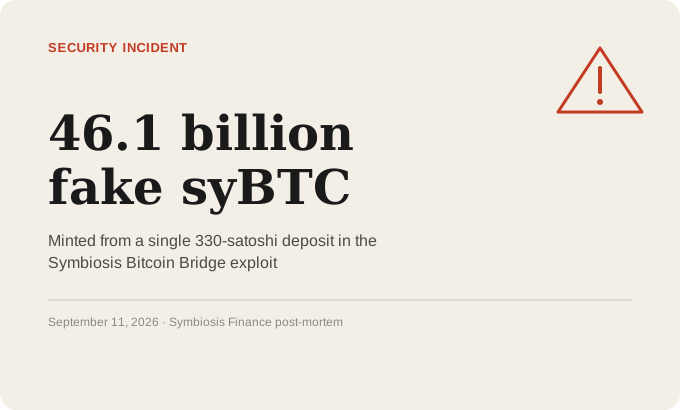
How Did a Hacker Create 46 Billion Fake Bitcoin in the Symbiosis Exploit? Decodes Bitcoin Hacker With WEEX Now
How two Symbiosis bridge bugs let a hacker mint 46.1 billion unbacked syBTC, drain Bitcoin pools and expose critical bridge risks.
This Cycle May Not Be Led by Bitcoin?
Bitcoin, Sports, and Politics: Predictive Markets Target $10 Trillion
Exclusive Interview with CK Zheng of ZX Squared Capital: How a Wall Street Risk Control Expert Accurately Grasped Market Trends and Outperformed Bitcoin Returns by Double
The End of the Blank Prompt: Why Trading AI Needs a Playbook
Bankless Ventures Partner Claims ZEC Will Attract Bitcoin Funds in 2026
US Bond Market 'Meltdown'... Why Are Interest Rates Soaring?
Sam Price: The Impact of Cryptocurrency Legislation on Market Dynamics


