
Why Did 7 Senate Democrats Say Trump's Crypto Ethics Deal 'Falls Short' Before Today's Vote?

 Prefer us on Google


Seven Senate Democrats — Angela Alsobrooks, Cory Booker, Catherine Cortez Masto, Ruben Gallego, John Hickenlooper, Mark Warner, and Raphael Warnock — jointly declared in July that the CLARITY Act's ethics language "falls short," and as of today's cloture vote, their objections were never really one shared complaint. Each senator has been quietly fighting a different specific battle inside that same joint statement, and understanding which one matters most to which senator is the real key to predicting today's vote.
At A Glance:
- The seven senators' original July 22, 2026 joint statement called out four distinct problem areas — ethics for elected officials, consumer protection, illicit finance, and market integrity — not a single unified objection.
- Senator Angela Alsobrooks specifically blasted the bill's original DOJ-only enforcement model, calling it "wild and unserious and stone crazy" and demanding state attorneys general get independent enforcement power.
- Senators Catherine Cortez Masto and Mark Warner have conditioned their support on a separate dispute entirely — Section 604's DeFi developer liability protections, which the National District Attorneys' Association warned could impair criminal investigations.
- The September 14 revised text reportedly added state attorney general enforcement authority alongside the DOJ — directly addressing Alsobrooks's core complaint — yet a coalition of state AGs led by New York's Letitia James sent a letter the very same day still raising concerns, suggesting the fix may not be as complete as Republicans are presenting it.
Written by: Crypto Market Analyst | Reviewed by: Senior Financial Editor | Last Updated: September 15, 2026
The July 22 Statement That Started It
The seven-senator bloc's opposition became public on July 22, 2026, when Alsobrooks, Booker, Cortez Masto, Gallego, Hickenlooper, Warner, and Warnock released a joint statement after Republicans shared an updated draft of the CLARITY Act. Their language was carefully calibrated: "The Republican-proposed text of the CLARITY Act as it currently stands falls short. Key provisions including those addressing ethics for elected officials, consumer protection, illicit finance, conflicts of interest and market integrity must be strengthened." They closed by emphasizing they'd continue negotiating in good faith — leaving the door open rather than declaring the bill dead.
What made this bloc's opposition carry real weight is that it wasn't coming from crypto skeptics. Alsobrooks and Gallego were the only two Democrats who actually voted to advance the bill out of the Senate Banking Committee in May, on a 15-9 vote. Several others in the group, including Booker, Cortez Masto, Hickenlooper, and Warner, had previously worked on Democratic efforts to craft crypto legislation and had supported the GENIUS Act, the stablecoin law signed in 2025. These are senators who wanted a bill — which is exactly why their specific objections mattered more than a blanket "no" would have.
Breaking Down Each Senator's Specific Objection
Treating these seven senators as a single voting bloc misses what's actually been happening in the negotiations. Each has staked out a distinct priority within the broader "falls short" framing.
Angela Alsobrooks (D-MD): Enforcement authority. Alsobrooks has been the most publicly specific of the group. According to Semafor's reporting, she said she would oppose the bill unless Republicans strengthened its ethics enforcement, criticizing the original draft's reliance on the Department of Justice alone to enforce ethics rules as "wild and unserious and stone crazy." Her specific demand: empower state attorneys general to act independently if the DOJ doesn't.
Catherine Cortez Masto (D-NV) and Mark Warner (D-VA): DeFi developer liability. These two senators have signaled their support hinges on a completely different issue — Section 604 of the bill, which addresses liability protections for DeFi developers. The National District Attorneys' Association wrote to Senate leadership warning that the section, as drafted, would materially impair criminal investigations involving cryptocurrency. Cortez Masto and Warner have said they'll only back the bill if that law-enforcement concern gets addressed in the final text.
Ruben Gallego (D-AZ): Lead negotiator. Gallego, alongside Republican Senator Thom Tillis, has spent months working directly on the ethics compromise language itself, making him less a holdout and more a co-author of whatever final ethics text emerges. His position has shifted from committee "yes" to active dealmaker.
Booker, Hickenlooper, and Warnock: Signed but less individually vocal. These three senators co-signed the July statement and have continued to reference the same four concern areas — ethics, consumer protection, illicit finance, and market integrity — without staking out the kind of singular, headline-grabbing demand that Alsobrooks or the Cortez Masto/Warner pairing has.
Kirsten Gillibrand (D-NY): A separate hard line. Gillibrand isn't part of the seven-member bloc but has drawn her own independent red line specifically on ethics enforcement mechanics, making her an additional, harder-to-predict vote beyond the core group.
<div align="center">
| Senator | Party/State | Primary Specific Objection |
|---|---|---|
| Angela Alsobrooks | D-MD | DOJ-only enforcement; wants state AG authority |
| Cory Booker | D-NJ | General ethics, consumer protection, illicit finance |
| Catherine Cortez Masto | D-NV | Section 604 DeFi developer liability / law enforcement impact |
| Ruben Gallego | D-AZ | Lead negotiator on ethics compromise with Sen. Tillis |
| John Hickenlooper | D-CO | General ethics, consumer protection, illicit finance |
| Mark Warner | D-VA | Section 604 DeFi developer liability / law enforcement impact |
| Raphael Warnock | D-GA | General ethics, consumer protection, illicit finance |
| Kirsten Gillibrand | D-NY (not in bloc) | Independent hard line on ethics enforcement mechanism |
Did the September 14 Compromise Actually Fix Alsobrooks's Complaint?
This is the detail that's gotten surprisingly little direct attention: reporting on the revised text released September 13–14 indicates the updated ethics provision can now be enforced by both state attorneys general and the Department of Justice — which, on its face, is precisely what Alsobrooks demanded when she called the DOJ-only model "wild and unserious and stone crazy."
But here's the tension that most coverage has missed connecting: on that same day, September 14, a coalition of state attorneys general led by New York's Letitia James sent senators a letter warning that the CLARITY Act could still weaken state-level enforcement tools against crypto scams. If state AGs were just handed new enforcement authority in the revised text, why would state AGs themselves still be raising alarms on the very same day? The most likely explanation is that the added authority may be narrower than it appears — potentially limited to the ethics provisions specifically rather than the broader crypto-scam enforcement toolkit state prosecutors already use, or subject to procedural conditions that limit how independently state AGs can actually act. Until the specific statutory language is published in full, it's not possible to confirm which reading is correct — but the timing of James's letter arriving the same day as the "fix" is a signal worth watching closely rather than assuming the enforcement dispute is resolved.
-- Price
The Other Fight: Section 604 and DeFi Developer Liability
While the ethics provision has dominated headlines, Cortez Masto and Warner's objection over Section 604 represents a genuinely separate dispute that a permanent ethics clause does nothing to resolve. The National District Attorneys' Association's warning centers on liability protections intended to shield DeFi developers from prosecution over how third parties use their code — protections the crypto industry has pushed hard for, but that law enforcement groups argue could make it harder to prosecute cases where developers knew, or should have known, their tools would be used for money laundering or fraud. Notably, the September 14 revised text reportedly removed a related criminal-liability shield under 18 U.S.C. § 1960, which Galaxy Digital's research team flagged as a significant concession — meaning at least part of the Cortez Masto/Warner concern may have already been addressed by the same round of changes that targeted Alsobrooks's enforcement complaint.
An Analyst's Take: The "Falls Short" Label Was Always Doing Too Much Work
From where I sit, treating "seven Democrats say it falls short" as a single storyline has made this vote look more binary than it actually is. Alsobrooks's enforcement objection and Cortez Masto/Warner's DeFi liability objection are structurally different problems that happen to have been bundled into one joint statement for negotiating leverage. That matters today because it's entirely possible for Republicans to have satisfied one senator's specific concern while leaving another's completely untouched — and a vote count built on the assumption that "the ethics fix" moves all seven votes at once is likely to be wrong in either direction.
My honest read: Alsobrooks's specific demand looks close to addressed on paper, which is meaningful progress. But the Letitia James letter landing the same day as that fix tells me the state-enforcement question isn't actually closed — it's just moved to a more technical, harder-to-headline dispute about scope and procedure. If I had to guess which of the seven is most likely to end up a "yes" today, I'd watch Gallego and Alsobrooks first, given Gallego's direct authorship role and Alsobrooks's specific demand having apparently been at least partially met. Cortez Masto and Warner strike me as the harder votes to call, because their objection was never really about Trump's personal ethics at all — it's a law-enforcement concern that a permanent ethics clause doesn't directly touch.
What This Means for Today's Vote
Senate Banking Committee Chair Tim Scott has publicly predicted 12 to 18 Democrats will ultimately vote yes — a notably higher number than the seven senators who've been the public face of the holdout negotiations. That gap suggests Republican leadership believes a broader group of Democrats beyond this core seven are quietly prepared to support cloture if the visible leaders of the negotiation do, which would make Gallego and Alsobrooks's decisions today disproportionately influential relative to their number.
For anyone following the vote for its market impact rather than its politics, the practical takeaway is the same as with any high-stakes legislative catalyst: outcomes can move quickly and unpredictably around the actual roll call. Traders managing crypto exposure around this kind of event sometimes use platforms like WEEX TradFi to keep event-driven positions contained within a broader portfolio approach rather than concentrated around a single vote. Nothing in this article constitutes financial, legal, or investment advice.
FAQ
1. Which Senate Democrats Said the CLARITY Act Ethics Deal Falls Short?
Seven senators — Angela Alsobrooks, Cory Booker, Catherine Cortez Masto, Ruben Gallego, John Hickenlooper, Mark Warner, and Raphael Warnock — issued a joint statement on July 22, 2026, saying the bill's provisions on ethics, consumer protection, illicit finance, and market integrity needed to be strengthened.
2. What Was Senator Alsobrooks's Specific Objection to the CLARITY Act?
Alsobrooks criticized the bill's original reliance on the Department of Justice alone to enforce ethics rules, calling that approach "wild and unserious and stone crazy," and demanded that state attorneys general be given independent enforcement authority.
3. Why Do Cortez Masto and Warner Have a Different Objection Than the Ethics Dispute?
Cortez Masto and Warner have conditioned their support on Section 604's DeFi developer liability protections, which the National District Attorneys' Association warned could impair criminal investigations involving cryptocurrency — a law enforcement concern separate from the Trump ethics debate.
4. Did the September 14 CLARITY Act Revision Fix the Democrats' Ethics Complaint?
Partially. The revised text reportedly added state attorney general enforcement authority alongside the DOJ, directly addressing Alsobrooks's core demand, but a coalition of state AGs led by Letitia James sent a letter the same day still raising concerns, suggesting the fix may not fully resolve the underlying dispute.
5. How Many Democratic Votes Does the CLARITY Act Actually Need Today?
While the seven-senator bloc has been the public face of the negotiations, Senate Banking Committee Chair Tim Scott has predicted 12 to 18 Democrats will ultimately vote yes, suggesting Republicans believe support extends well beyond the senators who've spoken most publicly.
This content is provided for general informational purposes only and doesn't constitute financial, investment, legal, or tax advice. Any events, rewards, online promotions, or related information mentioned herein should not be considered a recommendation, solicitation, or invitation to purchase, sell, trade, or otherwise deal in any crypto assets. Crypto assets are highly volatile and may result in loss. The availability of WEEX services, products, and related events may vary by region. You are responsible for ensuring that your participation is in accordance with applicable local laws and regulations.
You may also like

Bitcoin, Sports, and Politics: Predictive Markets Target $10 Trillion

Exclusive Interview with CK Zheng of ZX Squared Capital: How a Wall Street Risk Control Expert Accurately Grasped Market Trends and Outperformed Bitcoin Returns by Double

The End of the Blank Prompt: Why Trading AI Needs a Playbook
Bankless Ventures Partner Claims ZEC Will Attract Bitcoin Funds in 2026

US Bond Market 'Meltdown'... Why Are Interest Rates Soaring?

Sam Price: The Impact of Cryptocurrency Legislation on Market Dynamics

The Quantum Issue: You Never Really Know The Future

Crypto Kidnapping: 6 Suspects Charged in Case Involving a Few Hundred Euros in Val-d’Oise

Security and fees hold back deeper crypto use among wealthy investors: Nexo report

Why leaving your crypto on an exchange is not the same as having it in your own wallet?

Binance Under Scrutiny Again for Iran-Related Trading
Altcoin demand meets $18B threat as flows move into RWA perps as just 19% of traders keep alts
90% of U.S. Treasury Yield Increase Concentrated Around Employment Data and Fed Speeches
Can Kraken's Parent Company Open the Door for Hyperliquid to Enter the U.S. Market?
Gold Price Today in Thailand: XAU/USD Holds Near $4,347 as Key Support Level Tested

Scam AI Bot: 274 ETH Lost in Smart Contract Trap

Why Do You Always Make Small Profits and Then Lose Everything? Taleb Explained It with 'Asymmetric Leverage' Twenty Years Ago
AI has become a tool for a new generation of fraudsters: how deepfakes are stealing millions of dollars - research

Can SOXL Reach $160 as AI and Semiconductor Stocks Rally?
Can PEPE Reach $0.000006 as Meme Coin Momentum Returns?
Meta's Muse: A Slightly Smarter Version of 'AI Ordering Coffee'
Over 70% of South Korean Crypto Investors Oppose Crypto Tax: What Are Their Concerns?

Howard Marks: U.S. Fiscal Discipline Out of Control, Buying Bonds to Suppress Yields is Just 'Putting Ice Packs on a Feverish Patient'
Bitget Conversations with Trader Shiguang: Seeking the Discrepancy Between Price and Value

AI and Crypto: Why BlackRock Sees a Major Convergence

Nomura Warns of 'Double Whammy' Risk: The Next Market Storm May Start with Interest Rate Volatility
What is Travix? An on-chain omnibroker combining AI trading and blockchain verification
VVV Hits All-Time High: Founder’s Perspective on Models, Privacy, and Crypto
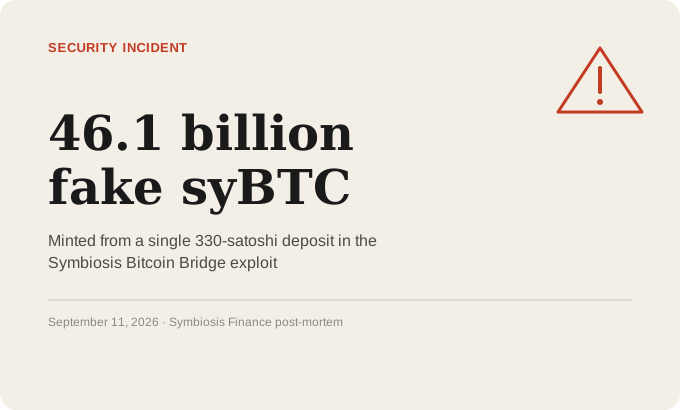
How Did a Hacker Create 46 Billion Fake Bitcoin in the Symbiosis Exploit? Decodes Bitcoin Hacker With WEEX Now
How two Symbiosis bridge bugs let a hacker mint 46.1 billion unbacked syBTC, drain Bitcoin pools and expose critical bridge risks.
This Cycle May Not Be Led by Bitcoin?
Bitcoin, Sports, and Politics: Predictive Markets Target $10 Trillion
Exclusive Interview with CK Zheng of ZX Squared Capital: How a Wall Street Risk Control Expert Accurately Grasped Market Trends and Outperformed Bitcoin Returns by Double
The End of the Blank Prompt: Why Trading AI Needs a Playbook
Bankless Ventures Partner Claims ZEC Will Attract Bitcoin Funds in 2026
US Bond Market 'Meltdown'... Why Are Interest Rates Soaring?
Sam Price: The Impact of Cryptocurrency Legislation on Market Dynamics


