
$20 a Day Against Rain: This Ice Cream Shop Covers 43% of Its Rent Thanks to Kalshi

 Prefer us on Google


Twenty dollars a day bet against nice weather. In Los Angeles, Jason Jiang, 37, co-manager of the ice cream shop 28wishes in the heart of downtown, earns up to $1,500 a month on Kalshi by betting on California's cold snaps. This amounts to 43% of the $3,500 monthly rent for his shop, paid through weather contracts.
A former banker turned ice cream maker who hedges against rain: the strategy is no whim. For $600 a month, it replicates what electricity companies have been doing for nearly thirty years in the weather derivatives market.
Key Points
- Jason Jiang, co-manager of the ice cream shop 28wishes in Los Angeles, bets $20 a day on Kalshi's weather markets and earns up to $1,500 a month, covering 43% of his rent.
- His shop loses nearly 20% of revenue below 21 °C (70 °F): binary contracts based on NOAA readings compensate for these slow days.
- CME's weather derivatives, reserved for energy companies and large industries, have never been accessible to a business paying $3,500 in rent.
- Kalshi, valued at $22 billion, faces competition from Arizona and Ohio while the CFTC wraps up a consultation assessing the utility of hedging contracts.
Twenty Dollars a Day Against Days Without Customers
The shop collects five-star reviews for its homemade ice creams, but its business hinges on one figure: below 70 degrees Fahrenheit, around 21 °C, it loses nearly 20% of its revenue. Jason Jiang spent years in corporate banking before serving ice cream, and he tackled the issue like a banker.
<< Ice cream is one of the most weather-dependent products in the world. We lose about 20% of revenue when the temperature drops below 70 degrees. So we essentially cover this profit loss through the app. >>
Jason Jiang, co-manager of the ice cream shop 28wishes in Los Angeles
With his younger brother James, co-owner of the shop, he started in the spring by betting $20 a day on Kalshi's climate markets. $600 committed each month, for gains that rise to $1,500. The two brothers rely on weather forecasts, specialized websites, and scientists followed on social media. Jason Jiang finds their predictions "frighteningly accurate" and embraces the spending line: "it's a risk we are willing to take."
His wife, however, was initially skeptical. "She said to me: 'Are you sure? Is this a good idea?' Eyebrows were definitely raised. But when I showed her that we could win up to $800 in a single day with a weather forecast, it's hard to argue against that." Brothers Jason and James Jiang cover nearly half of their monthly rent by betting on climate fluctuations -- Source
Weather Hedging, Long Reserved for Electricians
Covering oneself in finance means taking a position that pays off precisely when the activity loses money. Weather derivatives have existed since the late 1990s, and the CME Group offers a comprehensive range: contracts on heating degree days (HDD) and cooling degree days (CDD), which measure the daily deviation from a reference temperature, along with contracts on cumulative average temperatures. Each unit is worth 20 dollars per index point and is primarily traded in blocks via ClearPort, the group's over-the-counter clearing service, facing speculative funds and insurers.
Typical clientele includes energy companies, agricultural groups, breweries, and amusement parks. An independent ice cream shop with a rent of 3,500 dollars has never crossed this threshold due to unsuitable contract sizes and the lack of a professional brokerage account.
Kalshi has eliminated the entry ticket. Its weather markets operate on binary contracts, in 2 °F increments on the day's maximum in a given city, with variations for rain, snow, and hurricanes. The contract pays 1 dollar if the event occurs, zero otherwise, and settlement relies on official readings from NOAA, the U.S. federal weather agency, and the National Weather Service. Thus, a position bought at 4 cents yields 25 times the stake. No minimum deposit is required, and no broker needs to be approached. This absence of a threshold has raised concerns from the American Farm Bureau Federation, which pointed out the massive influx of speculators into the agricultural contracts listed on the platform.
Kalshi is valued at 22 billion dollars and faces opposition from the states.
Launched in 2021 by two former MIT students, Tarek Mansour and Luana Lopes Lara, the platform claims over 5 million monthly active users. In March, it processed 13.1 billion dollars in volume out of 25.7 billion across all predictive markets, ahead of the 10.6 billion from Polymarket, its on-chain competitor that settles its positions in USDC. In June, its volume surpassed 20 billion, including about 7 billion on the perpetual crypto futures launched at the end of May on bitcoin, ether, XRP, and Solana. These perpetual futures are the first allowed by the CFTC, the federal regulator of U.S. derivatives markets. A Series F round of 1 billion dollars led by Coatue valued the company at 22 billion.
Local regulators, however, are not backing down. In Arizona, Attorney General Kris Mayes filed twenty criminal charges against Kalshi, before a federal judge temporarily prohibited the state from enforcing its gambling laws and suspended the proceedings. The Ohio Casino Control Commission is demanding 5 million dollars in fines. The CFTC retaliated by suing Arizona, Connecticut, and Illinois, arguing that these contracts fall under federal derivatives law, just like a farmer's hedge on his crops.
The U.S. regulator published a draft of rules on June 10, with public consultation closing on July 27. Among the criteria considered for authorizing a contract: its hedging utility, its ability to provide businesses with finer protection than existing instruments, and the risk of pushing volumes to less regulated offshore platforms. The former financier embraces the irony of a rainy day fund: << But even in banking, you know, everything is a bet. Even in life. You have to do your own thing to be happy. >>
-- Price
This content is provided for general informational purposes only and doesn't constitute financial, investment, legal, or tax advice. Any events, rewards, online promotions, or related information mentioned herein should not be considered a recommendation, solicitation, or invitation to purchase, sell, trade, or otherwise deal in any crypto assets. Crypto assets are highly volatile and may result in loss. The availability of WEEX services, products, and related events may vary by region. You are responsible for ensuring that your participation is in accordance with applicable local laws and regulations.
You may also like

The End of the Blank Prompt: Why Trading AI Needs a Playbook

Cardano proposal slashes fees by 55%, but it comes with a cost for small pools

The Evolution of AI: The Boundaries and Truth of Recursive Self-Improvement (RSI)

The Quantum Issue: You Never Really Know The Future

Security and fees hold back deeper crypto use among wealthy investors: Nexo report

Bitcoin Developers Concerned About Mining Subsidy

VVV Hits All-Time High: Founder’s Perspective on Models, Privacy, and Crypto

XRPL fixes critical pre-mainnet flaw, but client apps remain at risk

Glassnode Indicates Shift Towards Altcoin Season

Crypto: Kalshi accused of inflating its volumes with thousands of identical orders

HODLing ETH: Should You Choose Staking for Yield or Collateralized Lending?

SEC Clarity Meets Fed Rate Hike: How WEEX TradFi Lucky Eggs S2 Taps Into Cross-Market Opportunities

How Significant Are Changes in Overseas AI Investment?
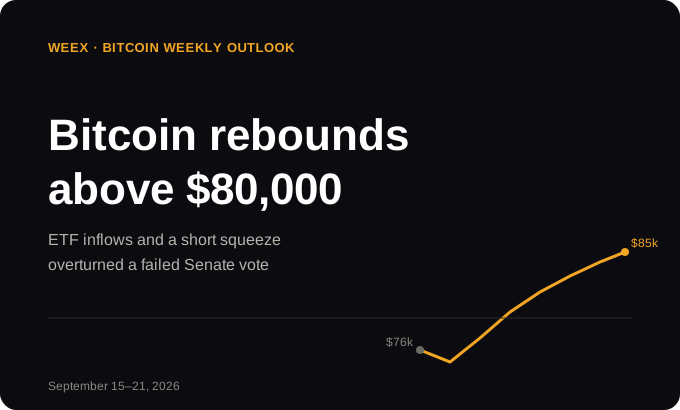
WEEX Bitcoin Weekly Outlook: Why Did Bitcoin Rebound Above $80,000 After the CLARITY Act Vote?
Bitcoin rebounded above $80,000 as SEC and CFTC action, renewed ETF inflows, and a short squeeze outweighed the failed CLARITY Act vote.

$8 Makes a Comeback, This Time X Money Rewrites the Logic of NFT Issuance
AMD Jumps Nearly 10%, Market Cap Tops $1 Trillion| WEEX TradFi Daily Brief (September 22, 2026)
Global markets on September 22 focus on a repair in AI-compute pricing. On September 21 the three major equity indexes closed higher. AMD rose nearly 10% and its market cap crossed $1 trillion for the first time, while Intel and Arm also surged. Brent crude fell about 3.4% to $100.34 and the 10-year Treasury yield eased to about 4.96%, lowering discount-rate pressure on long-duration tech. Bitcoin briefly broke above $87,000 and total crypto market cap returned above $3 trillion. Investors next watch consumer and housing earnings plus PMI flash prints.
Balancer Community Proposes Fork and Rebirth

The Answer to Dreamforce 2026: AI Agent, Has It Finally Turned from Demo to Revenue?
Ethereum: BitMine Approaches 5% of Total ETH Supply
Bitcoin's $84K rally isn't saving miners as difficulty signals already flash caution
ZEC's Largest Mining Company Moves to US Stock Market After Mining 70,000 ZEC in Six Months

Validators Vote on Batch V1.1 After Security Overhaul

Aptos Validators Decrease by 40% in Two Years, Concentration of Validator Nodes Shifts to Europe and America

SEC Takes Action: Who Can Handle "Compliant ICOs"?

TRON Weekly Industry Report: Regulatory and Interest Rate Pressures Fail to Dampen BTC Bullish Sentiment, Detailed Analysis of PayFi High-Performance Payment Infrastructure Axon Finance

When AI Agents Accelerate into Intranets: The Main Battlefield of Cybersecurity Has Changed
How to Earn Crypto Futures Trading Rewards on WEEX: Daily Lucky Eggs S2

ZetaChain, Linera, Switchboard Cease Operations
WEEX Futures Trading Rewards in Sep 2026: Win Up to 10,000 USDT

The Next Phase of Ethereum from the EF Protocol AMA
The End of the Blank Prompt: Why Trading AI Needs a Playbook
Cardano proposal slashes fees by 55%, but it comes with a cost for small pools
The Evolution of AI: The Boundaries and Truth of Recursive Self-Improvement (RSI)
The Quantum Issue: You Never Really Know The Future
Security and fees hold back deeper crypto use among wealthy investors: Nexo report
Bitcoin Developers Concerned About Mining Subsidy
Contents
Latest articles


Latest coin listings on WEEX


