
Bitcoin on the Path to $11 Million... "The Power Law Will Break in 2036"

 Prefer us on Google


Joe Burnett, Vice President of Strive, presents a bold outlook
Bitcoin prices are expected to rise through three stages
Decreased volatility → Surge in collateral value → Explosive positive cycle
"The moment Bitcoin comes down from this roller coaster, it will be shot into space and fly to the moon."
Joe Burnett, Vice President responsible for Bitcoin strategy at the U.S. listed company Strive, wrote a report in March stating that "the price of Bitcoin will reach $11 million per coin in the first quarter of 2036." At that time, the report was so detached from market conditions that it did not receive much attention. On the 28th, Burnett revealed the specific path for Bitcoin to reach $11 million in another report.
Bitcoin at $11 Million
His report (The Fracture: Breaking Bitcoin's Power Law) predicts that Bitcoin prices will move through three stages, and in the final third stage, the Power Law will break, leading to an explosive upward phase.
The 'disruptive force' that will drive Bitcoin to $11 million comes from decreased volatility, a surge in collateral value, and the resulting influx of capital creating a positive cycle. To verify this hypothesis in the financial market, Bitcoin must be recognized as collateral in real financial transactions, such as purchasing homes or investing in data centers.
In fact, financial institutions that handle Bitcoin-backed loans have started to appear one by one in the U.S.
The Misunderstanding that Bitcoin is Trapped in the 'Power Law'
In the past, Bitcoin exhibited roller coaster-like movements, soaring by 100 times and then plummeting dramatically. As time passed and the market grew, the price volatility has significantly decreased compared to the past.
Financial experts have accepted the 'Power Law' as a theory based on over ten years of price data, which states that Bitcoin's rate of increase and volatility are gradually flattening. According to this formula, the price of Bitcoin is expected to rise to about $1.25 million by 2036.
The Power Law refers to the exponential spread of any technology or product when it is accepted in the market. As the market matures, price volatility decreases, and the rate of increase also proportionally declines. In other words, it is expected that Bitcoin will also face growth limits as its maturity increases according to the Power Law. However, Burnett believes that the Power Law will break.
Hints Found in Materials Science... The Principle of Sudden 'Fracture'
Joe Burnett argues that Bitcoin prices will soar above the flat upward prediction line, breaking the Power Law. He found hints in materials science. He likens the phenomenon where repeated stress on airplane wings or legs accumulates metal fatigue, leading to the eventual destruction of steel structures.
The tiny cracks that form in the metal initially grow slowly and predictably, but once a certain threshold (critical point) is passed, they suddenly accelerate and break. Burnett claims that the Bitcoin market will also experience a 'three-stage fracture' that breaks through existing prediction lines and explodes after passing the current flat stage.
The Reversal Brought by Decreased Volatility... Transformation into 'The Best Collateral'
Bitcoin's volatility is indeed decreasing. In previous cycles, Bitcoin typically showed an 80% drop, but this time it started to reverse around the 50% mark. So where will the power for the now calmer Bitcoin to explode again come from?
Burnett argues that the very reduction in price volatility is a significant turning point. As the risk of Bitcoin price crashes decreases, banks and financial institutions begin to evaluate Bitcoin as a highly reliable 'safe collateral asset.'
In the past, loans were given sparingly due to high risk, but as volatility decreases, more dollars can be lent against the same Bitcoin collateral at lower interest rates. This is the principle behind the 'digital credit' emphasized by listed companies like Strive and Strategy.
The Collision of Fixed Supply of 21 Million and Increasing Dollars
Burnett claims that a strong capital positive cycle (Reflexive Loop) occurs in this process. Bitcoin is strictly limited to only 21 million units worldwide. In contrast, the dollar loans and credit funds issued against Bitcoin collateral can continue to grow without limits.
With the now less risky Bitcoin as collateral, massive dollar loans are created, and this capital competes to buy the limited Bitcoin, leading to explosive price increases. As prices rise, the collateral value increases further, completing a positive cycle of increased lending. Once the acceleration begins, it operates like a flywheel that spins even faster.
The Combination of AI Deflation and the $11 Million Scenario
Burnett emphasizes that this feedback loop connects to the macroeconomics of the AI era, leading to the price of $11 million in 2036.
As AI technology advances and production costs plummet, strong price declines (deflation) occur. However, the existing financial system, maintained by debt, cannot withstand deflation, so governments and central banks have no choice but to continue injecting massive amounts of money (liquidity) to prevent system collapse.
In a depreciating currency environment, investors will gather funds into Bitcoin, which has absolute scarcity. The recent rise of debasement trading is precisely that.
Bitcoin Leaping Beyond the Upper Limit of the Power Law
The $1.25 million predicted by the Power Law for 2036 is merely a figure representing the process of Bitcoin maturing into 'excellent collateral' (stage 2). The accumulated collateral value from decreased volatility, combined with the unlimited dollar expansion of the AI era, will cause Bitcoin to break through the upper limit of the existing Power Law and soar upwards.
If Bitcoin reaches $11 million per coin, its market capitalization will be $230 trillion. If global financial assets grow at 7% annually until 2036, their scale will reach $1,970 trillion. Even at a price of $11 million per coin, Bitcoin's share will be about 12%. It is argued that even if it does not completely replace the existing currency system, it can still reach a price that is sufficiently attainable by absorbing a portion of global assets.
According to Burnett, the $11 million per Bitcoin is not an extreme optimism but rather a conservative outlook.
-- Price
This content is provided for general informational purposes only and doesn't constitute financial, investment, legal, or tax advice. Any events, rewards, online promotions, or related information mentioned herein should not be considered a recommendation, solicitation, or invitation to purchase, sell, trade, or otherwise deal in any crypto assets. Crypto assets are highly volatile and may result in loss. The availability of WEEX services, products, and related events may vary by region. You are responsible for ensuring that your participation is in accordance with applicable local laws and regulations.
You may also like

The End of the Blank Prompt: Why Trading AI Needs a Playbook

Cardano proposal slashes fees by 55%, but it comes with a cost for small pools

The Evolution of AI: The Boundaries and Truth of Recursive Self-Improvement (RSI)

The Quantum Issue: You Never Really Know The Future

Security and fees hold back deeper crypto use among wealthy investors: Nexo report

Bitcoin Developers Concerned About Mining Subsidy

VVV Hits All-Time High: Founder’s Perspective on Models, Privacy, and Crypto

XRPL fixes critical pre-mainnet flaw, but client apps remain at risk

Glassnode Indicates Shift Towards Altcoin Season

Crypto: Kalshi accused of inflating its volumes with thousands of identical orders

HODLing ETH: Should You Choose Staking for Yield or Collateralized Lending?

SEC Clarity Meets Fed Rate Hike: How WEEX TradFi Lucky Eggs S2 Taps Into Cross-Market Opportunities

How Significant Are Changes in Overseas AI Investment?
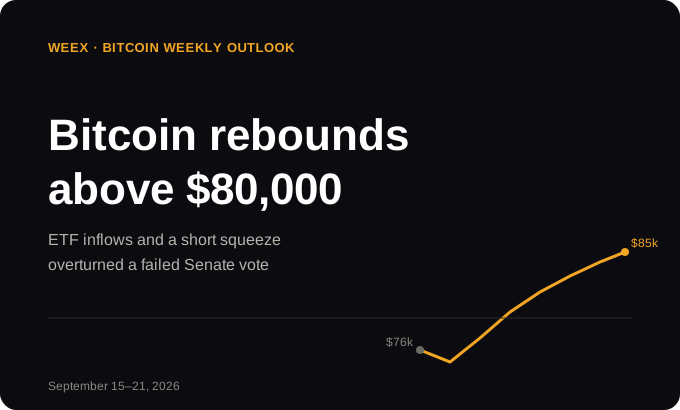
WEEX Bitcoin Weekly Outlook: Why Did Bitcoin Rebound Above $80,000 After the CLARITY Act Vote?
Bitcoin rebounded above $80,000 as SEC and CFTC action, renewed ETF inflows, and a short squeeze outweighed the failed CLARITY Act vote.

$8 Makes a Comeback, This Time X Money Rewrites the Logic of NFT Issuance
AMD Jumps Nearly 10%, Market Cap Tops $1 Trillion| WEEX TradFi Daily Brief (September 22, 2026)
Global markets on September 22 focus on a repair in AI-compute pricing. On September 21 the three major equity indexes closed higher. AMD rose nearly 10% and its market cap crossed $1 trillion for the first time, while Intel and Arm also surged. Brent crude fell about 3.4% to $100.34 and the 10-year Treasury yield eased to about 4.96%, lowering discount-rate pressure on long-duration tech. Bitcoin briefly broke above $87,000 and total crypto market cap returned above $3 trillion. Investors next watch consumer and housing earnings plus PMI flash prints.
Balancer Community Proposes Fork and Rebirth

The Answer to Dreamforce 2026: AI Agent, Has It Finally Turned from Demo to Revenue?
Ethereum: BitMine Approaches 5% of Total ETH Supply
Bitcoin's $84K rally isn't saving miners as difficulty signals already flash caution
ZEC's Largest Mining Company Moves to US Stock Market After Mining 70,000 ZEC in Six Months

Validators Vote on Batch V1.1 After Security Overhaul

Aptos Validators Decrease by 40% in Two Years, Concentration of Validator Nodes Shifts to Europe and America

SEC Takes Action: Who Can Handle "Compliant ICOs"?

TRON Weekly Industry Report: Regulatory and Interest Rate Pressures Fail to Dampen BTC Bullish Sentiment, Detailed Analysis of PayFi High-Performance Payment Infrastructure Axon Finance

When AI Agents Accelerate into Intranets: The Main Battlefield of Cybersecurity Has Changed
How to Earn Crypto Futures Trading Rewards on WEEX: Daily Lucky Eggs S2

ZetaChain, Linera, Switchboard Cease Operations
WEEX Futures Trading Rewards in Sep 2026: Win Up to 10,000 USDT

The Next Phase of Ethereum from the EF Protocol AMA
The End of the Blank Prompt: Why Trading AI Needs a Playbook
Cardano proposal slashes fees by 55%, but it comes with a cost for small pools
The Evolution of AI: The Boundaries and Truth of Recursive Self-Improvement (RSI)
The Quantum Issue: You Never Really Know The Future
Security and fees hold back deeper crypto use among wealthy investors: Nexo report
Bitcoin Developers Concerned About Mining Subsidy
Contents
Latest articles


Latest coin listings on WEEX


