
Cardano clears key voting thresholds for constitutional committee renewal by 0.18% margin

 Prefer us on Google


Cardano's 2026 Constitutional Committee renewal had crossed both voting thresholds in a pre-boundary snapshot on Sept. 1, but formal ratification still waited for the epoch change. The narrow margin on the stake pool side exposed how non-participation can become an effective veto in the network's on-chain governance.
Cardano divides governance authority among delegated representatives, stake pool operators, and the Constitutional Committee.
DReps vote with ADA delegated to them, SPOs represent block-producing stake pools, and the committee reviews the constitutionality of actions that require its approval. For an update to the committee's own membership, DReps and SPOs vote while the committee does not.
A synchronized Koios voting snapshot retrieved at about 09:59 UTC showed DRep support at 69.36% against a 67% threshold. SPO support stood at 51.18% against a 51% requirement, leaving a margin of 0.18 percentage points at that observed moment.
The proposal's on-chain record still showed no ratification, enactment, or expiration, and the Koios chain tip remained in epoch 652. The decision was due at the boundary into epoch 653 at about 21:44 UTC on Sept. 1.
| Measure | Pre-boundary snapshot | Requirement or timing |
|---|---|---|
| DRep approval | 69.36% | 67% threshold met |
| SPO approval | 51.18% | 51% threshold met |
| Formal outcome | Pending in epoch 652 | Decision at epoch 653 boundary |
| Enactment if ratified | Pending | Epoch 654 boundary on Sept. 6 |
The thresholds come from Cardano's epoch-652 protocol parameters, while Cardano's governance overview and CIP-1694 set out the division of voting authority.
The key mechanism sits inside the SPO denominator. The Cardano Developer Portal's governance rules say stake behind a pool that does not cast a ballot remains against ratification in the effective calculation. The pool has not submitted an explicit No, but its uncast stake still makes the Yes threshold harder to reach.
Abstention follows a different path. Explicit abstentions and stake assigned to alwaysAbstain are removed from the effective calculation.
The Koios breakdown separated roughly 2.008 million ADA of explicit SPO No votes from about 5.316 billion ADA in the total No or default-No side of the calculation. The gap indicates that non-participating stake created most of the drag on approval.
The four committee seats due to lapse raise the stakes of that denominator rule. Those seats remain valid through epoch 653 and expire as epoch 654 begins on Sept. 6. Without an enacted renewal, the committee would fall to three active members, below the minimum of five.
Voting closes as epoch 652 ends, and ratification is assessed at the boundary into epoch 653. If the update is ratified there, it is scheduled to enact one epoch later at the start of epoch 654, the same boundary at which the four current seats lapse. The action page and a ledger-focused chronology align those two events.
A committee below its five-member minimum could not supply the approval required for new treasury withdrawals, protocol parameter changes, hard fork initiations, or a new constitution. The Cardano ledger implementation treats an undersized committee as lacking the voting threshold needed for actions that require committee approval.
No-confidence and update-committee actions would remain available because the committee does not vote on them. The cited protocol rules describe a ratification bottleneck affecting specified governance actions.
If the threshold-crossing snapshot held through the epoch boundary and the ledger ratified the action, the immediate three-seat bottleneck would be avoided. The vote would still leave a governance lesson: SPO approval rested just 0.18 percentage points above the line after billions of ADA in non-voting stake weighed against passage.
Intersect had warned that failed renewal could interrupt governance continuity and may affect progress toward Dijkstra, Cardano's next hard-fork program. Cardano has separately described the constitutional preparation required for Dijkstra.
Those sources frame a timeline impact as a risk rather than a confirmed delay.
At the latest synchronized pre-boundary snapshot, late voting had moved the renewal above both thresholds. Its razor-thin SPO margin still demonstrated the force of Cardano's participation rule: when uncast stake remains in the denominator, governance silence can decide whether the network's decision-making machinery keeps moving.
-- Price
This content is provided for general informational purposes only and doesn't constitute financial, investment, legal, or tax advice. Any events, rewards, online promotions, or related information mentioned herein should not be considered a recommendation, solicitation, or invitation to purchase, sell, trade, or otherwise deal in any crypto assets. Crypto assets are highly volatile and may result in loss. The availability of WEEX services, products, and related events may vary by region. You are responsible for ensuring that your participation is in accordance with applicable local laws and regulations.
You may also like

The Quantum Issue: You Never Really Know The Future

Security and fees hold back deeper crypto use among wealthy investors: Nexo report

Bitcoin Developers Concerned About Mining Subsidy

VVV Hits All-Time High: Founder’s Perspective on Models, Privacy, and Crypto

XRPL fixes critical pre-mainnet flaw, but client apps remain at risk

Glassnode Indicates Shift Towards Altcoin Season
Crypto: Kalshi accused of inflating its volumes with thousands of identical orders

HODLing ETH: Should You Choose Staking for Yield or Collateralized Lending?

SEC Clarity Meets Fed Rate Hike: How WEEX TradFi Lucky Eggs S2 Taps Into Cross-Market Opportunities

How Significant Are Changes in Overseas AI Investment?
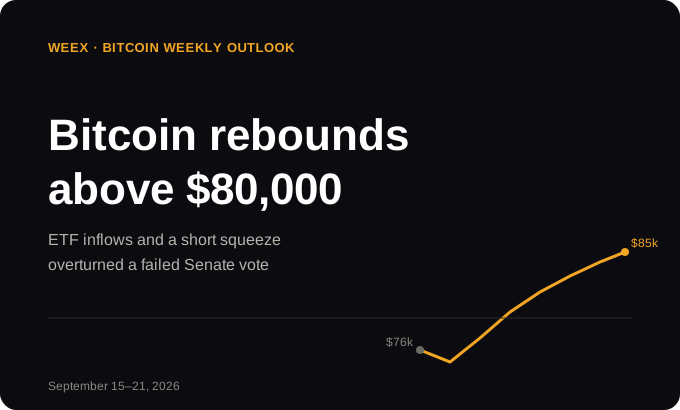
WEEX Bitcoin Weekly Outlook: Why Did Bitcoin Rebound Above $80,000 After the CLARITY Act Vote?
Bitcoin rebounded above $80,000 as SEC and CFTC action, renewed ETF inflows, and a short squeeze outweighed the failed CLARITY Act vote.
$8 Makes a Comeback, This Time X Money Rewrites the Logic of NFT Issuance
AMD Jumps Nearly 10%, Market Cap Tops $1 Trillion| WEEX TradFi Daily Brief (September 22, 2026)
Global markets on September 22 focus on a repair in AI-compute pricing. On September 21 the three major equity indexes closed higher. AMD rose nearly 10% and its market cap crossed $1 trillion for the first time, while Intel and Arm also surged. Brent crude fell about 3.4% to $100.34 and the 10-year Treasury yield eased to about 4.96%, lowering discount-rate pressure on long-duration tech. Bitcoin briefly broke above $87,000 and total crypto market cap returned above $3 trillion. Investors next watch consumer and housing earnings plus PMI flash prints.
Balancer Community Proposes Fork and Rebirth

The Answer to Dreamforce 2026: AI Agent, Has It Finally Turned from Demo to Revenue?

Ethereum: BitMine Approaches 5% of Total ETH Supply
Bitcoin's $84K rally isn't saving miners as difficulty signals already flash caution
ZEC's Largest Mining Company Moves to US Stock Market After Mining 70,000 ZEC in Six Months

Validators Vote on Batch V1.1 After Security Overhaul

Aptos Validators Decrease by 40% in Two Years, Concentration of Validator Nodes Shifts to Europe and America

SEC Takes Action: Who Can Handle "Compliant ICOs"?

TRON Weekly Industry Report: Regulatory and Interest Rate Pressures Fail to Dampen BTC Bullish Sentiment, Detailed Analysis of PayFi High-Performance Payment Infrastructure Axon Finance

When AI Agents Accelerate into Intranets: The Main Battlefield of Cybersecurity Has Changed
How to Earn Crypto Futures Trading Rewards on WEEX: Daily Lucky Eggs S2

ZetaChain, Linera, Switchboard Cease Operations
WEEX Futures Trading Rewards in Sep 2026: Win Up to 10,000 USDT

The Next Phase of Ethereum from the EF Protocol AMA

TapeOut Ecosystem Overview: From NAND, LATCH to On-Chain Application Ecosystem
BlackRock says Bitcoin volatility fell to 35–40
Coinbase Sets $100 Billion Market Cap Threshold for Individual Stock Futures, COIN Fails to Meet Criteria
The Quantum Issue: You Never Really Know The Future
Security and fees hold back deeper crypto use among wealthy investors: Nexo report
Bitcoin Developers Concerned About Mining Subsidy
VVV Hits All-Time High: Founder’s Perspective on Models, Privacy, and Crypto
XRPL fixes critical pre-mainnet flaw, but client apps remain at risk
Glassnode Indicates Shift Towards Altcoin Season
Contents
Latest articles





Latest coin listings on WEEX


