
Design Flaw in Uniswap v4 Hook? 0x Reveals Over Half of Hooks Exhibit Malicious Behavior

 Prefer us on Google


Open to developers, but also a gateway for wrongdoers.
Written by: 0x
Compiled by: Chopper, Foresight News
It’s time to confront the real issues with the Uniswap v4 Hook mechanism.
This year, the 0x protocol has completed 81.92 million transactions, with a total trading volume of $42.67 billion, and about 70% of transactions call on Uniswap’s liquidity pools.
We receive dozens of audits and applications to access v4 Hook every month, witnessing both good and bad cases. However, recently, a surge of malicious cases has emerged.
Hooks can indeed enable many practical functions, including custom trading rules and liquidity management. This article does not argue against the existence of these application scenarios or oppose developers building on Hooks; however, the permissionless Hook mechanism introduces new risk trade-offs for transaction execution and aggregation. A typical issue is that some malicious pools return quotes that do not match the actual assets users receive.
In the past few weeks, 0x has observed a sharp increase in the number of malicious Uniswap v4 Hooks. These malicious Hooks return one price during the quote request but use another price during actual settlement. The implementation patterns of malicious Hooks vary, but the end result is the same: they deceive aggregators, wallets, and trading applications to steal user assets.
Here are the phenomena we have observed on-chain, along with the measures 0x has taken in response.
Issues with the Hook Mechanism: Open to Developers, but Also a Gateway for Wrongdoers
Let’s start with the advantages. v4 Hook brings a layer of innovative capability to automated market makers (AMM). Developers can build AMMs with custom logic, executing logic at critical points in the pool's lifecycle, such as before and after swaps, or when liquidity provider positions change. Hooks can implement any logic, and anyone can deploy them; once deployed, they can directly reuse traffic from the most connected liquidity networks in the DeFi ecosystem.
This is the core contradiction: while this mechanism provides legitimate developers with stronger liquidity and transaction execution customization capabilities, it also makes it difficult for aggregators to discern which pools are trustworthy.
In addition to lowering the development threshold for developers, Hooks also leave significant operational space for malicious behavior. Malicious Hook projects do not need to build a well-known brand, guide users to access independent front-ends, or acquire traffic from scratch. They only need to return highly attractive quotes to various liquidity aggregators.
When aggregators see the optimal quotes, they will route transactions to that pool. Wallets and trading applications rely on the results output by aggregators, allowing malicious pools to exploit this trusted infrastructure to commit wrongdoing.
Current State of Malicious Hooks
In the past 18 months, the number of Uniswap v4 Hooks has exploded. We conducted static and dynamic analyses on a total of 84,163 Hooks across 6 chains and reviewed actual transaction data: only 19.4% are safe Hooks, 54.2% are malicious Hooks, and 26.4% are suspected malicious Hooks.
Data statistics as of September 11, 2026
The malicious behavior patterns vary: some resemble random fees like dice rolls, while others detect the EVM runtime environment to identify whether it comes from a quote inquiry. However, the underlying behavior is highly consistent; the quotes returned by the routing are not reliable prices that users can actually obtain. We have observed that transactions through malicious v4 Hooks result in users receiving assets that can be up to 50% less than the quotes initially presented to them.
Case 1
Hook Address: 0x800cef53c3fd41109dffec62e5251bdd7acba5c7
Chain: Base
Trading Pair: ETH/NVDAc
Total Transactions: 6,516
Fee Transactions: 3,946 (60.6%)
Fee Range: 0-18%
Median Fee for All Transactions: 17.96%
Median Fee for Transactions with Fees: 18%
Total Fees Collected (USD): $143,037
Data as of September 11, 2026
Case 2
Hook Address: 0x141984423d1a28242b3dd8888c5b0daa7b13c880
Chain: BNB Chain
Trading Pair: USDT/WBNB
Total Transactions: 4,879
Fee Transactions: 1,619 (33.2%)
Fee Range: 0-12.8%
Median Fee for All Transactions: 0%
Median Fee for Transactions with Fees: 12.8%
Total Fees Collected (USD): $18,592
Data as of September 11, 2026
Conclusion
The original intention of designing Hooks was to enhance Uniswap's scalability, but it has also given rise to significant abuse risks. Permissionless scalability introduces trade-offs in transaction execution and trust that cannot be ignored by routing contracts, applications, or ordinary users.
The current market situation this summer proves that permissionless liquidity does not equate to trustworthy liquidity. Just like the previous chaos with Prop AMM, this flexibility that allows developers to customize swap logic also provides wrongdoers with new means to manipulate transactions.
Based on the above observations, we propose several insights:
- Routing contracts must verify that the quotes returned by pools align with the actual execution results;
- Various applications need to have the capability to quickly eliminate suspicious transaction routes;
- Users need to understand that a displayed optimal quote is only meaningful if the route behind it is secure.
-- Price
This content is provided for general informational purposes only and doesn't constitute financial, investment, legal, or tax advice. Any events, rewards, online promotions, or related information mentioned herein should not be considered a recommendation, solicitation, or invitation to purchase, sell, trade, or otherwise deal in any crypto assets. Crypto assets are highly volatile and may result in loss. The availability of WEEX services, products, and related events may vary by region. You are responsible for ensuring that your participation is in accordance with applicable local laws and regulations.
You may also like

The End of the Blank Prompt: Why Trading AI Needs a Playbook

Cardano proposal slashes fees by 55%, but it comes with a cost for small pools

The Evolution of AI: The Boundaries and Truth of Recursive Self-Improvement (RSI)

The Quantum Issue: You Never Really Know The Future

Security and fees hold back deeper crypto use among wealthy investors: Nexo report

Bitcoin Developers Concerned About Mining Subsidy

VVV Hits All-Time High: Founder’s Perspective on Models, Privacy, and Crypto

XRPL fixes critical pre-mainnet flaw, but client apps remain at risk

Glassnode Indicates Shift Towards Altcoin Season
Crypto: Kalshi accused of inflating its volumes with thousands of identical orders

HODLing ETH: Should You Choose Staking for Yield or Collateralized Lending?

SEC Clarity Meets Fed Rate Hike: How WEEX TradFi Lucky Eggs S2 Taps Into Cross-Market Opportunities

How Significant Are Changes in Overseas AI Investment?
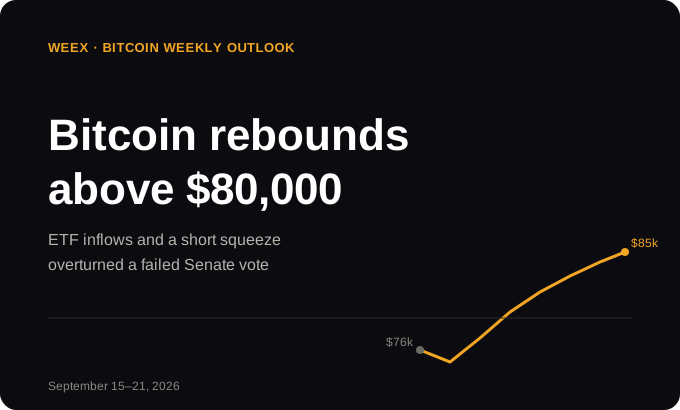
WEEX Bitcoin Weekly Outlook: Why Did Bitcoin Rebound Above $80,000 After the CLARITY Act Vote?
Bitcoin rebounded above $80,000 as SEC and CFTC action, renewed ETF inflows, and a short squeeze outweighed the failed CLARITY Act vote.
$8 Makes a Comeback, This Time X Money Rewrites the Logic of NFT Issuance
AMD Jumps Nearly 10%, Market Cap Tops $1 Trillion| WEEX TradFi Daily Brief (September 22, 2026)
Global markets on September 22 focus on a repair in AI-compute pricing. On September 21 the three major equity indexes closed higher. AMD rose nearly 10% and its market cap crossed $1 trillion for the first time, while Intel and Arm also surged. Brent crude fell about 3.4% to $100.34 and the 10-year Treasury yield eased to about 4.96%, lowering discount-rate pressure on long-duration tech. Bitcoin briefly broke above $87,000 and total crypto market cap returned above $3 trillion. Investors next watch consumer and housing earnings plus PMI flash prints.
Balancer Community Proposes Fork and Rebirth

The Answer to Dreamforce 2026: AI Agent, Has It Finally Turned from Demo to Revenue?
Ethereum: BitMine Approaches 5% of Total ETH Supply
Bitcoin's $84K rally isn't saving miners as difficulty signals already flash caution
ZEC's Largest Mining Company Moves to US Stock Market After Mining 70,000 ZEC in Six Months

Validators Vote on Batch V1.1 After Security Overhaul

Aptos Validators Decrease by 40% in Two Years, Concentration of Validator Nodes Shifts to Europe and America

SEC Takes Action: Who Can Handle "Compliant ICOs"?

TRON Weekly Industry Report: Regulatory and Interest Rate Pressures Fail to Dampen BTC Bullish Sentiment, Detailed Analysis of PayFi High-Performance Payment Infrastructure Axon Finance

When AI Agents Accelerate into Intranets: The Main Battlefield of Cybersecurity Has Changed
How to Earn Crypto Futures Trading Rewards on WEEX: Daily Lucky Eggs S2

ZetaChain, Linera, Switchboard Cease Operations
WEEX Futures Trading Rewards in Sep 2026: Win Up to 10,000 USDT

The Next Phase of Ethereum from the EF Protocol AMA
The End of the Blank Prompt: Why Trading AI Needs a Playbook
Cardano proposal slashes fees by 55%, but it comes with a cost for small pools
The Evolution of AI: The Boundaries and Truth of Recursive Self-Improvement (RSI)
The Quantum Issue: You Never Really Know The Future
Security and fees hold back deeper crypto use among wealthy investors: Nexo report
Bitcoin Developers Concerned About Mining Subsidy
Contents
Latest articles


Latest coin listings on WEEX


