
Ethereum's 'Two-Track Update': Glamsterdam Public Testnet and Hegotá Initial Validation

 Prefer us on Google


[Block Media Reporter Ham Ji-hyun] Ethereum is continuing preparations ahead of the application of its next upgrade, 'Glamsterdam', to the Sepolia testnet. The subsequent upgrade, 'Hegotá', is also being developed in parallel by testing core functionalities separately before integration.
According to the developer testing meeting 'ACDT #97' organized by Ethereum Collective Korea (ECK) on the 24th, the development team coordinated the schedule for the Glamsterdam testnet and the initial testing method for Hegotá during a meeting on the 21st (local time). The discussion focused on the order of verifying already ongoing functionalities rather than adding new features.
The main upgrade flow of Ethereum follows from 'Fusaka', which has already been applied to the mainnet, to the currently validating 'Glamsterdam', and then to 'Hegotá'. Glamsterdam aims for mainnet application in the fourth quarter of this year, while Hegotá is targeted for the second quarter of next year, although specific dates have not been finalized.
Before Glamsterdam can be introduced to the mainnet, the stability of new features must first be confirmed on the testnet. The Ethereum testnets utilized in this process are 'Sepolia' and 'Hoodi'. The development team plans to first apply Glamsterdam to these two testnets, checking primarily whether applications and smart contracts operate normally on Sepolia, and verifying network functionalities such as validator operations and staking on Hoodi.
Sepolia and Hoodi are not separate upgrade names but Ethereum testnets used to validate new features before their introduction to the mainnet. Sepolia is mainly used for testing applications and smart contracts, while Hoodi is utilized for validating operations and staking, as well as network upgrades. Therefore, it is not Hoodi that is applied to Ethereum, but rather the Glamsterdam upgrade is first applied to the Hoodi testnet to confirm its stability.
Glamsterdam has entered a phase where it defines the scope of major functionalities and checks stability on the developer testnet (Devnet). Previously, on the 17th of last month, the Ethereum Foundation unveiled a pre-testnet called 'Platåberget', which allows general developers and node operators to participate. This created an environment to verify that wallets and various services operate normally after the upgrade.
The next major schedule is to apply Glamsterdam to the Sepolia testnet on October 6. In line with this, each development team has agreed to distribute a new version of the client software that runs the network by the 29th of this month. The date for applying Glamsterdam to the Hoodi testnet has been tentatively set for October 27, with the decision on whether to proceed to be made on October 8.
In other words, Glamsterdam is undergoing verification after functional design and initial implementation, with stability checks on existing public testnets like Sepolia and Hoodi still pending before its mainnet introduction. The schedule for applying Sepolia does not mean that the mainnet launch date is confirmed.
The core of Glamsterdam lies in changing Ethereum's internal structure to handle more transactions. ePBS, which manages the separation of roles between block producers and validators proposing them to the network as a network rule, and BAL, which provides a list of what data transactions read and modify, are representative examples. In particular, BAL lays the groundwork for processing multiple tasks simultaneously by distinguishing transactions that do not affect each other.
A bug bounty program is also underway, rewarding those who find and report vulnerabilities. However, as of the 24th, the rewards related to Glamsterdam are limited to technical specifications and Ethereum Improvement Proposals (EIPs). The implementation code of Glamsterdam in the client is not yet eligible, and the scope of rewards will expand after the release candidate version is announced.
Hegotá: Separate Validation for 'Transaction Censorship Resistance' and 'Wallet Convenience'
Preparing for Hegotá after Glamsterdam, the team is in the stage of defining core functionalities and pushing for initial implementation and testnet configuration. The main functionalities are 'FOCIL (Fork Choice-based Forced Inclusion List)' and 'Frame Transaction (EIP-8141)', while further discussions are needed for other detailed components.
FOCIL is a mechanism that makes it difficult for block producers to intentionally exclude normal transactions from specific users. It aims to reduce the problem of transaction selection authority being concentrated among certain operators by requiring multiple validators to present a list of transactions that must be included in the block and adhere to it.
Frame Transaction proposes to reflect the programmatic approval of wallet transactions and fee processing methods in Ethereum's basic transaction rules, making the transaction approval and fee payment methods of wallets more flexible. The key is to directly support functionalities that the existing ERC-4337 provided through separate infrastructure at the network level.
In ERC-4337, when a user sends a request called 'UserOperation' instead of a regular transaction, a 'bundler' collects these requests and submits them as Ethereum transactions. Subsequently, a common smart contract called 'EntryPoint' manages the process of verifying the wallet's approval conditions and executing the requests. If the service pays the user's fees, a separate contract called 'Paymaster' is also utilized. This allows for convenient wallet functionalities without changing Ethereum's basic transaction rules, but it requires additional infrastructure to connect them.
In contrast, Frame Transaction consists of multiple processing stages such as 'User Approval Confirmation', 'Fee Payer Agreement Confirmation', and 'Actual Task Execution'. It places the process of confirming whether the user has approved the transfer, verifying whether the service agrees to bear the fee, and executing the actual transfer within a single transaction. Unlike the method of processing separate user requests within existing transactions, it changes Ethereum's transaction format itself to support this structure.
For example, when a user holding only stablecoins without ETH makes a transfer, the payer can be designed to pay the fee in ETH to the network while receiving payment from the user in stablecoins. It is also possible to bundle 'Token Approval' and 'Token Exchange' into a single transaction at a decentralized exchange, ensuring that if the exchange fails, the approval is also reverted.
During this meeting, the development team decided to test the two functionalities separately on different Devnets and then combine them into a single Hegotá integrated Devnet once the basic operations are stable. This approach is based on the understanding that inserting complex functionalities all at once from the beginning makes it difficult to identify the cause of errors when they occur.
However, there were also opinions that individual tests alone are not sufficient. This is because it is necessary to confirm whether FOCIL, which requires transactions to be included in blocks, operates without issues when working alongside the new format of frame transactions. Foundation researcher Tony Barshteiter pointed out that early integrated validation is crucial since the two functionalities closely affect each other in the transaction waiting space, known as 'mempool'.
Geth developer Matt Garnett expressed a desire to aim for a functioning Frame and FOCIL Devnet before Devcon. He suggested pushing for an integrated Devnet in October if the initial tests go smoothly. This is aimed at operating a developer testnet, and does not imply that Hegotá will be introduced to the mainnet at that time.
Regarding Glamsterdam, the discussion also included how long nodes participating in network operations should retain and provide auxiliary data necessary for processing past blocks and transactions to other nodes. Reducing the retention period could lower the storage capacity required by operators.
However, if one software deletes data while another must retain the same data, the overall storage burden does not decrease. Therefore, it was pointed out that the data retention criteria for the 'execution layer', which processes transactions, and the 'consensus layer', which is responsible for consensus on blocks, need to be adjusted together.
The development team did not finalize the retention period during this meeting and passed it on for online discussions and subsequent developer meetings. They also confirmed that this issue does not obstruct the application of Glamsterdam to the Sepolia testnet.
-- Price
This content is provided for general informational purposes only and doesn't constitute financial, investment, legal, or tax advice. Any events, rewards, online promotions, or related information mentioned herein should not be considered a recommendation, solicitation, or invitation to purchase, sell, trade, or otherwise deal in any crypto assets. Crypto assets are highly volatile and may result in loss. The availability of WEEX services, products, and related events may vary by region. You are responsible for ensuring that your participation is in accordance with applicable local laws and regulations.
You may also like

Exclusive Interview with Frontier Technology Investor Zheng Di: SEC's 'Innovation Exemption' Opens the Door to a Compliant Bull Market, Which Assets Are Potential Stocks?

HTX DeepThink: Opportunities Concentrate on Profitable and Fund-Supported Assets, BTC Still Has Room for Recovery After Consolidation

Why Did Sui (SUI) Crypto Price Jump 44%? Crypto OI and Leverage Explain the Rally
See why Sui (SUI) jumped 44%, how crypto OI and leverage amplified the rally, what the pullback means, and how to trade SUI on WEEX.

CFTC Chair Calls for "Mass Tokenization"! Wall Street Faces Three Barriers to Full On-Chain Adoption

Is the 1 Billion POL Burn Just a Joke?

Bitcoin Pulls Back From $87,000| WEEX TradFi Daily Brief (September 24, 2026)
Bitcoin pulled back from about $87,000 to about $84,000, with Ethereum near $2,680. S&P Global PMI on September 23 ET far exceeded forecasts. The 10-year yield broke above 5.00%, while the 5-year and 30-year touched highs last seen in 2007 and 2004. The S&P 500 and Nasdaq slipped. Energy moved with oil and crypto-treasury stocks followed bitcoin lower. Investors await earnings from COST, BB, and others.

WEEX Exclusive:Bitcoin Pulls Back From $87,000| WEEX TradFi Daily Brief (September 24, 2026)
MIT Warns AI Bubble May Require 2.7x Productivity Increase by 2030
Davie Reveals BTC Strategy Data, Volume 205.42K, Rate +0.0016%

Stablecoins hold nearly $200 billion in US debt, but money funds bought the surge

Coin Metrics revises 19 months of Bitcoin ETF wallet data

HTX Research Analyst WZ: Crypto Market Pricing Extends Beyond Crypto, Regulation and Liquidity Become Key Variables
Ye Tan: The Internet Era is Coming to an End, the AI Era has Already Begun

Chainalysis: Crypto Economic Activity Down 1.6%, Market Value Shrinks by $2.1 Trillion

$1.7 Billion Inflow to Bitcoin ETFs in Two Days

Why Do You Always Make Small Profits and Then Lose Everything? Taleb Explained It with 'Asymmetric Leverage' Twenty Years Ago

Coinbase traced $1.1 million crypto trail behind AI phishing service EvilTokens
Over 70% of South Korean Crypto Investors Oppose Crypto Tax: What Are Their Concerns?
Nomura Warns of 'Double Whammy' Risk: The Next Market Storm May Start with Interest Rate Volatility

VVV Hits All-Time High: Founder’s Perspective on Models, Privacy, and Crypto

Binance Research Team: A Bull Market Requires the Resonance of Monetary Easing and Paradigm Innovation, with RWA as a Key Driving Force

Bitpace Partners with Fireblocks for Cross-Border Payments with Stablecoins
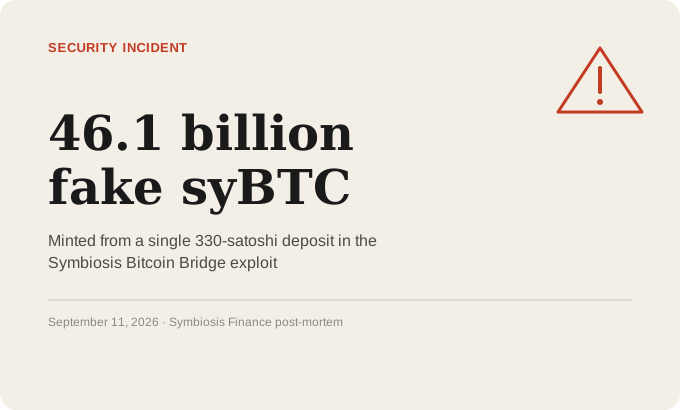
How Did a Hacker Create 46 Billion Fake Bitcoin in the Symbiosis Exploit? Decodes Bitcoin Hacker With WEEX Now
How two Symbiosis bridge bugs let a hacker mint 46.1 billion unbacked syBTC, drain Bitcoin pools and expose critical bridge risks.
[Interview] Lee Yun-ho, CEO of KIP: "We need to set the stage before the STO market opens... sharing RWA know-how with financial companies"
What is Fin.com? Understanding Cross-Border Payment Infrastructure via API

Uniswap (UNI) Price Jumps Toward $10 as CME Futures Launch Nears: What Traders Need to Know
Bernstein Research Report: Why Can Gold Still Surge to $5,700 Even with Continued Rate Hikes by the Fed?
Masayoshi Son is borrowing money again, betting billions on OpenAI

Hashed invests in $300 million digital-asset private credit fund
The IMF opens an office in Venezuela to supervise an economy that has already migrated to USDT
Exclusive Interview with Frontier Technology Investor Zheng Di: SEC's 'Innovation Exemption' Opens the Door to a Compliant Bull Market, Which Assets Are Potential Stocks?
HTX DeepThink: Opportunities Concentrate on Profitable and Fund-Supported Assets, BTC Still Has Room for Recovery After Consolidation
Why Did Sui (SUI) Crypto Price Jump 44%? Crypto OI and Leverage Explain the Rally
See why Sui (SUI) jumped 44%, how crypto OI and leverage amplified the rally, what the pullback means, and how to trade SUI on WEEX.
CFTC Chair Calls for "Mass Tokenization"! Wall Street Faces Three Barriers to Full On-Chain Adoption
Is the 1 Billion POL Burn Just a Joke?
Bitcoin Pulls Back From $87,000| WEEX TradFi Daily Brief (September 24, 2026)
Bitcoin pulled back from about $87,000 to about $84,000, with Ethereum near $2,680. S&P Global PMI on September 23 ET far exceeded forecasts. The 10-year yield broke above 5.00%, while the 5-year and 30-year touched highs last seen in 2007 and 2004. The S&P 500 and Nasdaq slipped. Energy moved with oil and crypto-treasury stocks followed bitcoin lower. Investors await earnings from COST, BB, and others.
Contents
Latest articles


Latest coin listings on WEEX


