
Fed Rate Hike 2026: Can Bitcoin Hold $75K as Gold Stays Strong?

 Prefer us on Google


On September 16, 2026, the Federal Reserve raised the federal funds target range by 25 basis points to 3.75%–4.00% in a unanimous 12–0 vote, marking its first rate hike in more than three years. The immediate market response was telling: BTC traded roughly between $75,000 and $76,500, while spot gold briefly pushed above $4,365 before slipping back toward $4,240 as the dollar strengthened. That leaves investors with a clear macro question. Can Bitcoin hold the $75K area if rates stay higher for longer, or will gold keep attracting more defensive demand as inflation and geopolitical risks remain in focus?
Quick Answer
- The Fed raised rates to 3.75%–4.00%, and its projections suggest policymakers still lean restrictive.
- BTC held near $75K after the decision, but the pressure did not come from the Fed alone; regulation and higher yields were already weighing on sentiment.
- Gold pulled back after the dollar strengthened, yet it remains structurally strong above $4,200.
- For Bitcoin, the key near-term test is whether support around $73K–$75K holds and whether price can reclaim $78K–$80K.
What Did the Fed Decide in September 2026?
The September Federal Open Market Committee meeting delivered a clear tightening signal. The Fed raised its target range by 25 basis points to 3.75%–4.00%, effective September 17, 2026. The vote was unanimous at 12–0. The central bank also set interest on reserve balances at 3.90% and the primary credit rate at 4.00%, while continuing its ample-reserves framework.
In its statement, the Fed said economic activity was still expanding at a solid pace. Domestic spending remained resilient, productivity growth was strong, capital investment stayed robust, job gains kept pace with labor-force growth, and inflation remained elevated. The purpose of the hike, according to the statement, was to support a more timely return toward the Fed’s 2% inflation objective.
Just as important, the September projections did not look especially soft. The dot plot showed 12 of 18 participants at a 4.125% year-end midpoint, with two at 3.875% and four at 4.375%. That does not guarantee another hike, but the September dot plot indicates that many policymakers see room for further tightening.
How Did Bitcoin React to the Fed Rate Hike?
BTC traded in a relatively tight but fragile range immediately after the decision. According to The Block’s post-FOMC coverage, Bitcoin moved roughly between $75,000 and $76,500, with price near $75,600 shortly afterward. Traders looking for the WEEX Bitcoin live price and market can treat this zone as the first important reaction band after the Fed announcement.
It is important to separate the Fed move from the broader setup. Bitcoin had already been trading near a four-week low around $75,877 before the FOMC announcement as markets digested the failed U.S. CLARITY Act vote and ongoing uncertainty around crypto market structure. In other words, the rate hike intensified an existing pressure point rather than creating the whole decline by itself.
That matters because BTC is now reacting to several forces at once: higher policy rates, a stronger dollar, U.S. Treasury yields near 5%, regulatory uncertainty, and weaker risk appetite. The $75K level is therefore more than just a round number. It is becoming both a psychological threshold and a short-term technical decision zone.
-- Price
Why Higher Rates Put Pressure on Bitcoin
The macro logic is straightforward. When the Fed raises rates, risk-free returns become more attractive. That usually supports the dollar, tightens financial conditions, and increases the opportunity cost of holding volatile assets such as Bitcoin. If investors can earn solid nominal returns in Treasuries, some capital rotates away from risk assets.
Reuters reported that the U.S. 10-year Treasury yield had recently moved above 5%, a level that tends to matter for all speculative assets, not just crypto. Fed Chair Kevin Warsh said rising yields reflected strong economic activity, heavy capital spending, technology-sector investment, and global political uncertainty. From a portfolio perspective, that is a difficult backdrop for BTC because bonds start competing more directly for capital.
Still, Bitcoin does not trade on rates alone. Liquidity conditions, ETF demand, regulation, fiscal concerns, and broader crypto sentiment can partly offset macro pressure. The policy picture in Washington also remains relevant. Legal observers such as Paul Hastings and K&L Gates have noted that SEC-CFTC coordination is improving, while the SEC has already moved from March interpretive guidance to its proposed “Regulation Crypto Assets” framework. At the same time, CLARITY Act momentum appears less certain than it did earlier in 2026. That mix helps explain why a 25 bp hike does not automatically mean BTC must break down, even if it raises the bar for a rebound.
Why Is Gold Holding Up Better Than Bitcoin?
Gold did not rise in a straight line after the Fed decision, but it still looked sturdier than BTC on a structural basis. Reuters reported that spot gold initially climbed to $4,365.57 per ounce, then reversed to about $4,240.10, down roughly 1.2%, as the dollar strengthened. That pullback matters, but so does the bigger picture: spot gold remained above $4,200 even in a higher-rate environment.
Investors tracking the WEEX PAX Gold market can view this resilience as a sign that gold is still benefiting from multiple demand channels. Inflation remains above target, geopolitical uncertainty is high, central-bank buying continues to matter, and international demand has been supported in part by Chinese investment flows. MarketWatch also highlighted Chinese ETF inflows and central-bank buying as factors behind gold’s relative strength.
The fairest comparison is not that gold always rises while Bitcoin falls. Both are non-yielding assets and both can face short-term pressure when the dollar and real yields move up. The difference is that gold has a deeper reserve-asset role and a longer history as a defensive hedge. Bitcoin can still attract long-term capital, but in a higher-rate environment it usually needs stronger risk appetite or supportive crypto-specific catalysts to outperform.
Bitcoin Technical Outlook — Can $75K Hold?
The current chart structure can be framed with a few practical zones rather than one exact number.
| BTC Level | Interpretation |
|---|---|
| $73K–$75K | Main near-term support |
| $75K–$77K | Current decision zone |
| $78K–$80K | First recovery resistance |
| $82K–$83K | Recent September high zone |
| $69K–$72K | Deeper downside area if $75K fails |
| $85K+ | Bullish recovery extension |
If BTC can hold above $73K–$75K and then reclaim $78K–$80K, that would suggest traders have absorbed much of the Fed shock and are no longer pricing a sharp deterioration in financial conditions. On the other hand, a decisive break below $73K would likely shift focus toward the $69K–$72K region. These are editorial technical reference zones, not guaranteed floors or targets.
Bitcoin Price Prediction After the September Fed Hike
Because macro and regulatory signals are still mixed, it makes more sense to use scenarios than a single forecast.
| Scenario | Timeframe | BTC Range |
|---|---|---|
| Bear Case | Late Sep–Oct 2026 | $68K–$74K |
| Base Case | Late Sep–Oct 2026 | $74K–$82K |
| Bull Case | Q4 2026 | $82K–$90K |
The bear case becomes more plausible if BTC loses $73K–$75K support, Treasury yields remain above 5%, the dollar keeps strengthening, the Fed signals more tightening, and crypto flows weaken. The base case assumes the September move was largely priced in, current support broadly holds, yields stabilize, and guidance becomes more data-dependent. The bull case needs more than simple survival; BTC would likely need to reclaim $80K, see yields retreat or settle, and benefit from stronger institutional or ETF-related demand.
That last point deserves caution. There is not enough high-quality official data in the supplied materials to confirm a persistent 2026 trend in BTC ETF inflows or institutional positioning. What can be said is that Bitcoin’s institutional foundation still appears to be broadening. Public-company treasury activity has continued in 2026, even if flows are mixed across buyers and sellers. So holding $75K does not require a dovish Fed pivot. It mainly requires financial conditions to stop worsening beyond what markets already expect.
What Should Investors Watch Next?
Five indicators stand out from here. First is Fed guidance, especially the next debate around the dot plot and whether policymakers keep signaling restrictive rates into 2027. Second is the U.S. 10-year Treasury yield. A sustained move materially above 5% would likely keep pressure on BTC and other risk assets.
Third is the dollar. A stronger dollar tends to tighten global liquidity and weigh on both crypto and commodities. Fourth is Bitcoin’s own support zone at $73K–$75K, which remains the clearest near-term chart test. Fifth is gold around $4,200–$4,400. If gold stays elevated even under tighter monetary policy, that would reinforce the view that inflation and geopolitical hedging demand remain powerful.
Can Bitcoin Hold $75K as Gold Stays Strong?
Yes, Bitcoin can hold the $75,000 region, but only if the September hike proves mostly priced in and Treasury yields stop pushing aggressively higher. The clearest bullish confirmation would be a sustained defense of $73K–$75K followed by a recovery above $78K–$80K. If yields and the dollar keep climbing, however, BTC could still revisit the $68K–$72K zone. Gold’s pullback after the Fed decision does not change its broader resilience above $4,200. The next move for both assets now depends less on the 25 bp hike itself and more on whether the Fed tightens further and whether long-end yields remain around or above 5%.
Conclusion
BTC is facing a tougher macro test after the September 2026 Fed hike, but $75K is still defendable if yields stabilize, the dollar stops accelerating, and crypto-specific risk sentiment does not worsen. Gold looks stronger structurally because it has deeper defensive demand, yet Bitcoin can still recover if support holds and markets absorb the higher-rate backdrop without pricing a much more aggressive tightening cycle.
FAQ
1. Why is $75K so important for Bitcoin right now?
The $75K area is acting as both a psychological level and a short-term technical support zone. If BTC holds that region and starts reclaiming higher resistance, it would suggest traders are absorbing the Fed shock rather than accelerating risk reduction.
2. Did the Fed rate hike alone cause BTC to fall?
No. Bitcoin was already trading near a four-week low before the FOMC decision as markets weighed the failed CLARITY Act vote, higher Treasury yields, and weaker risk appetite. The rate hike added pressure to an already fragile setup.
3. Why has gold looked more resilient than BTC?
Gold still benefits from inflation hedging, geopolitical demand, central-bank buying, and reserve diversification. Bitcoin can attract long-term capital too, but it usually reacts more sharply to tighter liquidity and changing risk sentiment.
4. What would improve the near-term outlook for BTC?
A stable or lower 10-year Treasury yield, less aggressive Fed expectations, a steadier dollar, and a move back above $78K–$80K would all help. Supportive regulatory progress could also improve sentiment.
5. Is another Fed hike in 2026 guaranteed?
No. The September dot plot indicates that many policymakers see room for further tightening, but that is not the same as a guaranteed move. Upcoming inflation, labor, and growth data will still matter.
This content is provided for general informational purposes only and doesn't constitute financial, investment, legal, or tax advice. Any events, rewards, online promotions, or related information mentioned herein should not be considered a recommendation, solicitation, or invitation to purchase, sell, trade, or otherwise deal in any crypto assets. Crypto assets are highly volatile and may result in loss. The availability of WEEX services, products, and related events may vary by region. You are responsible for ensuring that your participation is in accordance with applicable local laws and regulations.
You may also like

The End of the Blank Prompt: Why Trading AI Needs a Playbook

Cardano proposal slashes fees by 55%, but it comes with a cost for small pools

The Evolution of AI: The Boundaries and Truth of Recursive Self-Improvement (RSI)

The Quantum Issue: You Never Really Know The Future

Security and fees hold back deeper crypto use among wealthy investors: Nexo report

Bitcoin Developers Concerned About Mining Subsidy

VVV Hits All-Time High: Founder’s Perspective on Models, Privacy, and Crypto

XRPL fixes critical pre-mainnet flaw, but client apps remain at risk

Glassnode Indicates Shift Towards Altcoin Season

Crypto: Kalshi accused of inflating its volumes with thousands of identical orders

HODLing ETH: Should You Choose Staking for Yield or Collateralized Lending?

SEC Clarity Meets Fed Rate Hike: How WEEX TradFi Lucky Eggs S2 Taps Into Cross-Market Opportunities

How Significant Are Changes in Overseas AI Investment?
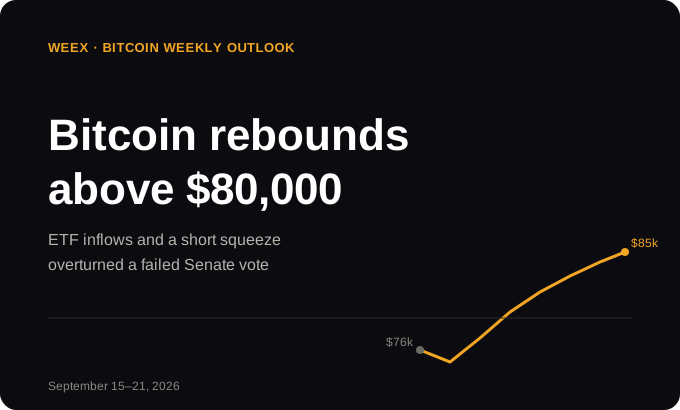
WEEX Bitcoin Weekly Outlook: Why Did Bitcoin Rebound Above $80,000 After the CLARITY Act Vote?
Bitcoin rebounded above $80,000 as SEC and CFTC action, renewed ETF inflows, and a short squeeze outweighed the failed CLARITY Act vote.

$8 Makes a Comeback, This Time X Money Rewrites the Logic of NFT Issuance
AMD Jumps Nearly 10%, Market Cap Tops $1 Trillion| WEEX TradFi Daily Brief (September 22, 2026)
Global markets on September 22 focus on a repair in AI-compute pricing. On September 21 the three major equity indexes closed higher. AMD rose nearly 10% and its market cap crossed $1 trillion for the first time, while Intel and Arm also surged. Brent crude fell about 3.4% to $100.34 and the 10-year Treasury yield eased to about 4.96%, lowering discount-rate pressure on long-duration tech. Bitcoin briefly broke above $87,000 and total crypto market cap returned above $3 trillion. Investors next watch consumer and housing earnings plus PMI flash prints.
Balancer Community Proposes Fork and Rebirth

The Answer to Dreamforce 2026: AI Agent, Has It Finally Turned from Demo to Revenue?
Ethereum: BitMine Approaches 5% of Total ETH Supply
Bitcoin's $84K rally isn't saving miners as difficulty signals already flash caution
ZEC's Largest Mining Company Moves to US Stock Market After Mining 70,000 ZEC in Six Months

Validators Vote on Batch V1.1 After Security Overhaul

Aptos Validators Decrease by 40% in Two Years, Concentration of Validator Nodes Shifts to Europe and America

SEC Takes Action: Who Can Handle "Compliant ICOs"?

TRON Weekly Industry Report: Regulatory and Interest Rate Pressures Fail to Dampen BTC Bullish Sentiment, Detailed Analysis of PayFi High-Performance Payment Infrastructure Axon Finance

When AI Agents Accelerate into Intranets: The Main Battlefield of Cybersecurity Has Changed
How to Earn Crypto Futures Trading Rewards on WEEX: Daily Lucky Eggs S2

ZetaChain, Linera, Switchboard Cease Operations
WEEX Futures Trading Rewards in Sep 2026: Win Up to 10,000 USDT

The Next Phase of Ethereum from the EF Protocol AMA
The End of the Blank Prompt: Why Trading AI Needs a Playbook
Cardano proposal slashes fees by 55%, but it comes with a cost for small pools
The Evolution of AI: The Boundaries and Truth of Recursive Self-Improvement (RSI)
The Quantum Issue: You Never Really Know The Future
Security and fees hold back deeper crypto use among wealthy investors: Nexo report
Bitcoin Developers Concerned About Mining Subsidy
Contents
Latest articles


Latest coin listings on WEEX


