
Oil Crisis: 5 Reasons Why the Surge Won't Stop

 Prefer us on Google


The fuel price is never reasonable. The SP95-E10 reached its highest level since the beginning of the conflict in Iran, around €2.10 per liter on Saturday, €2.12 at Turbo on September 10-11. Diesel fared worse, returning to around €2.30, its record from April 2026. Three fronts converge to explain this: the Iranian front that has been suffocating the Gulf for seven months, the Houthis who have just seized a key port on the Red Sea, and the one that Russia is leading against its own burning refineries. Key points of this article: * The SP95-E10 and diesel have reached historic price levels in France, exacerbated by major geopolitical tensions. * Successive crises around the Strait of Hormuz and the Red Sea have caused a dramatic increase in Brent prices, impacting global oil supply. Brent Driven Up by Hormuz, and Russian Refining on Its Knees Since the closure of the Strait of Hormuz at the end of February, Brent has risen above $100 for the first time since 2022 in March, peaking at over $120 at the end of April. It then fell below this threshold during the summer, around $84 in June-July, before crossing it again on September 10 following the Houthis' capture of the port of Mokha, a second front added to that of Hormuz. The third shock, distinct from the previous two: Ukrainian drone strikes have crippled Russian refining. Bloomberg estimates Russian refining at its lowest level in 24 years, at about 3.6 million barrels per day in July. Estimates of lost capacity vary. The Ukrainian Razumkov Center estimates it at 20-25%, while the Financial Times speaks of over 30% of actual capacity and 45% of nominal capacity. Regardless of the figures and their complexity, the result is the same on the ground: shortages in almost all Russian regions, with a daily shortfall estimated at 15,000 to 25,000 tons. To compensate, Russia is now importing gasoline from Belarus, Kazakhstan, India, Turkey, and even China. Belarusian deliveries reportedly increased by 141 times in June year-on-year. A second lock closes in the Red Sea A second front escalated on September 10. Houthi rebels captured Mokha, a key Yemeni port near the Bab el-Mandeb Strait, through which about 6 million barrels per day still transit to Asia, accounting for about 10% of global oil supply, two-thirds of which comes from Saudi Arabia. Brent surged by over 4% in response, reaching $105.4, while the barrel had already peaked at $126 at the end of April during the height of the Hormuz crisis. The strait is not completely closed. However, the number of vessels in transit has significantly decreased since the Houthi announcement. Passing through the Suez Canal extends the journey to South Korea from 24 to 54 days, and the largest tankers cannot even pass through at full load. By the end of July, the Houthis had already claimed strikes on two Saudi tankers, including the Encelia, hit in the Red Sea, tightening the noose on the kingdom's exports, already constrained on the Hormuz side. Transporting oil is becoming increasingly expensive The two locks directly impact freight prices. According to maritime brokers, a supertanker (VLCC) on the Middle East/China route now charges nearly $800,000 per day, and up to $386,000 per week on the Oman/Asia route. Between the Gulf of Mexico and Asia, a full charter reaches $29.5 million, or about $15 per barrel just for transport. Bypassing Africa via the Cape of Good Hope adds more than three weeks at sea and millions of dollars in additional costs. Morgan Stanley, according to Bloomberg, anticipates a 20 to 30% increase in biannual charter rates. Shipping companies are not mistaken. Kpler forecasts daily revenues from VLCCs exceeding $100,000 until next year. American diesel hits a record not seen since 2022 In the United States, diesel surpassed $6 per gallon on Thursday, September 10, an absolute record up by $2.30 year-on-year. It had already broken the June 2022 record at the beginning of September, reaching $5.85 per gallon according to AAA, compared to $5.81 four years earlier. The AAA automobile association points to two compounding factors: the traffic restriction at Hormuz and Ukrainian strikes on Russian refineries, which also deprive the global market of exported diesel. As long as these two factors remain in place, prices will not drop. Dan Jørgensen, the European Commissioner for Energy, already mentioned in April a crisis that could last "very difficult months, even years". The ECB raises the stakes in the face of energy-driven inflation This surge does not stop at gas pumps. In France, the harmonized price index rose by 2.7% year-on-year in August, compared to 2.4% on the national index, with energy soaring by 16.7% year-on-year, up from 12.6% in July. Fuel drives the entire curve. Faced with inflation that refuses to recede, the European Central Bank raised its key rates on Thursday, September 10, for the second time this year. A tightening that also weighs on risky assets. Bitcoin had already lost 2.7% at the announcement of the American blockade of the Strait of Hormuz in mid-April, before resuming its rise. Oil is not falling, nor is the ECB.
-- Price
This content is provided for general informational purposes only and doesn't constitute financial, investment, legal, or tax advice. Any events, rewards, online promotions, or related information mentioned herein should not be considered a recommendation, solicitation, or invitation to purchase, sell, trade, or otherwise deal in any crypto assets. Crypto assets are highly volatile and may result in loss. The availability of WEEX services, products, and related events may vary by region. You are responsible for ensuring that your participation is in accordance with applicable local laws and regulations.
You may also like

XRPL to Implement Major Upgrade on October 5: Adding Permission Delegation Feature

67% of the wealthy own digital assets, but the crypto adoption gap remains huge

How to Rewrite Internet Rules When Everyone Has an Indefatigable Agent

The End of the Blank Prompt: Why Trading AI Needs a Playbook
Cardano proposal slashes fees by 55%, but it comes with a cost for small pools

The Evolution of AI: The Boundaries and Truth of Recursive Self-Improvement (RSI)
The Quantum Issue: You Never Really Know The Future

Security and fees hold back deeper crypto use among wealthy investors: Nexo report

Bitcoin Developers Concerned About Mining Subsidy

VVV Hits All-Time High: Founder’s Perspective on Models, Privacy, and Crypto

XRPL fixes critical pre-mainnet flaw, but client apps remain at risk

Glassnode Indicates Shift Towards Altcoin Season

Crypto: Kalshi accused of inflating its volumes with thousands of identical orders
HODLing ETH: Should You Choose Staking for Yield or Collateralized Lending?

SEC Clarity Meets Fed Rate Hike: How WEEX TradFi Lucky Eggs S2 Taps Into Cross-Market Opportunities

How Significant Are Changes in Overseas AI Investment?
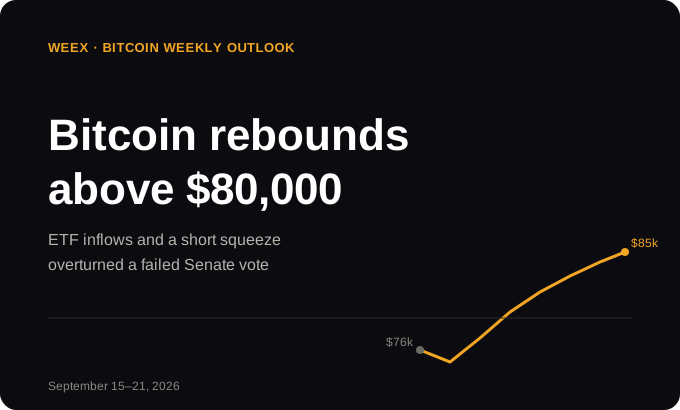
WEEX Bitcoin Weekly Outlook: Why Did Bitcoin Rebound Above $80,000 After the CLARITY Act Vote?
Bitcoin rebounded above $80,000 as SEC and CFTC action, renewed ETF inflows, and a short squeeze outweighed the failed CLARITY Act vote.
$8 Makes a Comeback, This Time X Money Rewrites the Logic of NFT Issuance
AMD Jumps Nearly 10%, Market Cap Tops $1 Trillion| WEEX TradFi Daily Brief (September 22, 2026)
Global markets on September 22 focus on a repair in AI-compute pricing. On September 21 the three major equity indexes closed higher. AMD rose nearly 10% and its market cap crossed $1 trillion for the first time, while Intel and Arm also surged. Brent crude fell about 3.4% to $100.34 and the 10-year Treasury yield eased to about 4.96%, lowering discount-rate pressure on long-duration tech. Bitcoin briefly broke above $87,000 and total crypto market cap returned above $3 trillion. Investors next watch consumer and housing earnings plus PMI flash prints.
Balancer Community Proposes Fork and Rebirth

The Answer to Dreamforce 2026: AI Agent, Has It Finally Turned from Demo to Revenue?
Ethereum: BitMine Approaches 5% of Total ETH Supply
Bitcoin's $84K rally isn't saving miners as difficulty signals already flash caution
ZEC's Largest Mining Company Moves to US Stock Market After Mining 70,000 ZEC in Six Months

Validators Vote on Batch V1.1 After Security Overhaul

Aptos Validators Decrease by 40% in Two Years, Concentration of Validator Nodes Shifts to Europe and America

SEC Takes Action: Who Can Handle "Compliant ICOs"?

TRON Weekly Industry Report: Regulatory and Interest Rate Pressures Fail to Dampen BTC Bullish Sentiment, Detailed Analysis of PayFi High-Performance Payment Infrastructure Axon Finance

When AI Agents Accelerate into Intranets: The Main Battlefield of Cybersecurity Has Changed
How to Earn Crypto Futures Trading Rewards on WEEX: Daily Lucky Eggs S2
XRPL to Implement Major Upgrade on October 5: Adding Permission Delegation Feature
67% of the wealthy own digital assets, but the crypto adoption gap remains huge
How to Rewrite Internet Rules When Everyone Has an Indefatigable Agent
The End of the Blank Prompt: Why Trading AI Needs a Playbook
Cardano proposal slashes fees by 55%, but it comes with a cost for small pools
The Evolution of AI: The Boundaries and Truth of Recursive Self-Improvement (RSI)


