
OpenAI Expenses in Campaigns: 39 US Candidates Paid for ChatGPT

 Prefer us on Google

It only takes twenty dollars a month for a paid version of ChatGPT, yet that seemingly minimal expense has turned into a political issue. An analysis by the Washington Post of documents filed with the Federal Election Commission has revealed OpenAI's expenses in US electoral campaigns this cycle: thirty-nine congressional candidates reported payments to OpenAI, the company behind ChatGPT, for the use of artificial intelligence tools in their campaigns. A number that, according to those closely following the sector, tells only part of the story.
Summary
- Key Points
- Extensive use of OpenAI tools in congressional campaigns
- Who spends and how much
- Violations of rules and use beyond OpenAI's guidelines
- OpenAI's ban on political advertising
- Synthetic media and personalized communications
- Transparency and regulatory gaps in AI campaign spending
- Outdated spending categories
- Why the real numbers are likely higher
- FAQ
- How many congressional candidates reported expenses for OpenAI subscriptions?
- Does OpenAI allow its tools to be used for creating political ads?
- Why is it difficult to accurately monitor campaign spending on AI tools?
- Do all campaigns fully disclose their use of AI tools in their reports?
Key Points {#Key_Points}
- Thirty-nine congressional candidates reported payments to OpenAI in this election cycle, according to the FEC document analysis.
- Republican Representative Mike Lawler spent about $3,260 on OpenAI services since 2025.
- The Republican National Committee has paid nearly $9,700 in OpenAI subscriptions, the highest amount among committees.
- About 30 PACs and political parties reported similar expenses.
- At least two candidates used the tools to produce political ads, violating OpenAI's usage rules.
Extensive Use of OpenAI Tools in Congressional Campaigns {#Extensive_Use_of_OpenAI_Tools_in_Congressional_Campaigns}
Generative artificial intelligence has become a recurring item in campaign budgets. Documents filed with the FEC show that the use of ChatGPT and other OpenAI tools is no longer an isolated exception, but a widespread practice among candidates, committees, and political organizations at all levels.
Who Spends and How Much {#Who_Spends_and_How_Much}
Among individual candidates, New York Republican Mike Lawler leads the individual spending chart with about $3,260 paid to OpenAI since 2025. On the organizational front, the Republican National Committee is the largest contributor with payments nearing $9,700, the highest amount recorded among political action committees. Additionally, about 30 PACs and political parties reported similar payments to OpenAI during the election cycle.
These numbers, it should be noted, represent only what the campaigns have chosen to voluntarily disclose in their reports. Campaign staff may pay for personal subscriptions, use free versions of the services, or route payments through vendors and consultants whose invoices do not specify which tools are actually being used.
Violations of Rules and Use Beyond OpenAI's Guidelines {#Violations_of_Rules_and_Use_Beyond_OpenAI's_Guidelines}
Not all declared expenses fall within the permitted use. At least two campaigns have used their OpenAI subscriptions specifically to generate political advertising content, a use that is in open contradiction to the company's policies.
OpenAI's Ban on Political Advertising
OpenAI explicitly prohibits the use of its tools to produce content intended for political advertising, a restriction introduced well before the start of this electoral cycle. Despite this, at least two candidates have decided to consider the terms of service more as a suggestion than as a binding rule. It should be noted that OpenAI does not have officials dedicated to monitoring political compliance who oversee every conversation initiated on ChatGPT: the verification of policy compliance is therefore almost exclusively reliant on the self-reporting of the involved parties.
Synthetic Media and Personalized Communications
A third candidate has pushed the use beyond mere back-office efficiency, claiming to have employed unspecified artificial intelligence tools to draft communications, personalize messages, and produce what the Washington Post describes as synthetic media. This raises non-trivial questions about what actually reaches voters without any label indicating its artificial origin.
Transparency and Regulatory Gaps in AI Campaign Spending
Federal regulations on electoral funding have yet to catch up with generative artificial intelligence. The law requires the declaration of expenses, but the available categories for reporting were designed for a world of printing costs, travel, and staff salaries: an "OpenAI subscription" does not have its own dedicated budget line.
Outdated Spending Categories
This gap in reporting categories allows campaigns to legitimately file these expenses under generic headings, which end up obscuring the true nature of the expenditure. The Federal Election Commission has long been discussing whether to impose a requirement to declare content generated with artificial intelligence, but as of mid-2026, no binding federal rule has yet been finalized. Some states have moved more quickly, passing laws that require explicit notices on political advertising generated with AI or banning the creation of synthetic media depicting candidates.
Why the Real Numbers Are Likely Higher
Political consultants emphasize that many campaigns prefer to keep a low profile on the use of AI to avoid voter skepticism towards artificially generated content. The count of thirty-nine candidates made by the Washington Post should therefore be interpreted more as a minimum threshold than as a definitive estimate. The leap from the early years of public availability of ChatGPT, between late 2022 and 2023, when the use of AI in campaigns was mostly anecdotal, is nonetheless significant. And without binding disclosure obligations, campaigns have no duty to report which content has been drafted, refined, or entirely produced by a language model.
FAQ
How many congressional candidates have declared expenses for OpenAI subscriptions?
Thirty-nine candidates for Congress have reported payments to OpenAI for the use of artificial intelligence tools during this election cycle.
Does OpenAI allow the use of its tools to create political advertisements? {#OpenAI_allows_use_of_its_tools_to_create_political_advertisements}
No, OpenAI prohibits the use of its tools to produce political advertising content, but at least two candidates have violated this rule.
Why is it difficult to accurately monitor campaign spending on AI tools? {#Why_is_it_difficult_to_monitor_campaign_spending_on_AI_tools}
Campaign finance disclosures do not include a dedicated category for artificial intelligence tools, so expenses are often recorded under generic headings that obscure their true nature.
Do all campaigns fully disclose their use of AI tools in their reports? {#Do_all_campaigns_fully_disclose_their_use_of_AI_tools_in_their_reports}
No, political consultants report that many campaigns use personal accounts or vague spending categories to completely hide payments related to artificial intelligence tools.
Content created with the assistance of artificial intelligence and human editorial review.
-- Price
This content is provided for general informational purposes only and doesn't constitute financial, investment, legal, or tax advice. Any events, rewards, online promotions, or related information mentioned herein should not be considered a recommendation, solicitation, or invitation to purchase, sell, trade, or otherwise deal in any crypto assets. Crypto assets are highly volatile and may result in loss. The availability of WEEX services, products, and related events may vary by region. You are responsible for ensuring that your participation is in accordance with applicable local laws and regulations.
You may also like

Exclusive Interview with Frontier Technology Investor Zheng Di: SEC's 'Innovation Exemption' Opens the Door to a Compliant Bull Market, Which Assets Are Potential Stocks?

XRPL to Implement Major Upgrade on October 5: Adding Permission Delegation Feature

67% of the wealthy own digital assets, but the crypto adoption gap remains huge
How to Rewrite Internet Rules When Everyone Has an Indefatigable Agent

The End of the Blank Prompt: Why Trading AI Needs a Playbook

Cardano proposal slashes fees by 55%, but it comes with a cost for small pools

The Evolution of AI: The Boundaries and Truth of Recursive Self-Improvement (RSI)
The Quantum Issue: You Never Really Know The Future

Security and fees hold back deeper crypto use among wealthy investors: Nexo report

Bitcoin Developers Concerned About Mining Subsidy

VVV Hits All-Time High: Founder’s Perspective on Models, Privacy, and Crypto

XRPL fixes critical pre-mainnet flaw, but client apps remain at risk

Glassnode Indicates Shift Towards Altcoin Season

Crypto: Kalshi accused of inflating its volumes with thousands of identical orders

HODLing ETH: Should You Choose Staking for Yield or Collateralized Lending?

SEC Clarity Meets Fed Rate Hike: How WEEX TradFi Lucky Eggs S2 Taps Into Cross-Market Opportunities

How Significant Are Changes in Overseas AI Investment?
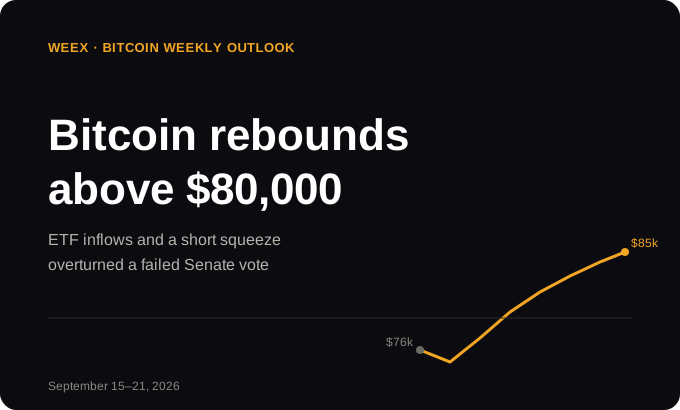
WEEX Bitcoin Weekly Outlook: Why Did Bitcoin Rebound Above $80,000 After the CLARITY Act Vote?
Bitcoin rebounded above $80,000 as SEC and CFTC action, renewed ETF inflows, and a short squeeze outweighed the failed CLARITY Act vote.

$8 Makes a Comeback, This Time X Money Rewrites the Logic of NFT Issuance
AMD Jumps Nearly 10%, Market Cap Tops $1 Trillion| WEEX TradFi Daily Brief (September 22, 2026)
Global markets on September 22 focus on a repair in AI-compute pricing. On September 21 the three major equity indexes closed higher. AMD rose nearly 10% and its market cap crossed $1 trillion for the first time, while Intel and Arm also surged. Brent crude fell about 3.4% to $100.34 and the 10-year Treasury yield eased to about 4.96%, lowering discount-rate pressure on long-duration tech. Bitcoin briefly broke above $87,000 and total crypto market cap returned above $3 trillion. Investors next watch consumer and housing earnings plus PMI flash prints.
Balancer Community Proposes Fork and Rebirth

The Answer to Dreamforce 2026: AI Agent, Has It Finally Turned from Demo to Revenue?
Ethereum: BitMine Approaches 5% of Total ETH Supply
Bitcoin's $84K rally isn't saving miners as difficulty signals already flash caution
ZEC's Largest Mining Company Moves to US Stock Market After Mining 70,000 ZEC in Six Months

Validators Vote on Batch V1.1 After Security Overhaul

Aptos Validators Decrease by 40% in Two Years, Concentration of Validator Nodes Shifts to Europe and America

SEC Takes Action: Who Can Handle "Compliant ICOs"?

TRON Weekly Industry Report: Regulatory and Interest Rate Pressures Fail to Dampen BTC Bullish Sentiment, Detailed Analysis of PayFi High-Performance Payment Infrastructure Axon Finance

When AI Agents Accelerate into Intranets: The Main Battlefield of Cybersecurity Has Changed
Exclusive Interview with Frontier Technology Investor Zheng Di: SEC's 'Innovation Exemption' Opens the Door to a Compliant Bull Market, Which Assets Are Potential Stocks?
XRPL to Implement Major Upgrade on October 5: Adding Permission Delegation Feature
67% of the wealthy own digital assets, but the crypto adoption gap remains huge
How to Rewrite Internet Rules When Everyone Has an Indefatigable Agent
The End of the Blank Prompt: Why Trading AI Needs a Playbook
Cardano proposal slashes fees by 55%, but it comes with a cost for small pools




