
Ripple says asset managers prepare for XRPL Batch

 Prefer us on Google


XRP Ledger's Batch V1.1 has remained above its required validator threshold as Ripple says asset managers and commercial projects are preparing to use the transaction feature if it activates later this month.
Summary
- Batch V1.1 has 30 validator votes, keeping XRP Ledger's September 29 activation countdown on track.
- Ripple says asset managers are building around Batch, though specific partners remain undisclosed for now.
- Batch can group eight transactions, allowing linked asset and payment transfers to settle atomically together.
- Developers replaced the original Batch after researchers found a critical signature validation flaw in February.
- XRPL version 3.3.0 shipped Batch V1.1 after expanded reviews and fixes to additional security issues.
CoinDesk reported on September 19 that RippleX head of engineering Ayo Akinyele said work involving asset managers is being prepared around Batch V1.1, which can package up to eight transactions into a single Batch operation. Ripple has not publicly named the asset managers or disclosed firm launch dates.
Live amendment data reviewed on September 20 showed 30 of 35 tracked trusted validators supporting Batch V1.1. The XRP Ledger requires at least 80% support to be maintained for 14 consecutive days before an amendment activates, putting the current threshold at 28 votes. The countdown began on September 15 at 14:06:41 UTC and points to possible activation shortly after the same time on September 29 if support holds.
JUST IN: Asset managers are preparing for XRP Ledger's next payments upgrade
Batch V1.1 can bundle up to eight transactions into one operation, with RippleX saying commercial projects are already being built around the feature ahead of activation. pic.twitter.com/DmleX4GBiA --- crypto.news (@cryptodotnews) September 20, 2026
You might also like: XRP Ledger 3.4.0 adds lending and protocol fixes
XRP Ledger Batch V1.1 can tie settlement legs together
The XLS-56 specification defines Batch as a transaction that packages between two and eight inner transactions. It supports four processing modes: All or Nothing, Only One, Until Failure and Independent. The All or Nothing setting requires the complete group to execute successfully or prevents the batch from taking effect.
Ripple is focusing part of the commercial discussion on delivery-versus-payment, or DvP. In such a transaction, an asset transfer and its payment can be placed within the same atomic operation. A failed payment would prevent the linked asset transfer from completing under the all-or-nothing setting.
Akinyele told CoinDesk that "We'll be sharing more once the feature is live, including work with key asset managers." Ripple has not identified those firms, so the statement remains a company description of work that has not yet been publicly documented through named partner announcements.
The XLS-56 specification lists trustless multi-account swaps, platform fees and flash-loan structures among potential uses. A marketplace or wallet could, for example, package a customer payment with a service charge instead of requiring separate transactions, while different accounts can authorize individual legs of the same Batch.
Akinyele said "some projects are already being built with Batch in mind," but partner identities and production schedules remain undisclosed. Ripple said details would follow after plans are finalized.
Validator support keeps the September 29 window open
As of the latest September 20 reading, Batch V1.1 had 30 supporting votes among 35 validators tracked by XRPLDashboard, equal to roughly 85%. Support therefore remained above the 28-vote threshold required to continue the activation window.
The projected September 29 date is conditional. XRPL amendments do not activate simply because they cross 80% once. Validators must maintain the supermajority for the complete 14-day period, and validators can change their votes while the clock is running. If support falls below the required level, the current window stops and another uninterrupted period would be required after the threshold is recovered.
The latest count extends a rapid rise in support this month. Batch V1.1 then had 24 of 35 validator votes, or 68.57%, leaving it below the activation threshold. Support had increased to 27 votes by September 15, before enough validators backed the amendment to start the countdown.
The amendment itself shipped with xrpld version 3.3.0 on August 6. Official XRP Ledger release notes describe Batch V1.1 as the replacement for the original Batch amendment and state that it supports up to eight inner transactions, including atomic-swap structures.
Since then, the XRP Ledger Foundation has released xrpld 3.4.0. The September 16 software release introduces separate lending and cleanup amendments and does not replace Batch V1.1, which remains in its own mainnet voting process. Server operators were advised to upgrade to version 3.4.0 for service continuity.
Batch V1.1 followed a critical flaw in the first version
The current amendment arrived after developers stopped the original Batch proposal in February. XRPL's official vulnerability disclosure says security researcher Pranamya Keshkamat and Cantina AI's Apex tool identified a critical signature-validation flaw on February 19.
Under specific conditions, the vulnerable code could stop checking Batch signers after encountering a newly created account. XRPL Labs said an attacker could then have included an unauthorized transaction from another account without possessing that account owner's private keys. Potential transactions could have included payments and certain ledger-state changes.
The flaw never became active on XRP Ledger mainnet. The original amendment was still in its voting stage, and XRPL Labs said no funds were at risk. Validators were advised to vote against it, while rippled version 3.1.1, released February 23, made Batch and fixBatchInnerSigs unsupported so they could not activate.
Developers then changed the signing and authorization logic for the replacement. The vulnerability report said the remediation removed the premature success condition, added authorization safeguards and tightened signature-checking rules. Batch V1.1 was later incorporated into xrpld 3.3.0 after development and review.
Security work continued before the current validator vote. As crypto.news reported in its Batch V1.1 security review coverage, developers fixed another 11 issues involving signatures, authorization checks and possible server crashes before the amendment reached its present voting stage.
Akinyele told CoinDesk that the review included internal adversarial testing, AI-assisted analysis, a Sherlock security contest and assessments involving Halborn and Common Prefix. CoinDesk attributed those details to RippleX; public partner reports covering every part of that review were not included in the material reviewed for this report.
The XRPL developer ecosystem made supporting changes as the signing design evolved. A June issue in the official xrpl.js repository documented that older Batch signing logic did not match Batch V1.1's revised format because additional account and sequence information had been bound to signatures. The JavaScript binary-codec release history states that Batch V1.1 signing support was added in version 2.9.0 in August.
-- Price
Asset managers are testing more tokenized settlement on XRPL
Ripple's comments on Batch arrive as financial firms and developers are using XRP Ledger infrastructure for tokenized assets and institutional settlement projects. In June, JPMorgan, Mastercard, Ondo Finance and Ripple participated in a tokenized U.S. Treasury redemption test using the XRP Ledger.
Ripple President Monica Long said in August that financial institutions were moving some tokenized-asset work from pilot programs toward production. Crypto.news reported on Ripple's institutional tokenization projects that Aviva Investors had launched a tokenized fund share class on XRPL in July and that Ripple viewed RLUSD as a possible cash leg for atomic delivery-versus-payment settlement.
Onchain asset activity has grown alongside that development. Another crypto.news review of XRP Ledger RWA data reported in July that the network had added roughly $2.6 billion in tokenized real-world asset value over six months, excluding stablecoins, based on RWA.xyz figures. The same report cautioned that represented asset value and actively distributed assets were materially different measures.
Batch V1.1 itself does not require asset managers to use XRP as the asset being transferred. The feature operates at the transaction layer and can package supported XRPL transactions from different accounts. XRP remains relevant for ledger transaction fees, while the underlying transactions can involve other supported assets and token structures.
The next procedural event is the end of the current amendment window. XRPLDashboard projects Batch V1.1 activation for September 29 at approximately 14:06:41 UTC if at least 80% validator backing remains uninterrupted through the full countdown. The latest published tally on September 20 remained 30 votes in favor out of 35 tracked validators.
This content is provided for general informational purposes only and doesn't constitute financial, investment, legal, or tax advice. Any events, rewards, online promotions, or related information mentioned herein should not be considered a recommendation, solicitation, or invitation to purchase, sell, trade, or otherwise deal in any crypto assets. Crypto assets are highly volatile and may result in loss. The availability of WEEX services, products, and related events may vary by region. You are responsible for ensuring that your participation is in accordance with applicable local laws and regulations.
You may also like

The End of the Blank Prompt: Why Trading AI Needs a Playbook

Cardano proposal slashes fees by 55%, but it comes with a cost for small pools

The Evolution of AI: The Boundaries and Truth of Recursive Self-Improvement (RSI)

The Quantum Issue: You Never Really Know The Future

Security and fees hold back deeper crypto use among wealthy investors: Nexo report

Bitcoin Developers Concerned About Mining Subsidy

VVV Hits All-Time High: Founder’s Perspective on Models, Privacy, and Crypto

XRPL fixes critical pre-mainnet flaw, but client apps remain at risk

Glassnode Indicates Shift Towards Altcoin Season

Crypto: Kalshi accused of inflating its volumes with thousands of identical orders

HODLing ETH: Should You Choose Staking for Yield or Collateralized Lending?

SEC Clarity Meets Fed Rate Hike: How WEEX TradFi Lucky Eggs S2 Taps Into Cross-Market Opportunities

How Significant Are Changes in Overseas AI Investment?
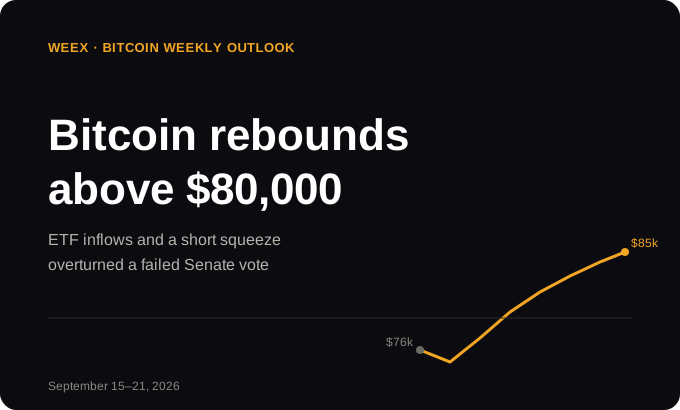
WEEX Bitcoin Weekly Outlook: Why Did Bitcoin Rebound Above $80,000 After the CLARITY Act Vote?
Bitcoin rebounded above $80,000 as SEC and CFTC action, renewed ETF inflows, and a short squeeze outweighed the failed CLARITY Act vote.

$8 Makes a Comeback, This Time X Money Rewrites the Logic of NFT Issuance
AMD Jumps Nearly 10%, Market Cap Tops $1 Trillion| WEEX TradFi Daily Brief (September 22, 2026)
Global markets on September 22 focus on a repair in AI-compute pricing. On September 21 the three major equity indexes closed higher. AMD rose nearly 10% and its market cap crossed $1 trillion for the first time, while Intel and Arm also surged. Brent crude fell about 3.4% to $100.34 and the 10-year Treasury yield eased to about 4.96%, lowering discount-rate pressure on long-duration tech. Bitcoin briefly broke above $87,000 and total crypto market cap returned above $3 trillion. Investors next watch consumer and housing earnings plus PMI flash prints.
Balancer Community Proposes Fork and Rebirth

The Answer to Dreamforce 2026: AI Agent, Has It Finally Turned from Demo to Revenue?
Ethereum: BitMine Approaches 5% of Total ETH Supply
Bitcoin's $84K rally isn't saving miners as difficulty signals already flash caution
ZEC's Largest Mining Company Moves to US Stock Market After Mining 70,000 ZEC in Six Months

Validators Vote on Batch V1.1 After Security Overhaul

Aptos Validators Decrease by 40% in Two Years, Concentration of Validator Nodes Shifts to Europe and America

SEC Takes Action: Who Can Handle "Compliant ICOs"?

TRON Weekly Industry Report: Regulatory and Interest Rate Pressures Fail to Dampen BTC Bullish Sentiment, Detailed Analysis of PayFi High-Performance Payment Infrastructure Axon Finance

When AI Agents Accelerate into Intranets: The Main Battlefield of Cybersecurity Has Changed
How to Earn Crypto Futures Trading Rewards on WEEX: Daily Lucky Eggs S2

ZetaChain, Linera, Switchboard Cease Operations
WEEX Futures Trading Rewards in Sep 2026: Win Up to 10,000 USDT

The Next Phase of Ethereum from the EF Protocol AMA
The End of the Blank Prompt: Why Trading AI Needs a Playbook
Cardano proposal slashes fees by 55%, but it comes with a cost for small pools
The Evolution of AI: The Boundaries and Truth of Recursive Self-Improvement (RSI)
The Quantum Issue: You Never Really Know The Future
Security and fees hold back deeper crypto use among wealthy investors: Nexo report
Bitcoin Developers Concerned About Mining Subsidy
Contents
Latest articles


Latest coin listings on WEEX


