
What is CBDC? Governments Push for Development of Central Bank Digital Currencies

 Prefer us on Google


The growing interest in cryptocurrencies is spreading worldwide, with many people, from beginners to experienced investors, beginning to realize the wide-ranging possibilities brought about by digitalization. The era when cryptocurrencies were primarily used for anonymity and illegal transactions is over, and many countries around the world are starting to explore this new financial world for themselves, particularly through initiatives in the form of Central Bank Digital Currencies (CBDCs).
CBDCs are essentially digital forms of national currencies, maintaining the same pegged value as legal tender. They are issued directly by central banks and regulated by traditional financial authorities. CBDCs are seen as a means to achieve more streamlined transactions at higher speeds, efficiencies, and lower costs compared to traditional systems.
Despite these possibilities, many countries are taking a cautious, phased approach, gradually testing or deploying systems to ensure stability and management. Following China’s launch of the digital yuan in 2021, making it the first major economy to deploy a CBDC, many countries are expected to follow suit quickly. The Federal Reserve (FRB), the largest central bank in the world by total assets, is also exploring the potential for a future U.S. CBDC and aims to participate in this movement.
Despite the recent explosive growth of Bitcoin and other cryptocurrencies, the concept of CBDCs is not new. China has been developing the Digital Currency Electronic Payment (DCEP), referred to as the "digital yuan," since 2014 to become independent from U.S. dominance in digital payments within SWIFT. Major local banks in China began collaborating on DCEP development as early as 2017, with tests conducted in major cities in 2020. The cautious Chinese authorities continue to expand the system gradually, aiming to eventually replace cash transactions entirely.
China is not the only country to enter early. From 2014 to 2018, Ecuadorian authorities launched their own retail CBDC pilot, but it only gained limited public use and had to close the program. Meanwhile, countries like France and Switzerland have chosen a clearer route, agreeing to launch cross-border CBDC payment trials among major banks rather than general consumers in 2021.
(Source: Flowchart of CBDC Development and Its Role in the Economy)
Following China, India, the second most populous country in the world, is also considering entry. Since 2017, Indian authorities have begun exploring the potential of CBDCs, but serious discussions only started from 2020 to 2021. However, considering public anxiety and the weaker institutional foundation compared to China and the U.S., Indian authorities are taking cautious steps. For example, Finance Minister Nirmala Sitharaman recently emphasized that the planned issuance of the digital rupee CBDC within the next fiscal year will have a centralized nature, unlike traditional unregulated cryptocurrencies, and is working to comply with the country’s anti-money laundering and counter-terrorism regulations.
T Rabi Sankar, Deputy Governor of the Reserve Bank of India, similarly seeks to separate CBDCs from traditional cryptocurrencies, stating that "cryptocurrencies cannot be defined as currency, assets, or commodities, lacking fundamental cash flow and intrinsic value, resembling Ponzi schemes." The scale of India’s rollout remains unclear, but New Delhi is believed to wish to align with Beijing amid intensifying regional competition.
What About the U.S. Digital Dollar?
Opinions in Washington are divided. In March of this year, President Joe Biden signed an executive order directing the FRB to begin urgent research and development on a potential U.S. CBDC. This may include experiments in multiple countries, positioning the U.S. as an international leader in CBDC development, and promoting national values, standards, and norms. According to the FRB, one of the attractive benefits of CBDCs is their impact on monetary policy. With the ability to influence the money supply more quickly and directly, the FRB would have a greater capacity to stabilize the economy during economic difficulties or shocks. This could mitigate future financial crises and allow policymakers to take action before more severe impacts occur. However, like other regions, this will likely be a long-term phased rollout and testing process. The initial stages are expected to focus on internal or interbank transfers, with widespread use by the general public still some time away.
However, not everyone is optimistic. Following the announcement, Christopher Waller, a Federal Reserve Board member appointed by then-President Donald Trump in 2020, criticized the digitalization concept, stating that cryptocurrencies are "not a payment method at all" and that "blockchain is completely overrated." Politicians from both parties have also raised concerns about privacy protection and the potential for citizen surveillance by U.S. and foreign governments.
Support among the American public remains divided. According to a Pew survey in late 2021, about 20% of Americans reported having experience investing in, trading, or using cryptocurrencies. Notably, over 40% of men aged 18 to 29 reported personal use. However, 75% of respondents indicated they had "heard very little" or "not at all" about cryptocurrencies, suggesting expectations should be tempered.
Furthermore, as political polarization in the U.S. deepens, it is necessary to consider whether such initiatives and research will continue if the Republican Party regains the White House in 2024. Former President Donald Trump is a leading candidate in the early stages and has previously voiced opposition to similar topics. In 2019, he tweeted, "I am not a fan of Bitcoin and other cryptocurrencies." The political winds may change, and the fact that CBDCs are significantly different from typical decentralized cryptocurrencies could alter Trump’s opinion, but many remember his efforts to overturn major decisions made by his predecessor early in his presidency in 2017.
Conclusion
Despite the divided opinions in Washington and domestically, the U.S. must continue to pay attention to further global trends regarding CBDCs. This is especially true as rival countries like China continue to establish their positions as global leaders and trendsetters. As the world enters a new era of globalization and digitalization, countries cannot afford to fall behind.
-- Price
This content is provided for general informational purposes only and doesn't constitute financial, investment, legal, or tax advice. Any events, rewards, online promotions, or related information mentioned herein should not be considered a recommendation, solicitation, or invitation to purchase, sell, trade, or otherwise deal in any crypto assets. Crypto assets are highly volatile and may result in loss. The availability of WEEX services, products, and related events may vary by region. You are responsible for ensuring that your participation is in accordance with applicable local laws and regulations.
You may also like

Bitcoin Has Not Fallen Below Realized Price During the Bear Market

The Clearing House Selects Quant for US Tokenized Deposit Network

4500 Bitcoins Moved to New Addresses, Sale Status Unconfirmed
![[New York Gold, Bonds, Dollar] Interest Rates and Dollar Strength Pause... Oil Prices Drop, Won and Gold Prices Rebound](/public-static/29_4631d65680.png?format=avif)
[New York Gold, Bonds, Dollar] Interest Rates and Dollar Strength Pause... Oil Prices Drop, Won and Gold Prices Rebound

Trump Expresses Concern Over Yen Depreciation, Japanese Finance Minister Says Coordination with U.S. Will Continue

Treasuries at 21-Year High: Impact on Stocks and Interest Rates

Solana DEX volume spike hides circular trades, and automated bots are blamed

Oracle Stock vs. KRAFTON Stock: Why Are Investors Questioning Two Growing Companies?
Compare Oracle and KRAFTON stocks through their latest results, share-price questions and the different growth tests investors face in 2026.

John Templeton: "Bull markets are born in pessimism"

The Death of Hsin-Ju: A Prelude to Conspiracy

LTC Airdrop 2026: How to Claim 50,000 USDT Rewards on WEEX

Raiffeisen’s crypto deal could reach 18 million customers. How many can actually trade?

TRON Surpasses $30T in Total Transaction Volume as it Secures its Place as Leading Chain for Stablecoins

HTX DeepThink: Opportunities Concentrate on Profitable and Fund-Supported Assets, BTC Still Has Room for Recovery After Consolidation

Why Did Sui (SUI) Crypto Price Jump 44%? Crypto OI and Leverage Explain the Rally
See why Sui (SUI) jumped 44%, how crypto OI and leverage amplified the rally, what the pullback means, and how to trade SUI on WEEX.

Circle expands CCTP to EURC and cirBTC on Arc

Bitcoin, Sports, and Politics: Predictive Markets Target $10 Trillion

AI Agent Jev Expects On-Chain Innovation Through Automated Judgment
The End of the Blank Prompt: Why Trading AI Needs a Playbook

Stablecoins hold nearly $200 billion in US debt, but money funds bought the surge
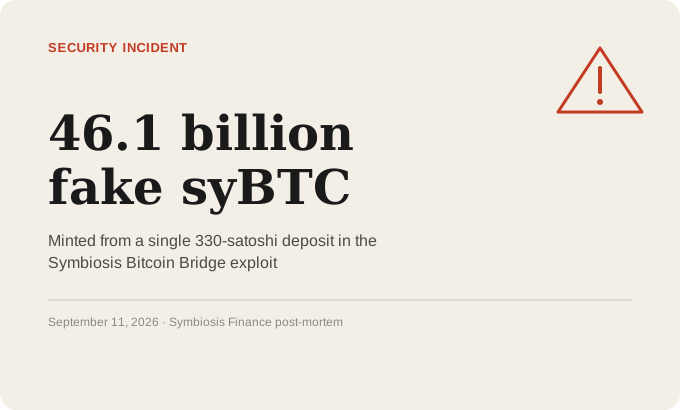
How Did a Hacker Create 46 Billion Fake Bitcoin in the Symbiosis Exploit? Decodes Bitcoin Hacker With WEEX Now
How two Symbiosis bridge bugs let a hacker mint 46.1 billion unbacked syBTC, drain Bitcoin pools and expose critical bridge risks.

CFTC's Selig Emphasizes the Need to Prepare for the Era of Large-Scale Tokenization in the U.S.

The IMF opens an office in Venezuela to supervise an economy that has already migrated to USDT

SOXL Stock Jumped 12% Yesterday: Three Companies Explain the Entire Move

Bitcoin's Hashrate Rises as Miners Reactivate Their Machines

Bitcoin 2x Leveraged ETF Launches on Cboe, But Doesn't Buy Bitcoin: Here's Why

Crypto: The ECB Enters the Tokenized Bond Market
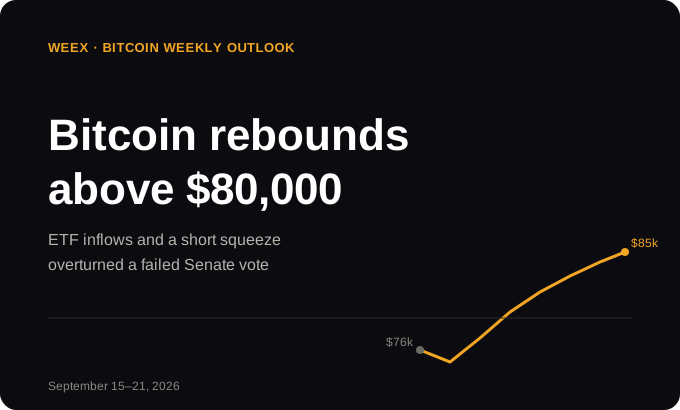
WEEX Bitcoin Weekly Outlook: Why Did Bitcoin Rebound Above $80,000 After the CLARITY Act Vote?
Bitcoin rebounded above $80,000 as SEC and CFTC action, renewed ETF inflows, and a short squeeze outweighed the failed CLARITY Act vote.
Coldcard whitehats move 52.37 BTC to recovery trust

Bitcoin's Rise Does Not Mean the Bull Market Has Returned; Don't Create Stories for Yourself
Bitcoin Has Not Fallen Below Realized Price During the Bear Market
The Clearing House Selects Quant for US Tokenized Deposit Network
4500 Bitcoins Moved to New Addresses, Sale Status Unconfirmed
[New York Gold, Bonds, Dollar] Interest Rates and Dollar Strength Pause... Oil Prices Drop, Won and Gold Prices Rebound
Trump Expresses Concern Over Yen Depreciation, Japanese Finance Minister Says Coordination with U.S. Will Continue
Treasuries at 21-Year High: Impact on Stocks and Interest Rates


