
USDC Stablecoin Growth: Dominates On-Chain Volumes, +$1 Billion Market

 Prefer us on Google


The stablecoin market has surpassed a new threshold, and once again, the same protagonist is leading the way. The USDC stablecoin growth continues to impress analysts: Circle's token has added approximately $584 million to its market capitalization in just seven days, contributing to the most substantial part of an overall increase of $1 billion shared with Ethena's USDe and PayPal's PYUSD.
Summary
- Key Points
- USDC leads the expansion of the stablecoin market
- Market cap growth and supply share
- Dominance in on-chain transaction volumes
- Key stablecoins in weekly supply growth
- Regulated infrastructure of USDC
- Delta-neutral strategy of USDe with ETH
- Contractions and supply variations of PYUSD
- Zcash volatility fuels large crypto liquidations
- Price increase near decade highs
- Short squeeze dynamics and liquidation sizes
- Effects of Grayscale's ZCSH ETF launch
- Market outlook and risks from financial leverage and ETF flows
- Fragility due to high open interest
- Institutional inflows supporting rallies
- Potential reversal risks and liquidation waves
- FAQ
- What growth has USDC shown recently in the stablecoin market?
- How does USDe maintain its peg to the dollar?
- What factors contributed to the recent rally and liquidations of Zcash?
- What risks does the Zcash market currently face?
Key Points
- USDC gained approximately $584 million in capitalization in one week
- The total supply of stablecoins fluctuates between $303 and $310 billion
- USDC holds about 24% of the market, USDT about 60% with $184 billion
- Zcash rose by 20% reaching decade highs near $1,023-$1,051
- Short liquidations on ZEC reached between $34.5 and $44 million
USDC Leads the Expansion of the Stablecoin Market
USDC confirms itself as the main engine behind the expansion of the stablecoin market at this stage, surpassing rivals in both supply growth and on-chain trading volumes. The overall picture tells of a sector that continues to gain ground despite periodic fluctuations from individual issuers.
Market Cap Growth and Supply Share
{#Market_Cap_Growth_and_Supply_Share} The total supply of stablecoins has reached a range between $303 and $310 billion. Of these, USDC represents about $74-77 billion, equivalent to approximately 24% of the total market. However, Tether remains the undisputed benchmark: USDT maintains a dominant position with about $184 billion, equivalent to approximately 60% market share. By August 2026, USDC had already shown significant momentum, adding $1.5 billion to its supply in just one week. The current gain of $584 million is more modest but fits into a pattern of constant and repeatable minting demand, not isolated spikes.
Dominance in On-Chain Transaction Volumes
{#Dominance_in_On-Chain_Transaction_Volumes} If USDT remains ahead in overall supply, the tables turn on the on-chain transaction volumes front. USDC has captured between 60% and 70% of the adjusted transaction volume in various periods during 2026, a figure that indicates how Circle's token has become the preferred choice for actual operational use, rather than just for simple reserve accumulation.
This disconnect between the supply quota and actual usage quota is probably the most interesting aspect for those observing the evolution of the sector. Why it matters: it means that Circle's regulated infrastructure, with periodic attestations and cash and short-term Treasury reserves, is becoming the preferred standard for everyday payments and transactions, while USDT remains the benchmark for large-scale value storage.
-- Price
Key Stablecoins in Weekly Supply Growth
The weekly increase of $1 billion in weekly stablecoin supply is attributed to three tokens with very different architectures, each with its own risk profile.
Regulated Infrastructure of USDC
USDC remains the simplest case to frame. Circle holds cash and short-term Treasuries as reserves, publishes regular attestations, and has built a solid reputation on the regulatory compliance front, a significant competitive advantage in a market where institutional user trust weighs heavily.
Delta-Neutral Strategy of USDe with ETH
The discussion is different for USDe, issued by Ethena. The USDe stablecoin strategy maintains its peg to the dollar through a delta-neutral approach: the token holds spot ETH while simultaneously shorting ETH futures, balancing exposures to neutralize the underlying volatility. USDe is currently positioned in a range between $4 billion and $6 billion in market capitalization.
Contractions and Supply Variations of PYUSD
The PYUSD trend, the token issued by PayPal on the Paxos infrastructure, tells a bumpier story. In previous months, the token has recorded supply contractions ranging from 11% to 35% at various times, with a current supply between $2.7 billion and $3.9 billion. A decidedly more volatile profile compared to its two peers.
Zcash Volatility Fuels Major Crypto Liquidations
While stablecoins grow in a relatively orderly manner, another corner of the market has experienced turbulent days. Zcash crypto liquidations dominated the headlines in early September, highlighting how fragile the leverage accumulated on derivatives can be.
Price Surge Near Decade-Highs
Zcash surged about 20% on September 4, reaching an intraday high between $1,023 and $1,051, the highest level recorded by ZEC in nearly a decade. The movement did not occur in a vacuum: it triggered a wave of short liquidations that contributed to bringing total crypto liquidations to around $212 million.
Short Squeeze Dynamics and Liquidation Sizes
Short liquidations on ZEC perpetual futures have totaled between $34.5 million and $44 million in recent trading sessions, a disproportionate share of the total $212 million, considering that Zcash is far from being among the top cryptocurrencies by market capitalization. The open interest on ZEC futures had surpassed $2 billion, with a strong concentration of short positions. Much of this bearish positioning dates back to May 2026, when a critical vulnerability was revealed in Zcash's Orchard shielded pool. The bug had spooked traders, prompting them to accumulate shorts, creating exactly the kind of unbalanced leverage that turns a moderate price increase into a cascade of liquidations. ZEC consistently ranked among the assets with the highest daily liquidations throughout September, indicating that the derivatives market around this coin remains much more leveraged than its spot volume would suggest.
Effects of Grayscale's ZCSH ETF Launch
The most significant factor behind the rally appears to be Grayscale's spot ETF ZCSH, launched on August 25, 2026. Within two weeks of its debut, the fund accumulated over $400 million in assets. The timing is striking: ZEC began its ascent shortly after the launch of ZCSH, and the acceleration in early September coincided precisely when the ETF surpassed the $400 million AUM threshold. Institutional inflows generated sustained buying pressure in the spot market, which in turn squeezed the leveraged short positions accumulated during the post-vulnerability pessimism.
Market Outlook and Risks from Leverage and ETF Flows
The $2 billion open interest on ZEC futures creates a fragile situation: any sharp reversal could trigger cascades of liquidations in the opposite direction, as easily as the rise occurred.
Fragility Due to High Open Interest
Such a leveraged derivatives market tends to amplify any price movement, both up and down. Why it matters: when open interest exceeds $2 billion on an asset with relatively modest capitalization, even a modest price change can generate large-scale forced liquidations, fueling volatility that goes well beyond the fundamentals of the asset itself.
Institutional Inflows Supporting Rallies
Those observing this market should keep an eye on two particular variables: the pace of inflows into the ZCSH ETF and the composition of open interest. A slowdown in the growth of Grayscale's fund assets could remove the support that has fueled ZEC's rally thus far.
Potential Reversal Risks and Waves of Liquidations
If shorts continue to rebuild at these high price levels, the next short squeeze could be even more dramatic. It’s a pattern already seen once, between May and September 2026: a negative event generates excessive bearish positioning, and a positive catalyst turns it into fuel for the subsequent rally.
FAQ
What growth has USDC recently shown in the stablecoin market?
USDC has added approximately $584 million to its market capitalization in just one week and holds about 24% of the total stablecoin supply, with robust on-chain transaction volumes capturing between 60% and 70% of the total during 2026.
How Does USDe Maintain Its Peg to the Dollar? {#How_Does_USDe_Maintain_Its_Peg_to_the_Dollar}
USDe employs a delta-neutral strategy, holding spot ETH while simultaneously shorting ETH futures to maintain its peg to the dollar.
What Factors Contributed to the Recent Rally and Liquidations of Zcash? {#What_Factors_Contributed_to_the_Recent_Rally_and_Liquidations_of_Zcash}
Zcash has surged by about 20%, reaching prices close to decade highs, partly driven by over $400 million in inflows into Grayscale's spot ETF ZCSH, which caused a short squeeze responsible for short liquidations ranging from $34.5 million to $44 million.
What Risks Does the Zcash Market Currently Face? {#What_Risks_Does_the_Zcash_Market_Currently_Face}
A high open interest exceeding $2 billion, with leveraged short positions, creates a fragile situation: a sudden price reversal could trigger liquidation cascades. The continuity of inflows into the ETF remains crucial to support the price.
Content created with the assistance of artificial intelligence and human editorial review.
This content is provided for general informational purposes only and doesn't constitute financial, investment, legal, or tax advice. Any events, rewards, online promotions, or related information mentioned herein should not be considered a recommendation, solicitation, or invitation to purchase, sell, trade, or otherwise deal in any crypto assets. Crypto assets are highly volatile and may result in loss. The availability of WEEX services, products, and related events may vary by region. You are responsible for ensuring that your participation is in accordance with applicable local laws and regulations.
You may also like

Security and fees hold back deeper crypto use among wealthy investors: Nexo report

Bitcoin Developers Concerned About Mining Subsidy

VVV Hits All-Time High: Founder’s Perspective on Models, Privacy, and Crypto

XRPL fixes critical pre-mainnet flaw, but client apps remain at risk

Glassnode Indicates Shift Towards Altcoin Season

Crypto: Kalshi accused of inflating its volumes with thousands of identical orders

HODLing ETH: Should You Choose Staking for Yield or Collateralized Lending?

SEC Clarity Meets Fed Rate Hike: How WEEX TradFi Lucky Eggs S2 Taps Into Cross-Market Opportunities

How Significant Are Changes in Overseas AI Investment?
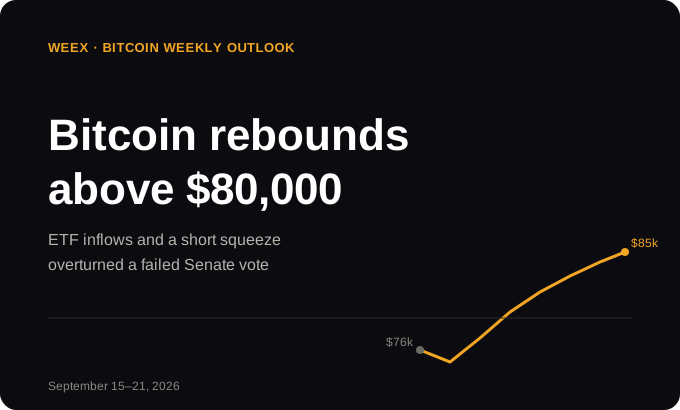
WEEX Bitcoin Weekly Outlook: Why Did Bitcoin Rebound Above $80,000 After the CLARITY Act Vote?
Bitcoin rebounded above $80,000 as SEC and CFTC action, renewed ETF inflows, and a short squeeze outweighed the failed CLARITY Act vote.
$8 Makes a Comeback, This Time X Money Rewrites the Logic of NFT Issuance
AMD Jumps Nearly 10%, Market Cap Tops $1 Trillion| WEEX TradFi Daily Brief (September 22, 2026)
Global markets on September 22 focus on a repair in AI-compute pricing. On September 21 the three major equity indexes closed higher. AMD rose nearly 10% and its market cap crossed $1 trillion for the first time, while Intel and Arm also surged. Brent crude fell about 3.4% to $100.34 and the 10-year Treasury yield eased to about 4.96%, lowering discount-rate pressure on long-duration tech. Bitcoin briefly broke above $87,000 and total crypto market cap returned above $3 trillion. Investors next watch consumer and housing earnings plus PMI flash prints.
Balancer Community Proposes Fork and Rebirth

The Answer to Dreamforce 2026: AI Agent, Has It Finally Turned from Demo to Revenue?

Ethereum: BitMine Approaches 5% of Total ETH Supply
Bitcoin's $84K rally isn't saving miners as difficulty signals already flash caution

ZEC's Largest Mining Company Moves to US Stock Market After Mining 70,000 ZEC in Six Months

Validators Vote on Batch V1.1 After Security Overhaul

Aptos Validators Decrease by 40% in Two Years, Concentration of Validator Nodes Shifts to Europe and America

SEC Takes Action: Who Can Handle "Compliant ICOs"?

TRON Weekly Industry Report: Regulatory and Interest Rate Pressures Fail to Dampen BTC Bullish Sentiment, Detailed Analysis of PayFi High-Performance Payment Infrastructure Axon Finance

When AI Agents Accelerate into Intranets: The Main Battlefield of Cybersecurity Has Changed
How to Earn Crypto Futures Trading Rewards on WEEX: Daily Lucky Eggs S2

ZetaChain, Linera, Switchboard Cease Operations
WEEX Futures Trading Rewards in Sep 2026: Win Up to 10,000 USDT

The Next Phase of Ethereum from the EF Protocol AMA

TapeOut Ecosystem Overview: From NAND, LATCH to On-Chain Application Ecosystem
BlackRock says Bitcoin volatility fell to 35–40
Coinbase Sets $100 Billion Market Cap Threshold for Individual Stock Futures, COIN Fails to Meet Criteria
Ripple says asset managers prepare for XRPL Batch
Security and fees hold back deeper crypto use among wealthy investors: Nexo report
Bitcoin Developers Concerned About Mining Subsidy
VVV Hits All-Time High: Founder’s Perspective on Models, Privacy, and Crypto
XRPL fixes critical pre-mainnet flaw, but client apps remain at risk
Glassnode Indicates Shift Towards Altcoin Season
Crypto: Kalshi accused of inflating its volumes with thousands of identical orders




